


ZStack Cloud Platform
Single Server Deployment with Full Features, Free for One Year

Comprehensive product documentation and tools

Upholding the value of Customer First and the mission of Serving Customer, ZStack is dedicated to providing secure and stable services for customers.

To educate ZStack partners and interested individuals about cloud computing and to cultivate cloud computing talent.

ZStack provides innovative cloud infrastructure for ten major industries
Through three major sections, tens of thousands of words, and more than 10 global representative customer ases
In November 2023, Broadcom completed its acquisition of VMware, marking a significant shift in the virtualization market. This acquisition has had a profound impact on VMware’s business model, particularly for its customers. VMware, traditionally known for offering perpetual licenses, has moved to a subscription-based pricing model. This change, part of Broadcom bundling strategy, has led to higher operational costs for businesses that were used to VMware’s traditional licensing model.
With this shift, many organizations are facing increased subscription fees for services they may not fully utilize. For instance, businesses paying for VMware’s vSAN storage solution, which they don’t use, are now questioning whether they need to continue paying for these services or if there are more cost-effective alternatives. As a result, more organizations are looking for ways to migrate from VMware to other virtualization solutions that offer better value.
VMware’s subscription setup pushes costs up. Businesses now hunt for VMs alternatives that bring room to adjust, growth potential, and money savings. The market sees rising attention to virtualization alternatives. These can match or beat VMware’s features. At the same time, they skip the climbing costs tied to VMware items.
In Reddit communities, discussions about the price hikes caused by VMware licensing changes have kept the topic of migrating away from VMware highly relevant. This reflects a real and urgent message to the public: migrating from VMware to other platforms has become an inevitable decision.
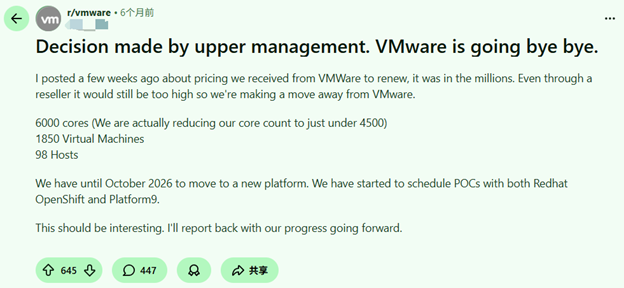
(From posts on Reddit about abandoning VMware)
As companies keep checking their choices, many eye tools like KVM-based systems are being considered. They also look at hyper-converged infrastructure (HCI) setups as good VMware Exodus picks. People call this trend the VMware refugee shift. In it, businesses leave VMware’s world fast. They seek cheaper and more adjustable solutions. The need for De-VMware plans and migrate VMware tools has sped up. Groups want to trim their IT setups without getting stuck in pricey deals.
Companies aiming to alternate VMware need to look closely at the different VMware migration path choices open to them. Here are four main ones.
Many enterprises are adopting virtualization platforms to replace VMware VVF, many of which are KVM-based and fully compatible with the VMware ecosystem. Open-source solutions such as KVM-based virtualization are popular due to their cost advantages and the flexibility in resource management. These alternatives can offer powerful virtualization capabilities comparable to VMware vSphere while significantly reducing costs, such as the ZStack ZSphere virtualization platform, which has been recognized as a Representative Vendor in Gartner’s 2025 Market Guide for Server Virtualization Platforms.
Hyper-converged infrastructure, such as ZStack HCI, offers an all-in-one solution that combines compute, storage, and networking resources into a single, integrated platform. These VMware alternatives are designed to simplify data center management while improving resource utilization and scalability. HCI solutions are perfect for businesses looking to replace VMware’s more traditional setups with something more modern and cost-efficient.
For enterprises that require full control over their infrastructure, enterprise cloud alternatives like ZStack Cloud provide a comprehensive solution that rivals VMware VCF’s private cloud offerings. ZStack Cloud enables organizations to build flexible, scalable, and secure enterprise cloud platforms without incurring the high operational costs associated with VMware solutions.
As cloud-native technologies continue to grow, container cloud alternatives like ZStack Zaku are gaining traction. These solutions provide high flexibility and scalability, enabling businesses to deploy and manage applications in containers alongside their traditional virtualized workloads. The demand for VMware migrate strategies that include container support is growing as organizations move toward more agile, cloud-native environments.
When moving from VMware, companies should use a clear plan. This keeps the shift smooth. A main part of the VMware Migration Path is a full check before the move. You need to grasp how VMware fits into your setup. Then, you can plan right. Some companies choose to move just certain tasks. Others go all in on new bases like ZStack Cloud or KVM-based tools.
One of the key reasons VMware attracts many teams is its potential to save costs compared to other options. However, VMware’s licensing and subscription fees can be excessively high, which is undoubtedly a significant burden for small companies with limited budgets. ZStack’s items, like ZStack Cloud and ZStack ZSphere, give strong virtualization power. But they cost much less. By going to ZStack, companies can trim running costs. At the same time, they keep or even boost their virtualization output.
ZStack provides four paths to replace VMware, including private platforms, enterprise cloud platforms, hyper-converged infrastructure (HCI), and container service platforms. ZStack meets the requirements for VMware’s VVF and VCF subscription packages, as well as the broader VMware ecosystem. Enterprises can adjust according to their specific needs. This flexible scalability allows organizations to expand their deployments as needed without being constrained by VMware’s legacy licensing model.
Another strong driver for migrating from VMware to ZStack is its open compatibility with infrastructure and server reuse capabilities, as well as its support for live migration, agentless migration, and V2V migration methods. Teams can easily migrate their current VMware workloads, minimizing the impact on operations.
ZStack offers four paths to replace VMware, including ZStack Cloud enterprise cloud platform, ZStack ZSphere virtualization platform, ZStack HCI hyper-converged infrastructure, and ZStack Zaku container service platform. These solutions provide the necessary flexibility and scalability for businesses, helping them remain competitive in today’s rapidly changing IT landscape.
A: Broadcom’s bundling strategy has shifted VMware to a subscription-based model, increasing operational costs for users. As a result, many users are already in the process of migrating away from VMware.
A: By 2025, KVM, ZStack, and other hyper-converged infrastructure solutions may become the best alternatives to VMware.
A: SMEs should assess their dependency on VMware. They can then consider using enterprise cloud platforms like ZStack Cloud, which offer an affordable and flexible migration path from VMware.
A: ZStack ZSphere provides a user experience very similar to VMware vSphere but supports multiple procurement options, server hardware reuse, seamless migration, live migration, agentless migration, and more. It also offers greater scalability and a wider range of connectivity options.
 2025-10-29
2025-11-26
2025-10-29
2025-11-26
 Featured
Virtualization
2024-12-12
Featured
Virtualization
2024-12-12


