


ZStack Cloud Platform
Single Server Deployment with Full Features, Free for One Year

Comprehensive product documentation and tools

Upholding the value of Customer First and the mission of Serving Customer, ZStack is dedicated to providing secure and stable services for customers.

To educate ZStack partners and interested individuals about cloud computing and to cultivate cloud computing talent.

ZStack provides innovative cloud infrastructure for ten major industries
Through three major sections, tens of thousands of words, and more than 10 global representative customer ases
Late one night, a frontline engineer was troubleshooting a failed VM live migration. The error was clear: rsync “connection unexpectedly closed.” He knew someone in the company must have dealt with the same issue before—perhaps in a document, a support ticket, or a colleague’s chat history. But at that moment, he could not find it.
This is not unique to any one company. Nearly every technology company with multiple product lines faces the same predicament: knowledge exists, but it is rarely at hand when someone needs it; answers have been written, but quietly become outdated as versions evolve; valuable experience disappears as people move on.
In the AI era, this long-standing problem has become more urgent. Large language models can produce fluent answers to almost any question, but enterprises do not simply need fluency. They need trust. And trust depends on the quality of the knowledge provided to AI.
Drawing on ZStack’s documentation engineering practice, this article shows how ZStack went deep into real business scenarios to build an AI-native, end-to-end trusted knowledge service, and shares practical experience and methods that other teams can reuse.
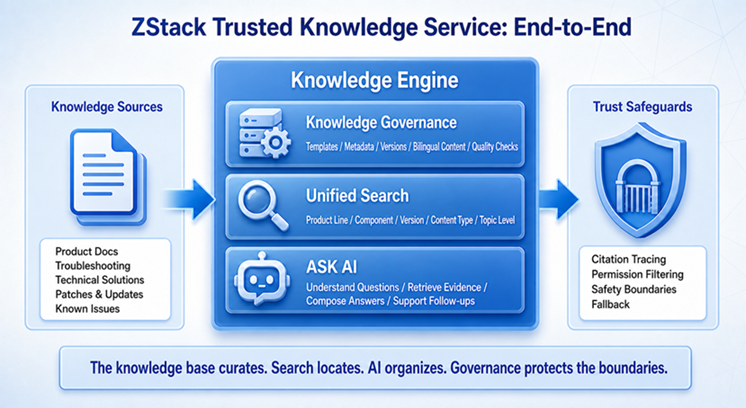
Figure 1. ZStack Trusted Knowledge Service: End-to-End
Consider the journey knowledge takes through a technology company. Product R&D teams produce design documents and version changes. Documentation teams turn them into product documentation for users. Technical service teams capture real troubleshooting experience from customer sites. Sales and presales teams need accurate solution information every day. Ultimately, customers and partners want to find a trustworthy path to a solution on their own—without making a call or submitting a ticket.
Every stage in this chain both produces and consumes knowledge. ZStack’s business landscape multiplies the complexity: four product lines—ZCF, which delivers an enterprise cloud platform for core cloud capabilities; ZVF, which provides enterprise server virtualization; HCI, which delivers hyperconvergence as an integrated software-and-hardware offering; and the AI infrastructure product line, which provides end-to-end capabilities from compute platforms to AI gateways for the intelligent computing era—along with dozens of components, hundreds of version combinations, and highly varied private deployment environments. The same “VM failed to start” symptom can require a completely different troubleshooting path depending on the version, storage architecture, and network design.
This gives knowledge three common fates. It is repeatedly created and repeatedly lost, scattered across documents, tickets, forums, and personal notes, with no one able to see the whole picture. It becomes distorted as it moves between teams, with different groups telling different stories and version-specific guidance gradually diverging. Or it quietly expires: yesterday’s correct procedure may be misleading today, while an operational guide exposed to the wrong audience can even become a security risk.
Building a knowledge base is not difficult; tools are readily available. The real challenge is to keep every piece of knowledge accurate throughout this long chain, with clear scope, proper permissions, and safe use by AI. This is an engineering problem, not a content problem.
Led by the ZStack documentation team in collaboration with Product R&D and Technical Service, we chose to answer this challenge through engineering: build a production line for knowledge.
On this production line, every piece of knowledge is “manufactured” like an industrial product. Raw material—perhaps a frontline troubleshooting record, a forum post, or an R&D change note—enters the line and is first structured into a standard form. Each article answers one clearly defined question and includes the applicable environment, symptoms, diagnostic approach, procedures, verification method, and risk information. It is then enriched with machine-readable labels: product line, component, applicable version, and visibility. Who the knowledge is for and which versions it applies to become data rather than something readers have to guess.
Next comes the most critical checkpoint on the line: the publication gate. Before an article can be released, it must pass automated checks for structural completeness, metadata compliance, version validity, bilingual consistency, and reference integrity. Failure in any one area blocks publication. Quality standards are thus transformed from an experience-based checklist into continuously running engineering rules that can be validated again and again. Every article in the initial release passed these checks.
The final stage always belongs to people. Professional editors and domain experts make the final call on technical accuracy and content boundaries. Machines catch formatting problems; people catch subject-matter problems. Both are indispensable.
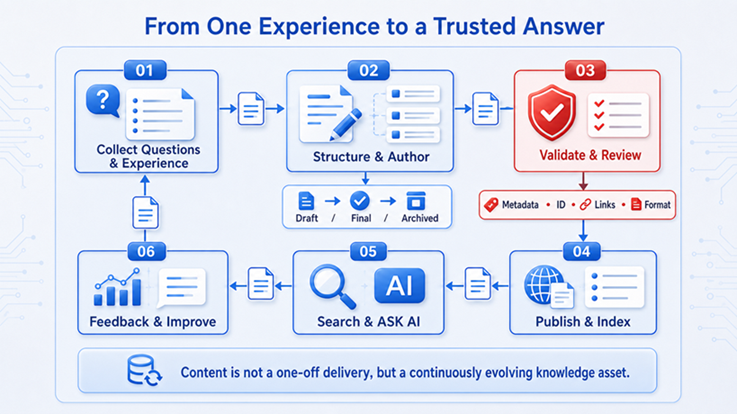
Figure 2. From One Experience to a Trusted Answer
AI-assisted content creation is now ubiquitous. Nearly every technical team is using AI to generate content and build tools. The ability to “make something” is no longer scarce. What is scarce is the ability to create something valuable: closely aligned with the business, capable of solving real problems, consistently reliable, and genuinely trusted. That is the dividing line.
Within the ZStack documentation team, AI is a default member at every stage. It performs the initial processing for source conversion, structural normalization, metadata validation, and bilingual synchronization. In the initial release, hundreds of raw records from frontline service scenarios were refined through this human-AI production line into consistently structured knowledge assets with Chinese and English derived from the same source. The scale would be unimaginable through human effort alone, while relying on AI alone would not be trustworthy.
This is in step with a transformation already under way in the international documentation engineering community: documentation engineers are becoming builders of knowledge systems. ZStack’s documentation practice sits near the front of this transformation curve—not because of how much AI it uses, but because every piece of AI-produced content runs on an engineering track that is verifiable, traceable, and trustworthy.
Progress has never depended on any single technology. It comes from turning forward-looking ideas into workflows that fit real business needs and run reliably every day. That is what makes this practice valuable: it does not depend on individual genius, but on mechanisms—configurable rules, portable gates, and reusable processes. Any team that wants to turn scattered experience into an enterprise asset can follow this path.
As AI moves deeper into core enterprise scenarios, the meaning of security is expanding. Beyond model security and data security lies a more fundamental concern: content security. Is every piece of knowledge cited by AI delivered to the right person and kept within the right boundary?
Enterprise knowledge services therefore face an unavoidable requirement: different people should see different knowledge. Troubleshooting guidance for customers, implementation solutions for partners, and high-risk procedures intended only for internal staff cannot share the same boundary. If that boundary fails, openness becomes risk.
On this production line, the visibility of knowledge is not decided ad hoc by any one person. The documentation, Product R&D, and Technical Service teams jointly review it, turning business consensus into a tiered policy that can be enforced across the system. Five permission levels—public visitors, registered users, customers, partners, and internal employees—apply article by article and are enforced on the server. Unauthorized content never reaches the browser and never enters the AI retrieval scope. This is a complete enterprise implementation of what the industry calls permission-aware retrieval (ACL-aware retrieval): AI answers each user’s questions using only the knowledge that user is authorized to see. Content security thus becomes a system capability rather than a signed promise.
This is paired with full knowledge lifecycle management. Drafting, review, publication, updates, and archival are governed by the same rules from end to end. Knowledge stays current as versions evolve, while outdated or questionable content is never left in the official published collection.
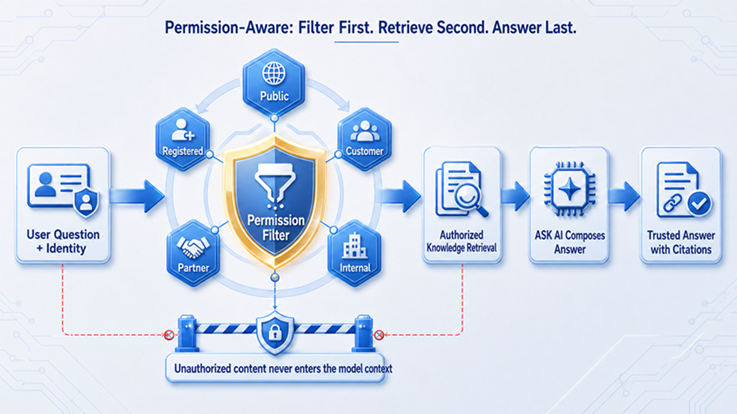
Figure 3. Permission-Aware Retrieval and Content Security
All this engineering investment ultimately becomes two simple things in front of the user: searching and asking.
Unified Search works at the section level. A search for “VM live migration rsync failed” goes directly to the relevant sections of technical solutions, troubleshooting articles, and product manuals instead of merely returning a book whose table of contents users must navigate on their own. Hundreds of bilingual knowledge articles in Chinese and English in the initial release, together with the complete set of product documentation, form a unified knowledge entry point.
Ask AI requires users only to explain “what happened.” It retrieves within the knowledge scope the user is permitted to access, composes an answer from the content it finds, and displays source citations throughout so users can return to the original material at any time. When the evidence is insufficient, it explicitly asks for more information. It would rather say “I’m not sure” than hide a knowledge gap behind a fluent but unsupported answer. The engineer troubleshooting late at night now needs only to paste the error message into the conversation.
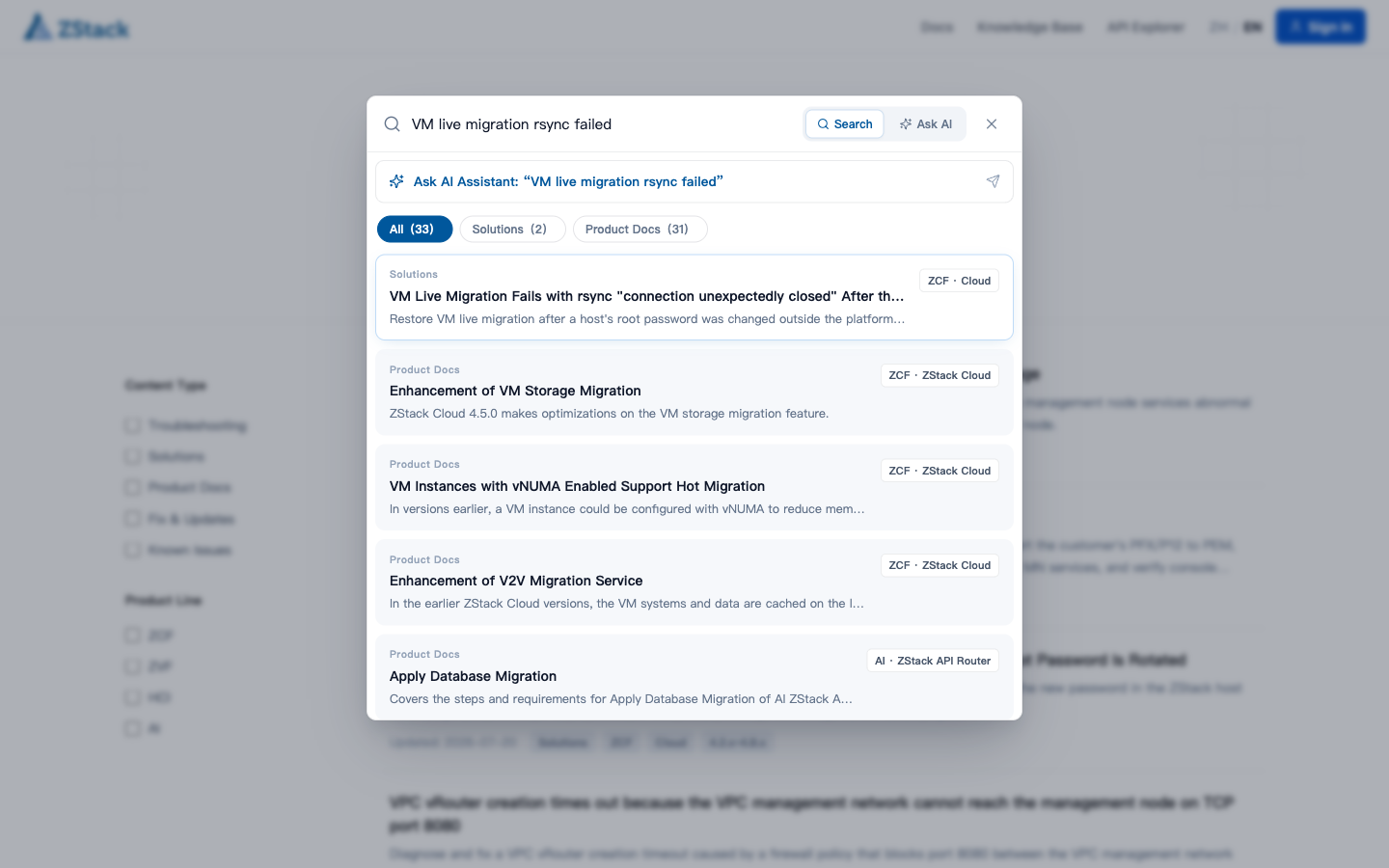
Figure 4. Unified Search in Action
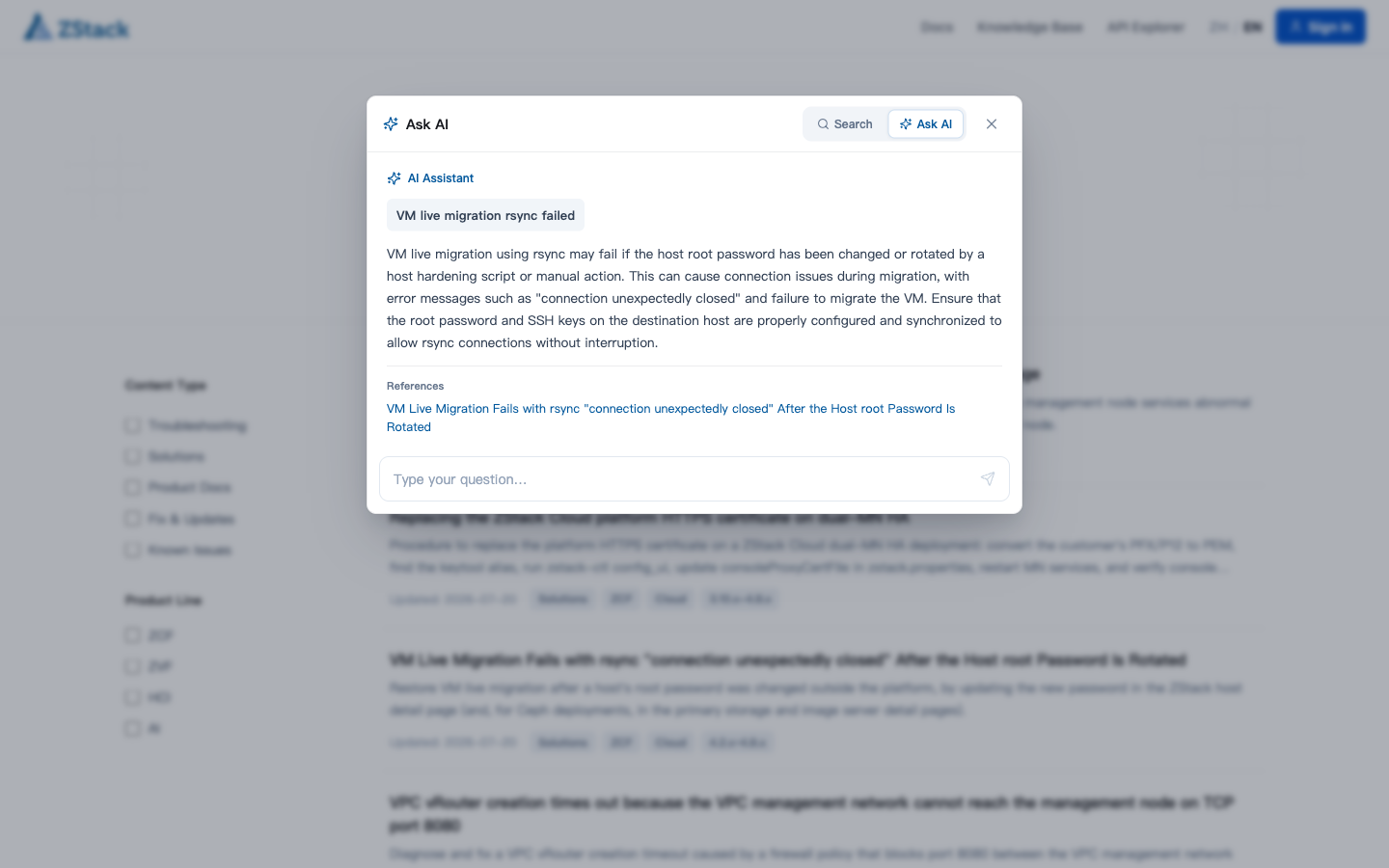
Figure 5. ASK AI in Action
This delivery marks the first turn of ZStack’s knowledge flywheel. The cycle is already moving across the technical chain: first-hand R&D materials and frontline service experience become trusted assets through unified governance. The industry’s direction is clear—from serving technical teams, to enabling the full business chain, to opening knowledge to customers and partners. Every additional layer of circulation multiplies its value. More product lines and knowledge types will join the system; usage data will guide content operations; and AI will keep improving how it understands and organizes knowledge. With every turn, answers move closer to the people who need them.
ZStack is bringing AI into customers’ core production environments, and a trusted knowledge foundation is the bedrock of that technological innovation. Models will continue to evolve; knowledge assets will continue to accumulate. Strategy lies on the horizon, but delivery begins underfoot.
Visit the ZStack Resource Center to experience the Knowledge Base and Ask AI. This is the beginning, not the end.
 2025-10-29
2026-01-19
2025-11-26
2025-10-29
2026-01-19
2025-11-26


 Hot
Hot