


ZStack Cloud Platform
Single Server Deployment with Full Features, Free for One Year

Comprehensive product documentation and tools

Upholding the value of Customer First and the mission of Serving Customer, ZStack is dedicated to providing secure and stable services for customers.

To educate ZStack partners and interested individuals about cloud computing and to cultivate cloud computing talent.

ZStack provides innovative cloud infrastructure for ten major industries
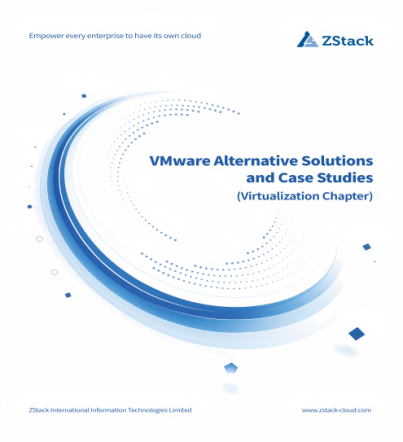
Through three major sections, tens of thousands of words, and more than 10 global representative customer ases
In the context of deep integration between global digital transformation and education informatization, a well-known private university in Hong Kong has long relied on the VMware virtualization platform to support the stable operation of its teaching, research, and administrative systems. Facing rising costs, changing support quality, and shifts in VMware’s product roadmap, the university decided to adopt a new platform to achieve a “VMware Alternative.”
Leveraging its extensive field experience in VMware replacement, robust hardware reuse capabilities, and “worry-free” migration technology, ZStack implemented a solution centered on the ZSphere Virtualization Platform. This initiative successfully helped the university achieve cost reduction and efficiency gains in its IT architecture.
As a prestigious higher education institution in Hong Kong, the university’s IT systems carry critical operations, including online learning platforms, academic management systems, and research data processing. These require extremely high stability, continuity, and cost predictability. However, several challenges had become increasingly prominent:
Cost and Uncertainty: VMware’s shift toward a mandatory subscription model led to surging costs, vendor lock-in, and uncertainty regarding the future product roadmap.
Lack of Flexibility: The legacy virtualization architecture struggled to adapt to the rapid development of emerging services like smart teaching and research big data analysis, failing to meet long-term digital transformation goals.
Sustainability: The university urgently needed to build a stable, sustainable IT infrastructure to ensure the security of research data and business continuity.
To address the university’s core needs and existing IT environment, the ZStack team formulated a strategy of “Service Grading – Risk Isolation – Gradual Replacement.” Through hardware reuse, smooth migration, and dual-track operation, ZStack ensured the upgrade caused zero disruption to teaching and research.
1. Hierarchical Migration to Mitigate Risk
The university categorized all business systems by importance and implemented differentiated migration strategies:
Core Systems (Learning Platforms, Academic Management): Employed a batch migration model during off-peak periods (summer/winter breaks or nights). Full migration was initiated followed by multiple incremental syncs to complete the final cutover, minimizing the impact on academic activities.
Non-Critical Systems (Training Platforms, Test Environments): Adopted mass migration to quickly complete replacements, accumulating migration experience while shortening the overall project lifecycle.
2. Full Hardware Reuse to Protect Investment
ZStack ZSphere offers extensive hardware compatibility, supporting the seamless integration of multi-brand and multi-model servers and storage. The university did not need to decommission existing servers or SAN storage. By integrating FC protocols, multiple legacy servers were transformed into ZSphere compute nodes, and existing FC SAN storage was brought under unified management. This approach revitalized existing assets and avoided the capital waste of redundant procurement.
3. Smooth Migration Technology for Business Continuity
Using ZMigrate, ZStack’s professional migration tool based on VMware VADP+CBT technology, the team performed agentless migrations. This allowed virtual machine data to be replicated to the ZStack ZSphere platform in real-time while systems remained online. By maintaining a dual-track operation between the ZStack cluster and the original VMware environment, the university ensured data consistency and achieved “perception-free migration.”
Multi-Layered Security: The platform features built-in Security Groups for granular control of East-West traffic and supports Two-Factor Authentication (2FA) to strengthen identity verification, building a comprehensive defense for research data.
Efficient Operations (O&M): ZStack provides a unified management console for centralized control of compute, storage, and network resources. The user experience is highly consistent with VMware vSphere, meaning the IT team required no additional training and could take over operations immediately, significantly reducing learning costs.
By deploying the ZStack ZSphere virtualization platform, the university successfully completed its VMware transition, achieving significant gains:
Significant Cost Optimization: ZStack’s flexible licensing model reduced long-term IT costs by more than 60%. Furthermore, hardware reuse eliminated new equipment procurement costs, allowing funds to be redirected toward teaching innovation and smart classroom construction.
Enhanced Security and Stability: The high-availability (HA) architecture and fine-grained security mechanisms of ZSphere ensure the stable operation of academic services, effectively eliminating the risk of data leaks.
Future-Proof Scalability: The platform’s open and extensible nature supports on-demand elastic expansion. It is fully capable of supporting future emerging workloads such as AI model training and big data analytics, providing a stable technical foundation for the university’s long-term digital evolution.

The case study collection covers three major alternative paths: virtualization, cloud platforms, and hyper-convergence. It includes over 600 typical customer practice experiences, spanning industries such as government, finance, education, transportation, manufacturing, and healthcare.
 Download Case Studies

ZStack upholds the craftsmanship spirit, dedicated to refining products and co-evolving with customers in cloud-enabled IT. The company has now served over 4,000 clients.
Download Case Studies
 Hot
Products In Depth
Hot
Products In Depth
 2025-10-29
2025-03-25
Featured
Products In Depth
2025-02-13
Hot
Products In Depth
2025-11-26
Featured
Products In Depth
2025-02-11
Featured
Market Trends
2024-12-12
Hot
Solutions
2025-12-24
Featured
Products In Depth
2025-02-05
Hot
Products In Depth
2025-03-13
2025-03-18
2025-10-29
2025-03-25
Featured
Products In Depth
2025-02-13
Hot
Products In Depth
2025-11-26
Featured
Products In Depth
2025-02-11
Featured
Market Trends
2024-12-12
Hot
Solutions
2025-12-24
Featured
Products In Depth
2025-02-05
Hot
Products In Depth
2025-03-13
2025-03-18


