
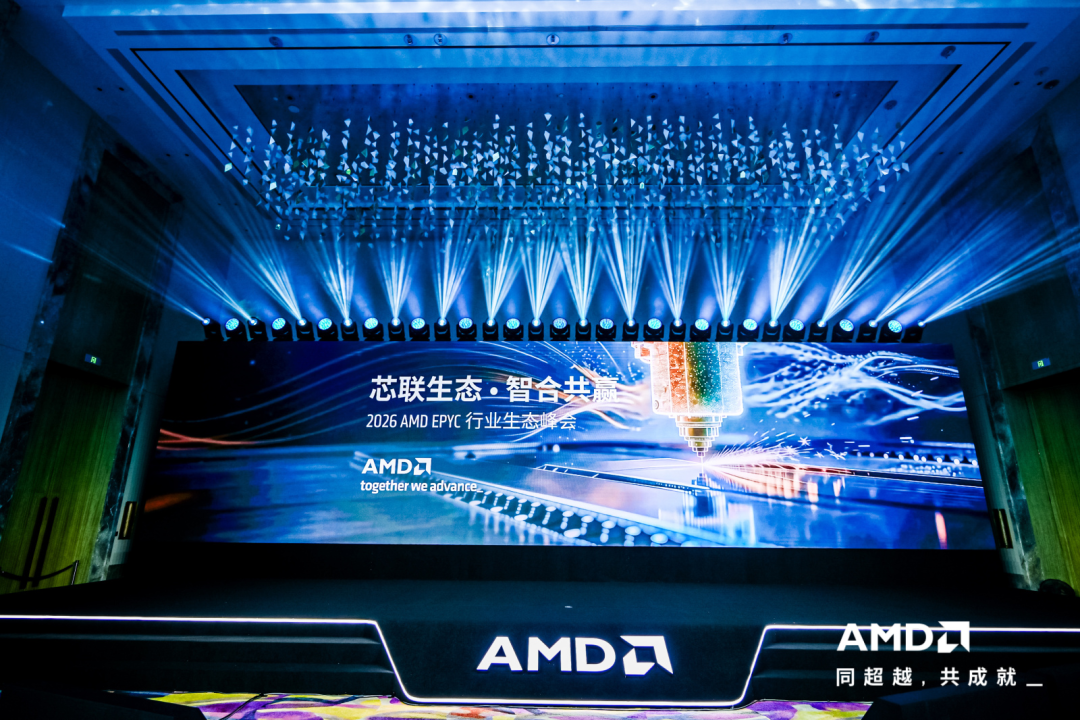
On September 3, 2026, AMD successfully hosted the "Connected by Silicon, Winning Together with Intelligence" 2026 AMD EPYC Industry Ecosystem Summit · Shanghai — Manufacturing Session at the MGM Shanghai West Bund hotel. Focusing on innovation at the intersection of industrial AI, high-performance computing, and manufacturing digitalization, the summit brought together more than 472 manufacturing executives, industrial informatization professionals, and ecosystem partners. Attendees engaged in in-depth discussions on core topics including HPC-driven R&D simulation, intelligent production, industrial quality inspection, and industrial internet development, jointly exploring new paths for intelligent manufacturing.
ZStack CTO Wang Wei was invited to attend the summit and delivered a keynote speech titled "From General Compute to AI Compute: ZStack's AI Infrastructure Practices for the Manufacturing Industry."
In his speech, drawing on policy trends, real customer scenarios, and joint lab test data, Wang Wei systematically introduced the joint manufacturing AI infrastructure solution built by ZStack together with AMD. Based on the ZStack AIOS "Zhita" platform, the solution addresses three typical customer scenarios — AIOS platform construction, enterprise-grade AI gateway governance, and VMware replacement — helping manufacturers steadily enter the AI compute era through a "start small, run with high availability, allocate compute resources with precision, and smoothly repurpose existing assets" approach.
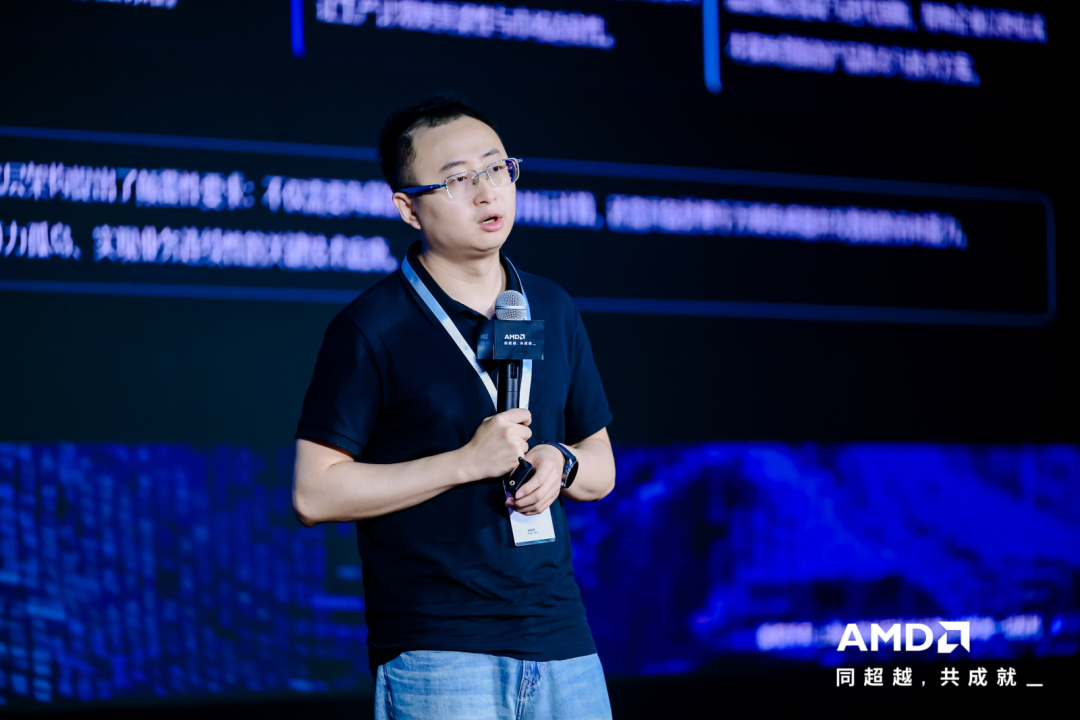
Wang Wei noted that as Industry 4.0 advances, AI is gradually evolving from an auxiliary tool into a key factor of production. As global demand for intelligent manufacturing upgrades continues to grow, the industrial AI market is accelerating, and the requirements placed on enterprises' underlying infrastructure are changing accordingly: it must not only provide compute resources capable of supporting large-scale parallel computing, but also deliver the throughput needed to process massive volumes of concurrent sensor data. At the same time, flexible resource scheduling mechanisms have become a critical technological foundation for breaking down compute silos and ensuring business continuity.
Across manufacturing segments — including high-tech manufacturing, automotive, biopharmaceuticals, heavy machinery, and light industry/retail — needs vary significantly. For example:
The semiconductor industry requires capabilities such as R&D simulation compute scheduling, defect detection, and supply chain risk early warning to accelerate product development cycles and strengthen supply chain resilience;
The automotive industry requires capabilities such as 3D crash simulation, process and quality analysis, after-sales diagnostics, and engineering assistants to improve the manufacturing quality of vehicles and key components, and to provide car owners with more timely and reliable after-sales service;
The light industry and retail sector needs capabilities such as personalized marketing, anti-counterfeiting traceability knowledge bases, and intelligent customer service to respond more quickly to trends and shifting consumer demand, while building consumer trust through credible traceability.
To meet these differentiated industry needs, ZStack has built a complete architecture consisting of an application layer, a model layer, a compute layer, and unified access and governance capabilities spanning all layers — turning general-purpose AI capabilities into deployable, operable productivity for real industry scenarios.
At the application layer, the Zentrix unified gateway provides AI development and governance capabilities including Agent, RAG, and LLMOps, and connects with core business systems such as PLM and ERP. At the model layer, the platform offers open-source models and a local model repository, supporting model fine-tuning, inference, and evaluation. At the compute layer, the platform supports unified compute operations through resource forms including GPU pools, virtual machines, containers, and bare metal, combined with multi-tenant management, resource metering, and billing capabilities.
The unified access and governance system spanning all layers connects models with business through capabilities such as Token management, model routing, security guardrails, and an MCP marketplace — bridging the "last mile" of AI capability deployment.
Through tuning with AMD EPYC processors, ZStack effectively enhances LLM inference pre- and post-processing, and leverages the high core counts and large memory bandwidth of AMD EPYC CPUs to deliver higher VM and container density — thereby improving the overall solution's ROI.
ZStack's solutions have already been validated in real manufacturing customer scenarios, helping customers achieve a smooth evolution from traditional virtualization to AI computing, and progressively completing the capability upgrade from general compute to AI compute.
Scenario 1: A Tire Manufacturer Builds a Model-as-a-Service (MaaS) Platform on CPU + GPU
The company is advancing its digital and intelligent strategy upgrade, with three main requirements: first, deploying an AI compute virtualization management platform for dynamic and elastic management of AI compute resources; second, launching model services such as DeepSeek-OCR, Reranker, and MinerU, and integrating commercial large models; third, using AI capabilities to improve product yield and overall work efficiency.
To address these needs, ZStack delivered the following solution:
01 Virtualized CPU and GPU compute resources to build a flexibly schedulable, centrally managed compute resource pool;
02 Rapidly completed the import, deployment, and validation of models such as DeepSeek-OCR, Reranker, and MinerU, and published the models as APIs callable by production systems;
03 Provided OCR, content reranking, and document parsing services, and empowered management, finance, and business systems through agents — bringing model capabilities into real production workflows.
Scenario 2: A Pharmaceutical Company Builds a Secure and Compliant One-Stop AI Hub Platform
Subject to GMP regulations, the company needed to deploy multiple types of models on-premises, build a biopharmaceutical vertical knowledge base and AI development assistant, and establish comprehensive management and audit mechanisms.
At the same time, Token usage by different R&D teams needed to be metered and accounted for separately; application data, call logs, and intermediate artifacts needed to be fully traceable end-to-end to ensure reliable system operation and meet production compliance requirements.
To meet these needs, ZStack delivered a unified AI access and governance solution based on the Zentrix enterprise-grade AI gateway:
01 Unified access to mainstream large models, supporting low-cost business migration and automatic failover, reducing the impact of model service anomalies on business operations;
02 Support for 22 types of data masking rules and full-chain auditing, with access credentials centrally managed by the gateway — reducing the risk of sensitive information leakage, such as molecular formulas and clinical data;
03 Rapidly packaged the LIMS laboratory system and literature repositories as Agent-callable tools, lowering the barrier for R&D personnel to use AI tools;
04 Full traceability of model calls and Token-level metering, accurately attributing resource consumption to different R&D pipelines and research groups — supporting FinOps-grade cost management while meeting GMP compliance requirements.
Scenario 3: "VMware Replacement and Legacy Equipment Renewal" for Multi-Site, Multi-Workshop Manufacturers
These enterprises want to protect their existing VMware investments while gradually evolving toward cloud and AI computing. Their core demands focus on reducing licensing and O&M costs, improving resource utilization, and smoothly supporting AI application workloads.
To address these needs, ZStack offers three evolution paths:
01 Virtualization replacement — rapidly taking over lightweight resource pools;
02 Hyperconverged replacement — enabling integrated O&M and multi-replica high availability;
03 Cloud platform upgrade replacement — supporting group-level cloud governance.
All three paths can be paired with a complete closed loop of "assessment and inventory — migration implementation — business validation — unified O&M — continuous optimization," helping enterprises reduce licensing and O&M costs and improve resource utilization while protecting existing investments and fully unlocking the value of legacy equipment.
For the AI-driven intelligent transformation of manufacturing, ZStack and AMD have jointly built an AI infrastructure solution based on the ZStack AIOS "Zhita" platform and the AMD EPYC compute platform. Addressing the differentiated needs of five types of manufacturing scenarios, it helps enterprises start from small-scale use cases and progressively build out AI computing capabilities while protecting existing investments.
Through sustained, steady technological evolution, manufacturers can complete the capability upgrade from traditional general-purpose computing to intelligent computing — bringing AI into R&D, production, and management processes, transforming it into deployable and operable productivity in real production scenarios, and injecting new momentum into the high-quality development of manufacturing.