
On November 13, the "Open Source into Universities" event — Fudan University stop: the Advanced Computing Systems and Open-Source Ecosystem Innovation Forum — was held at the South Hall of Xianghui Hall on Fudan University's Handan Campus. ZStack CTO Wang Wei delivered a keynote titled "Exploring Open Source from Traditional Infrastructure to AI Infrastructure," drawing on ZStack's open-source practices across cloud computing, virtualization, and AI compute to explain how infrastructure software evolves with application demands, and how the open-source community collaborates with enterprise-grade products.
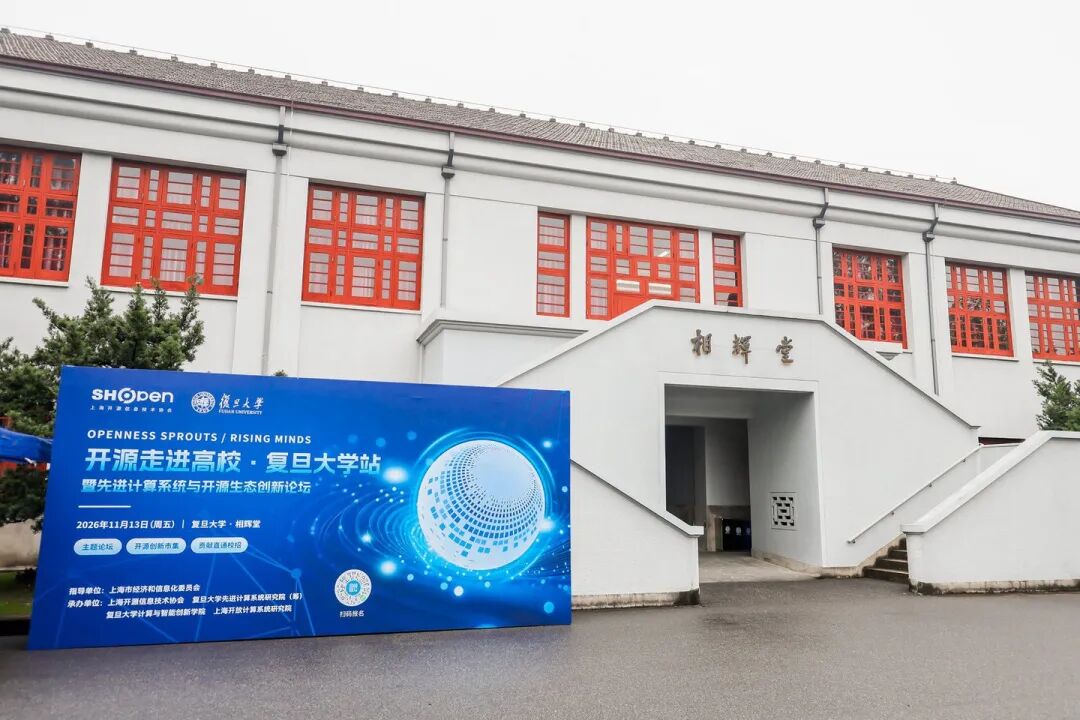
The "Open Source into Universities" was held at Fudan Xianghui Hall.
Guided by the Shanghai Municipal Commission of Economy and Informatization, the event was co-hosted by the Shanghai Open Source Information Technology Association, the Fudan University Institute of Advanced Computing Systems (under preparation), the Fudan University School of Computing and Intelligent Innovation, and the Shanghai Open Computing Systems Research Institute. Focusing on advanced computing and open-source technology, it offered enterprises, faculty, and students an opportunity for technical exchange and talent matching.
01 / OPEN SOURCE / INFRASTRUCTURE
Starting from Open Source, Extending the Technical Boundaries of Infrastructure
Open source has run through the entire evolution of ZStack's products. At its founding in 2015, ZStack released the source code of version 0.6 under the Apache-2.0 license and has continuously built an open-source IaaS community. Through a free community edition and enterprise-grade products and services built for production needs, ZStack enables users to start with hands-on use to understand the cloud platform, and then choose the appropriate capabilities and support according to their business needs.
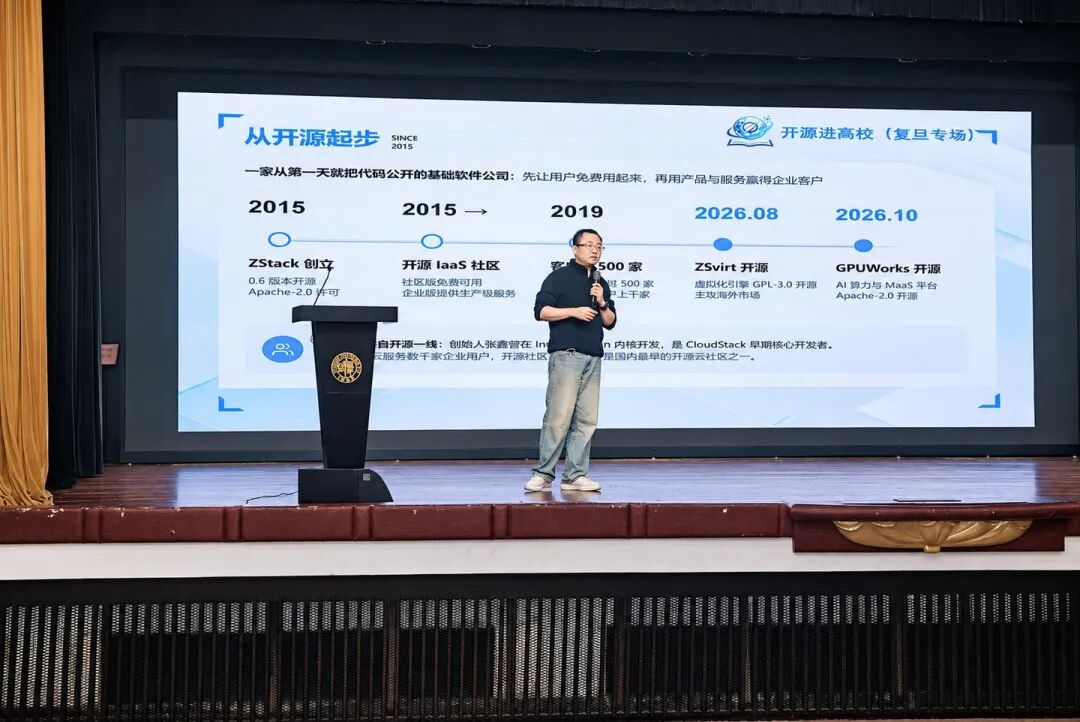
ZStack CTO Wang Wei presents ZStack's practices from open-source IaaS to virtualization, AI compute, and model services.
This practice has since extended to more layers of infrastructure. In August 2026, the virtualization engine ZSvirt was open-sourced under the GPL-3.0 license; in October of the same year, the AI compute and MaaS platform GPUWorks was open-sourced under the Apache-2.0 license. From unified management of compute, storage, and networking, to the virtualization engine, and on to model inference services, ZStack's open-source projects respond to the infrastructure needs of different stages.
The keynote also introduced the Open Core approach: building on an open-source core, improving the product through community usage, feedback, and contributions; offering enterprise customers large-scale capabilities and services, and reinvesting that input into the continued development of the open-source core. Open source and enterprise-grade services are thus connected, allowing community practices to feed into product iteration while supporting long-term R&D.
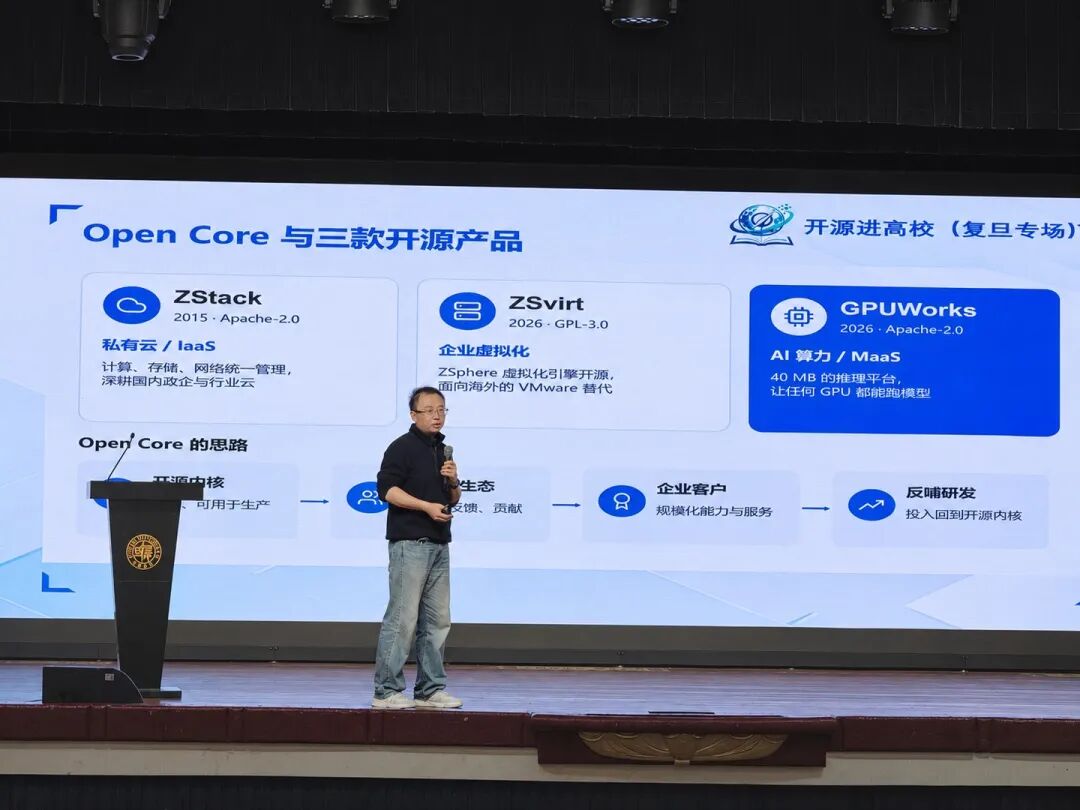
From ZStack, ZSvirt, to GPUWorks, the keynote showcased open-source practices across different infrastructure layers.
02 / AI / MODEL SERVICES
For AI, Turning Compute Resources into Model Services
AI applications place new demands on infrastructure. Beyond managing compute resources, teams must also handle model-to-hardware matching, memory requirements, inference environments, and service interfaces. The deliverable of infrastructure has also extended from allocatable resources to model services that applications can call.
GPUWorks is an open-source project under FlitAI, ZStack's private AI infrastructure brand, positioned as a lightweight GPU compute management and model-serving platform. It brings accelerators from different supported vendors and compute resources from various sources into a unified resource pool, and — through model-to-hardware matching, memory requirement assessment, and templated deployment — delivers model services accessible via an OpenAI-compatible interface.
This design brings resource management and model deployment into a single workflow: teams can view and manage existing compute, choose deployment configurations based on specific hardware and operating conditions, and deliver model capabilities to applications. In heterogeneous compute environments, unified management preserves the capability differences of each device, while specific models and inference features still need to match the corresponding hardware, engines, and runtime environments.
From cloud platforms to AI inference platforms, ZStack extends its engineering experience in infrastructure software to new application demands. The open-sourcing of GPUWorks also gives developers an entry point to understand its implementation, verify deployments, and participate in its improvement.
03 / CAMPUS / DEVELOPER CONNECTION
From Technical Sharing to Hands-On Experience and Talent Exchange
Beyond the keynote, ZStack set up a booth outside the venue to showcase the GPUWorks open-source project, related product information, and campus recruitment positions, and to engage in consultation and exchange with students.
On site, the ZStack team communicated with students about open-source projects, product applications, job requirements, and career development directions. Combining technical showcases with recruitment exchanges allowed students to understand the products while also gaining insight into the real-world problems underlying infrastructure software development and what enterprises look for in talent.
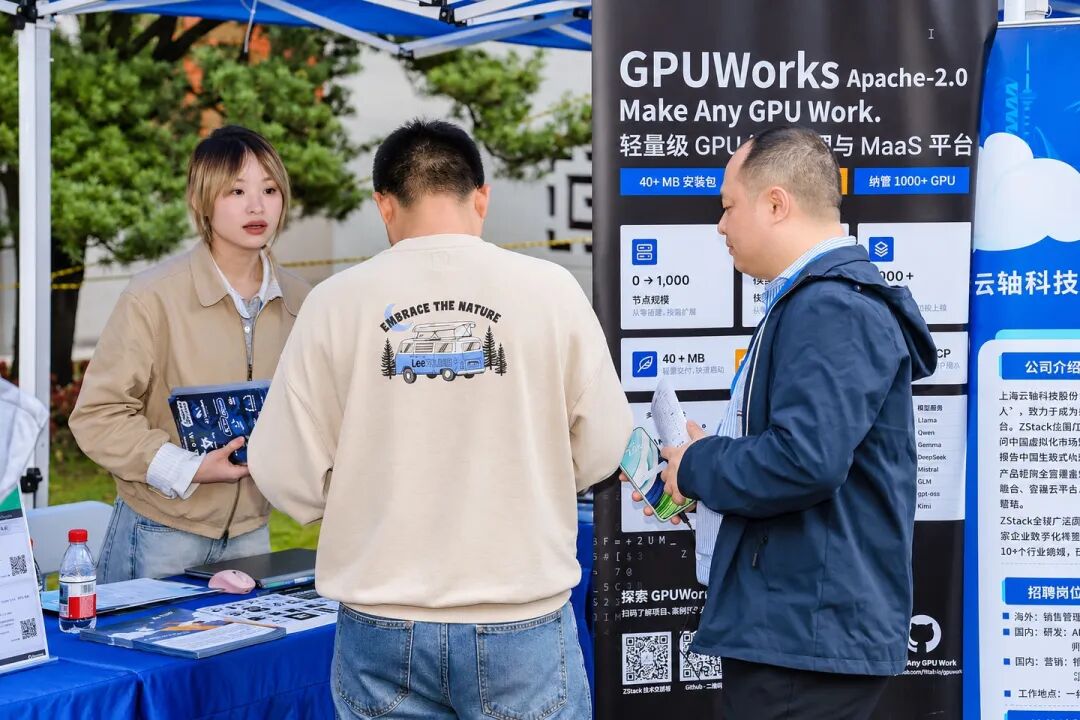
GPUWorks project showcase
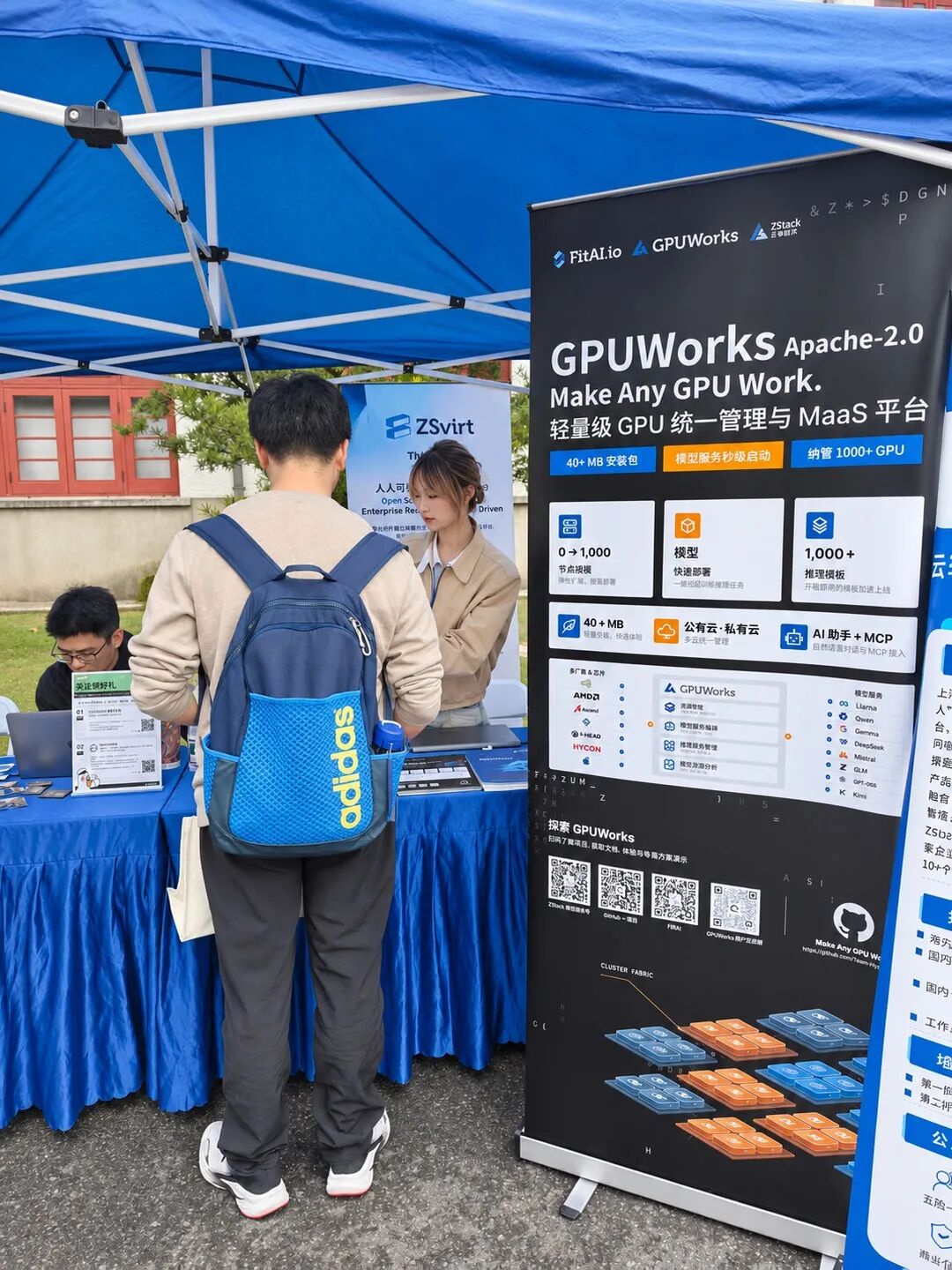
Campus recruitment consultation and on-site exchange
Open source offers faculty and students a concrete entry point to enterprise-grade infrastructure software: from reading code and deploying projects, to understanding the engineering trade-offs behind product design, learning can connect with real software practice. On this visit to Fudan, ZStack brought its open-source journey, product practices, and talent exchange to the same venue, making the evolution of infrastructure technology a subject that faculty and students can further understand and participate in.
04 / COMMUNITY
Join the Community
GPUWorks's open-source journey has only just begun. Whether you are an AI developer, an infrastructure engineer, or a hardware vendor, you are welcome to join in — try different model and compute combinations, share your experience, report issues, and improve GPUWorks together with us.
Experience GPUWorks and join open-source co-creation!
Join GPUWorks Discord at : https://discord.gg/9m3gryGwzg