A year ago, many financial institutions were still debating "should we replace VMware?" Today, two timelines are sitting on the table at the same time. One is about licensing, support, and IT-innovation compliance — it requires swapping the existing virtualization for a controllable, auditable production foundation. The other is about intelligent customer service, investment-research assistants, risk-control models, and knowledge bases — it requires wiring AI into the business as fast as possible, without data ever leaving the perimeter.
Many teams' first reaction is to split this into two projects: one for VMware replacement, one for a separately purchased AI platform. On paper the division of labor is clean — but it often turns into two sets of accounts, two sets of operations, and two sets of audits, with the core business and AI still unable to connect.
What financial cloud really has to answer is not "replacement first or AI first," but "can two very different workloads land on the same foundation that can evolve over time?"
Why Financial Scenarios Fear "Replacing Once, Then Rebuilding a Separate Stack"
Financial IT rarely has a single layer. Trading, settlement, risk control, channels, and dev/test are scattered across multiple data centers and platforms. Since Broadcom's takeover of VMware, licensing, support, and the upgrade path have all moved onto the decision table; the requirements for IT-innovation, classified protection, cryptographic evaluation, and business continuity have not been relaxed either. Replacement is no longer swapping a virtualization product — it's accounting for cost, compliance, and long-term availability all at once.
AI has stretched that table even further. Models need to read internal documents and business data, and the results have to be written back into the system. If compute lives on a new platform and data stays on the legacy cloud, permissions and audits split into two different standards.
So the real difficulty is not "migrating the VMs away" and not "installing a large model" — it is that when these two things run in parallel, you don't tear the production environment into two islands that can't talk to each other.
Foundation One: Use ZStack Cloud to Replace VMware Steadily
For a financial production environment, whether replacement actually lands comes down to three things: can you see the current environment first, can you keep downtime minimal during migration, and can your operations muscle memory carry over after the switch.
The ZStack Cloud platform pulls compute, storage, and networking into a single set of capabilities, and offers on-demand modules for VMware management, migration, multi-tenancy, backup and disaster recovery, and elastic bare metal. The common rhythm is not a one-shot cutover — it's first connecting to the existing vCenter and putting legacy and newly built resources in the same view; then migrating in waves by business tier, starting with dev/test, validating core systems separately, and keeping a rollback window for cutover. Migration supports agentless replication, keeping intrusion into the business side to a minimum.
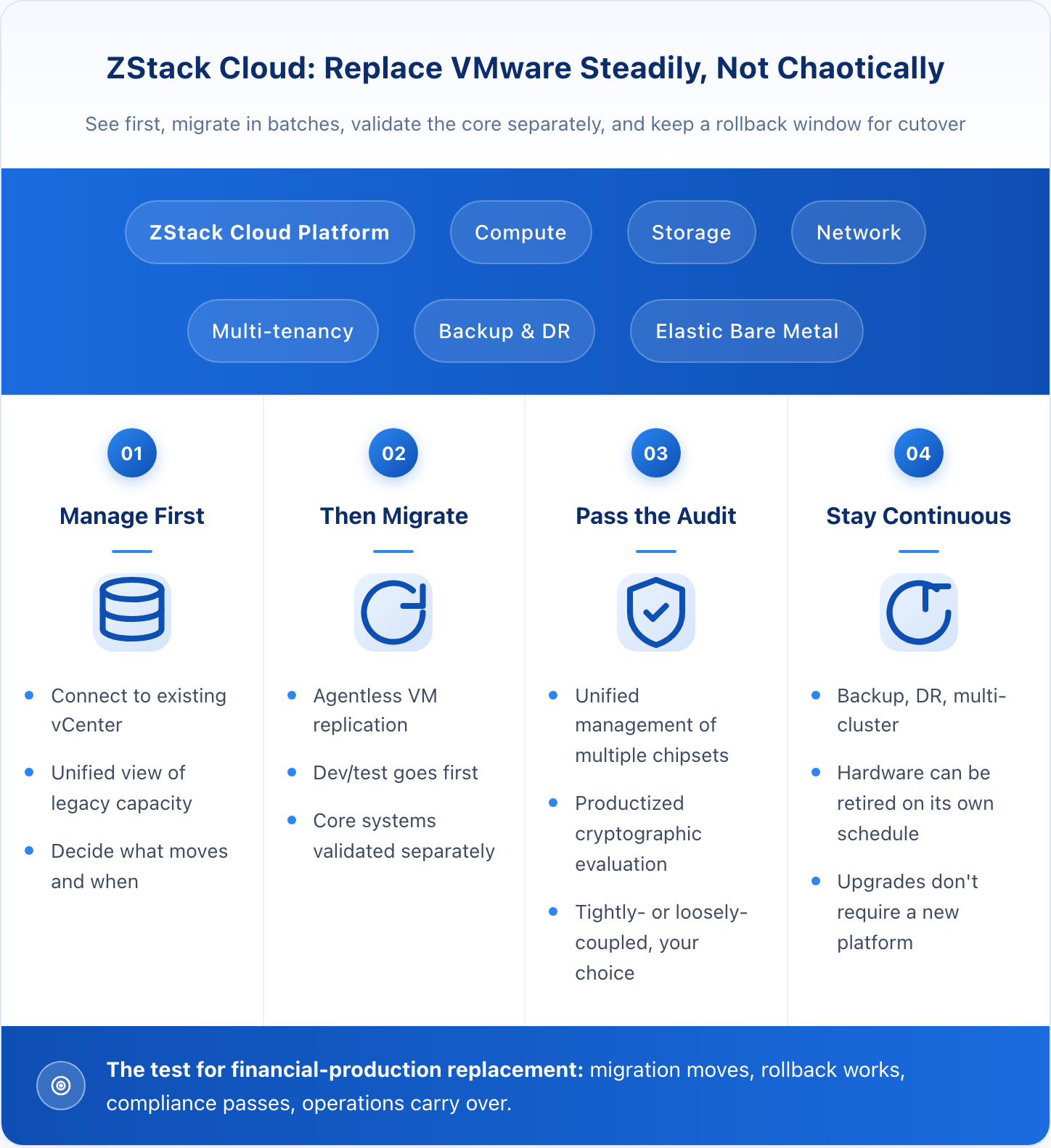
ZStack Cloud takes on VMware-compliant replacement — managing first, migrating in batches, and validating the core separately.
IT-innovation is not about building a second virtualization stack. The IT-innovation edition of Cloud supports one cloud with multiple chipsets, putting x86 and domestic chips under unified management, compatible with four major architectures and eight platform types, and has passed the Trusted Cloud "One Cloud, Multiple Chipsets" and "Virtualized Cloud Platform" advanced-level certifications. The value is not a longer chip list — it's not having to maintain a second production foundation for IT-innovation.
Cryptographic evaluation and cloud security must also be productized — not an engineering retrofit after passing the audit.Cloud provides a cryptographic-evaluation module and can choose tightly-coupled or loosely-coupled deployment based on existing cryptographic devices; networking, data, cryptography, and audit can be brought into a unified service catalog.
For business continuity, Cloud can layer on high availability, disaster recovery, and continuous data protection on demand, supporting intra-city multi-cluster and remote disaster-recovery deployments so that core business keeps running through failures and failovers.
Foundation Two: Use ZStack AIOS to Put AI to Work
Replacement only solves "whether today's systems can still run." AI has to solve "how tomorrow's business innovates" — and it must be private: customer data, investment-research material, and risk-control rules cannot drift into uncontrolled environments along with model calls.
ZStack AIOS is not a separate island sitting next to Cloud. By product definition, it includes the full capabilities of ZStack Cloud; existing Cloud environments can be smoothly extended to AI infrastructure without rebuilding from scratch. In other words, when a financial institution first swaps VMware for Cloud, it isn't dead-ending the road — it's paving the foundation for private AI.
The capabilities can be understood as four layers. The compute layer turns GPUs from "dedicated to a single machine" into a schedulable resource pool, uniformly managing NVIDIA, Ascend, Hygon, and other accelerators; utilization can rise from around 30% to over 70%, and you can start from as few as one node. The model layer covers import, fine-tuning, inference, and evaluation, supporting private deployment of mainstream models such as DeepSeek and Qwen. The gateway layer consolidates scattered calls behind a unified entry point, so usage, permissions, and audit are all manageable. The application layer comes pre-loaded with a knowledge base and orchestration tools, making it easy to plug into scenarios like intelligent customer service and investment-research Q&A.
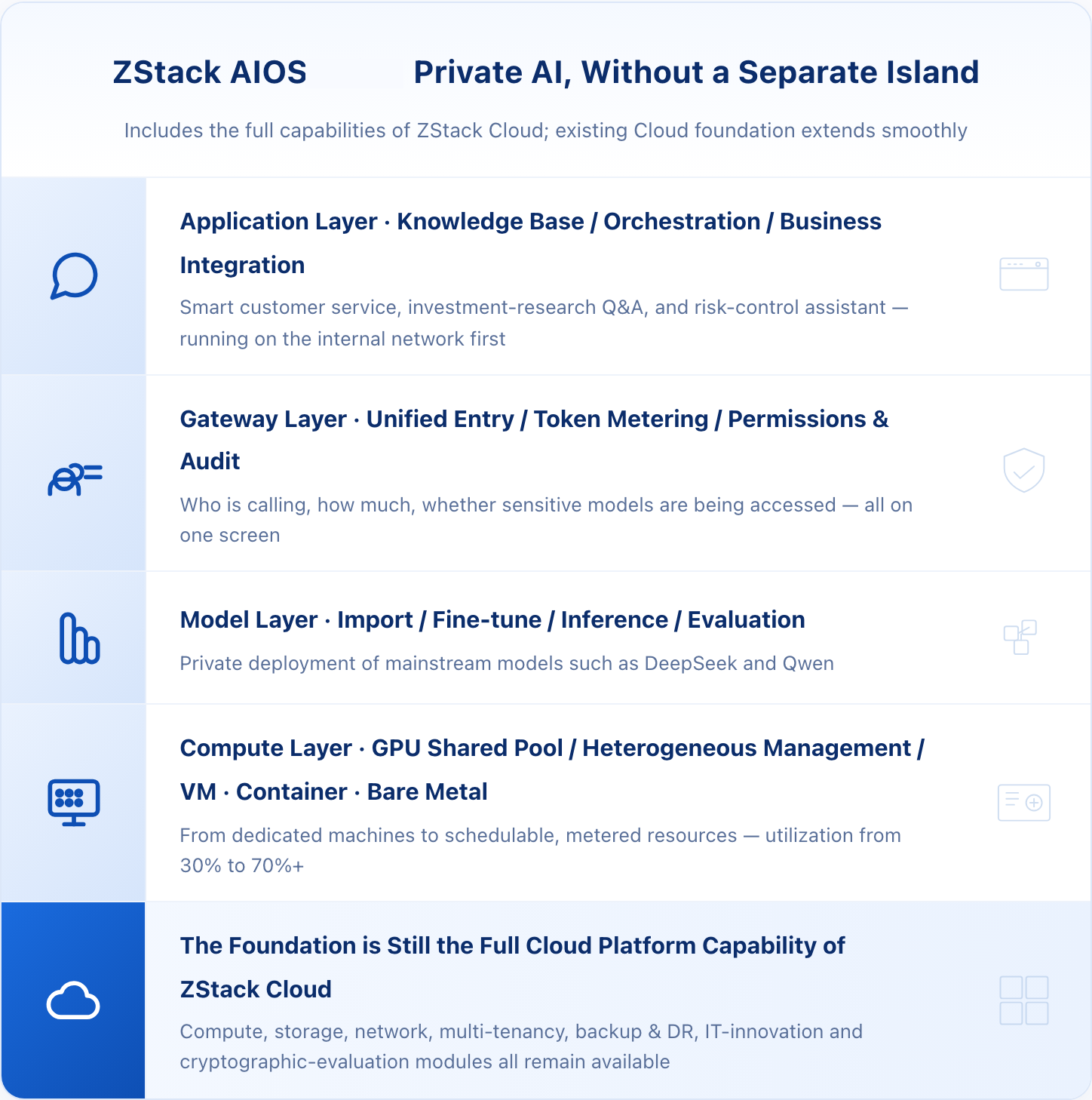
ZStack AIOS uses Cloud as the foundation and stacks compute, model, gateway, and application capabilities on top.
For financial institutions, this means AI does not have to wait for "the VMware project to fully wrap up" before it can be launched. Production zones keep using Cloud to finish the replacement steadily; innovation zones can use AIOS to stand up private model services first. Accounts, quotas, audit, and operations habits stay in the same product family on both sides — rather than two completely unfamiliar platforms.
In July 2026, ZStack joined the Dual-State AI Forum, listing financial AI infrastructure as a clear direction. What matters even more is still the order of execution: first keep data and calls inside a controllable boundary, then talk about how models and the business connect.
When Two Foundations Run in Parallel, It's Evolution, Not Two Tear-Downs
Parallel does not mean the two foundations sit side by side forever, never talking. A more robust path is: today, use Cloud to take on VMware replacement, IT-innovation, and compliance; when GPU and model services are needed, evolve the same foundation to AIOS; separate core systems, dev/test, and AI innovation by workload zone and in waves — not "cut the whole plant over tomorrow."
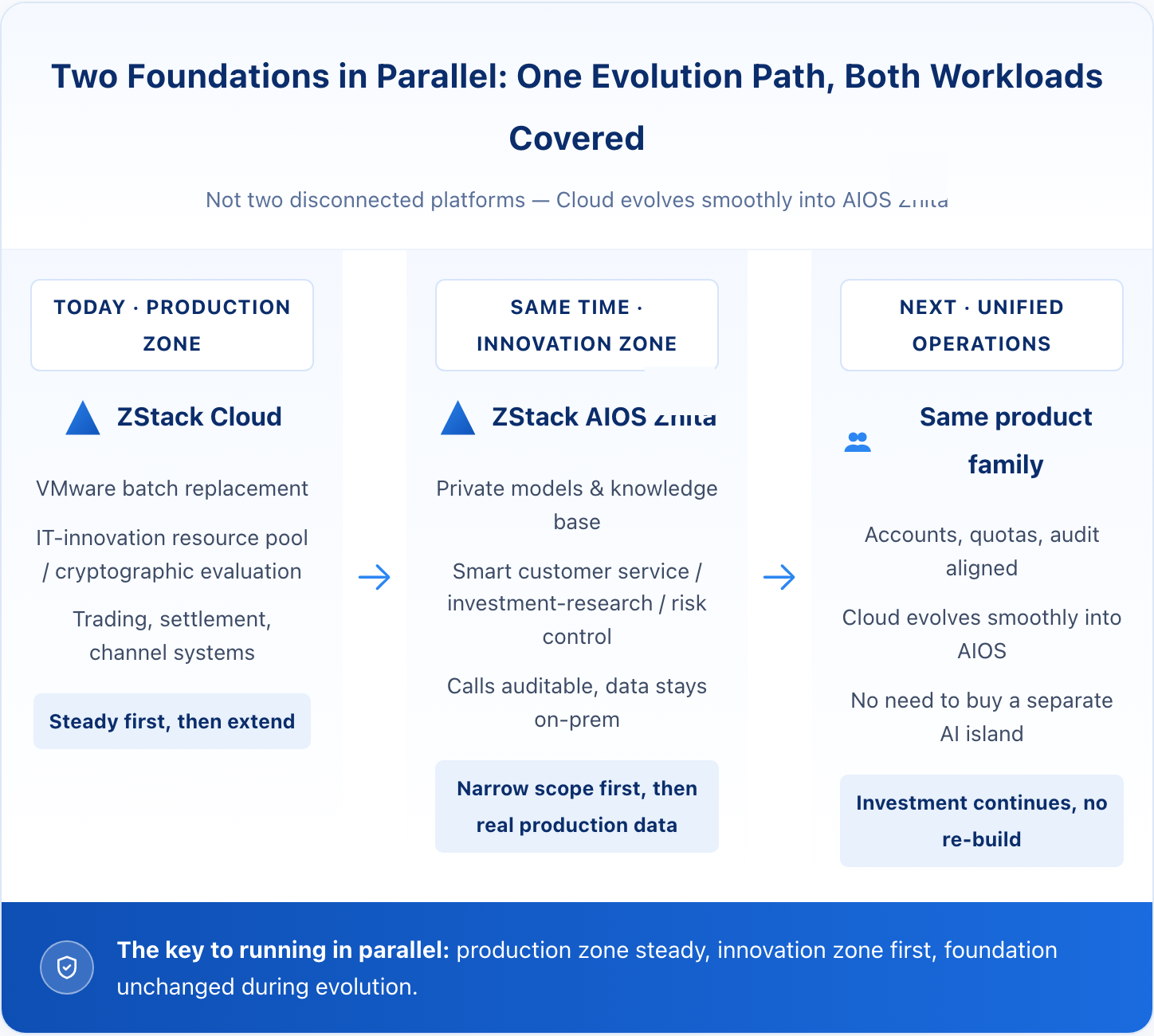
Production zones use Cloud for steady replacement; innovation zones use AIOS to run first; then operate everything uniformly in the same product family.
This path has been deployed in banks, securities, insurance, futures, and other financial institutions, covering more than 100 financial projects. Compared with traditional virtualization solutions, build and operations costs can drop significantly; the replacement platform continues to support uninterrupted business operations and can also take on subsequent AI innovation.
Write the Parallel Plan as a Checklist and Bring It into the POC
The conclusion usually isn't "the whole bank cuts over tomorrow" — it's a workload checklist: dev/test and general business can move to Cloud first; core trading keeps its own drills and rollback; IT-innovation workloads get their own pool; AI applications start with non-core, rollback-friendly scenarios. Bringing that checklist into the POC is far more useful than walking into the meeting with the slogan "cloud first or AI first."
What to run in parallel | What to actually look at | What not to focus on |
VMware replacement | Manage first, migrate agentlessly, do batched cutover, and roll back on failure | The shortest cutover time in the marketing material |
IT-innovation & cryptographic evaluation | Multiple chipsets managed uniformly; evaluation productized and ready to enable | How long the chip list is |
Business continuity | Backup, DR, and multi-cluster cover the existing service levels | Only the availability numbers in marketing material |
AI innovation | Data stays in-perimeter; calls metered and audited; models deployed privately | Only which large model has the newer name |
Long-term evolution | Cloud extends smoothly to AI; two workloads need no two platforms | Treating the cloud and AI projects as two separate procurements |
The usual sequence of execution is assessment, POC, batched migration, and then layering on AI. Under suitable conditions, some replacement projects can move quickly from assessment to go-live, but that should not be taken as a promise for every production environment. On the AI side, it's better to start with rollback-friendly assistive applications, retest with real data, and only then move toward core systems.
Large models can keep being used — to organize material, generate checklists, and remind you not to miss rollback, backup, and audit. They should not have a vote. The vote belongs to live-environment testing, compliance requirements, and business continuity.
The end state of financial cloud migration is not replacing the VMware logo with another vendor's, nor is it buying another platform that only runs large models. It is the institution regaining control over cost, compliance, and the pace of innovation: the systems that must be stable stay stable; the businesses that need to experiment can afford to try. What ZStack Cloud and ZStack AIOS are built to carry is the path from "swapping the VMs over" to "wiring AI into the financial business for real."