
Let's start with a direct question: if your business-critical appliance were to fail tomorrow, how much would the repair cost?
Two years ago, the answer was roughly "a repair bill that isn't cheap, but is still manageable."
That answer has changed. Because the components most likely to fail inside an appliance — memory, SSDs, and hard drives — are in the middle of a rare upward price cycle. You can't afford to have them break, and you can't afford to wait.
The "Gamble That Nothing Breaks" Cost-Saving Logic Is Failing
For many enterprises, their attitude toward maintenance is essentially a game of probability:
Traditional Thinking | The Harsh Reality |
No failure, no payment; pay a one-off repair fee only if something breaks. | Parts prices are soaring; a single repair can far exceed a full year of maintenance spend. |
The device just left warranty and is still "young" — push it one more year. | Hard drives, memory, power supplies and fans run long-term — failure rates keep climbing with time. |
Only buy parts and repair on an ad-hoc basis once it actually fails. | Emergency repair requests, last-minute procurement and waiting — cost and recovery time are both uncontrollable. |
This equation may have worked in an era of stable parts prices. But once the procurement cost of memory and SSDs climbs an upward curve, going off-warranty is no longer a cost-saving strategy — it hands control of your budget over to luck.
Parts Don't Just Fail; They're Getting More and More Expensive
Public market data shows that in 2026, storage and memory prices kept climbing, driven by AI servers, data-center procurement and tight supply. Three numbers are worth every IT leader's attention:
~3.6x — DRAM/memory contract-price index rose cumulatively over three quarters. Derived from the median of published quarterly gains, the 2026Q3 memory contract-price index is about 3.6x that of 2025Q4. Buying memory ad hoc after going off-warranty most likely lands right in this peak-price cycle.
~3.1x — NAND/SSD contract-price index rose cumulatively over three quarters. SSD and flash-related components are seeing greater price volatility — once a critical drive fails, the cost and lead time of self-procurement become harder to control.
+48%~53% — Enterprise SSD contract prices rose in tandem (TrendForce Enterprise SSD 2Q26 report summary). The value of a maintenance contract lies in managing spare-parts and service risk in advance.
Component price trend index, derived with 2025Q4 = 100:
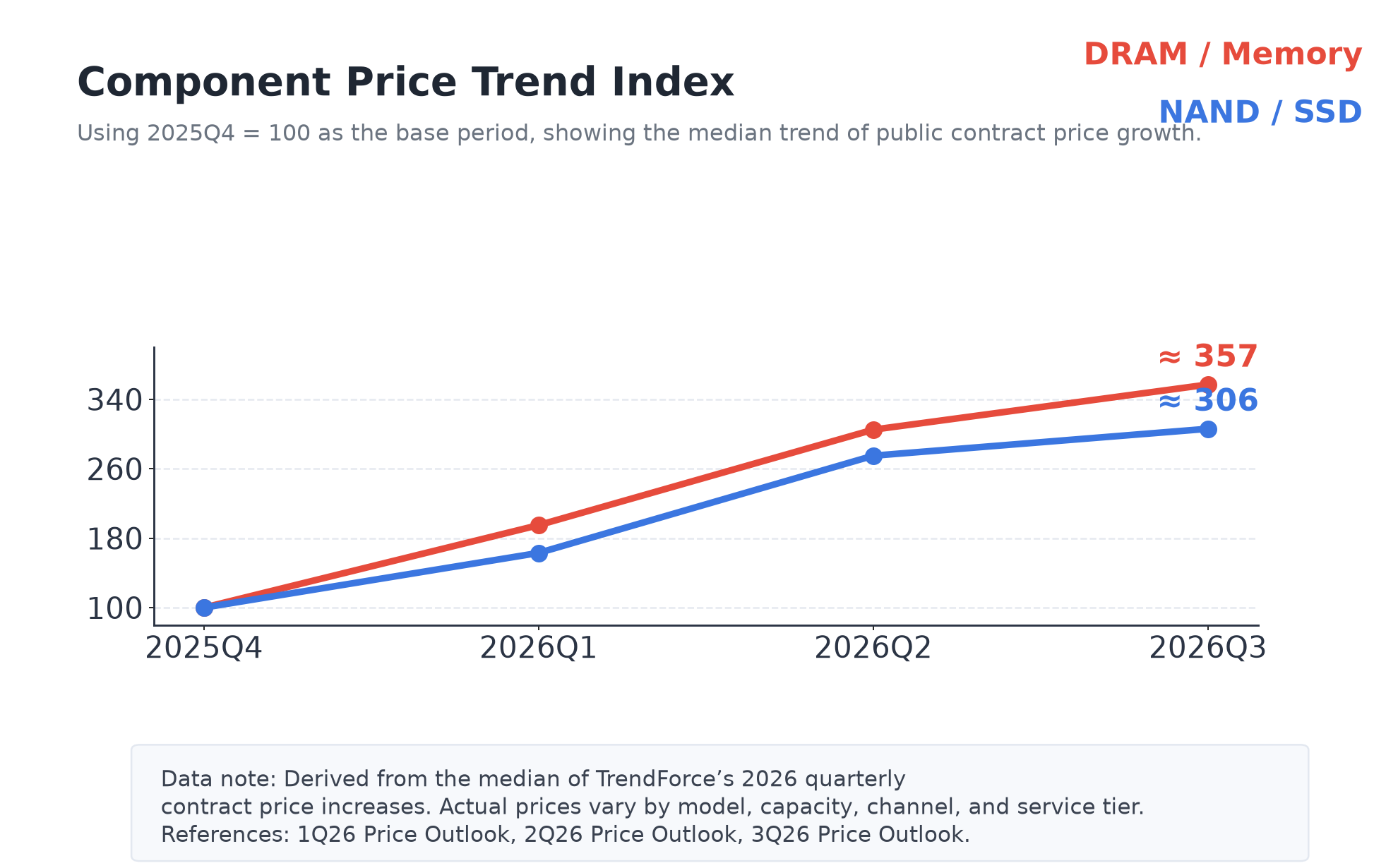
For customers, the risk after going off-warranty isn't just "pay to repair it yourself when it breaks" — it's also that the moment it breaks is exactly when parts are pricier and harder to wait for.
Every Failure After Going Off-Warranty Is Three Bills at Once
An appliance carries compute, storage, networking and platform-software capability over the long term. Hardware is aging, versions are iterating, parts are rising in price. Once maintenance expires, the enterprise faces not just a repair fee, but three overlapping bills:
The Hardware Bill: Tens of Thousands of Yuan — If key components (memory, SSD, hard drive, power supply, motherboard) fail, ad hoc diagnosis, procurement and replacement costs all need to be recalculated — and at the market price of a rising-price cycle.
The Downtime Bill: Amplified by the Hour — Applications unavailable, data access blocked, work affected. The longer you wait for parts and troubleshooting, the harder the overall loss is to control. This money has no invoice — but it hurts the most.
The Risk Bill: Hard to Remediate — Non-OEM parts, ad hoc repairs and version mismatches can amplify a hardware problem into platform-stability risk. The maintenance fee you saved may be paid back all at once.
One Year of Maintenance vs. One Off-Warranty Failure, Head to Head
One Off-Warranty Failure | Annual OEM Maintenance | |
Cost | In the tens of thousands, market-determined and uncontrollable | A controllable annual budget, locked in advance |
Spare Parts | Ad hoc procurement — pricier and harder to wait for in a rising-price cycle | OEM parts, guaranteed by a standardized process |
Response | Ad hoc repair requests, repeated hand-offs, waiting for scheduling | A formal service channel — someone takes your case |
Versions | Patches, licenses and upgrades may stall | Versions stay maintainable; standardized checks before upgrades |
Risk | Non-certified parts bring compatibility and stability risks | Health inspections catch small issues before an outage |
Renewing now is a budget line. A problem after going off-warranty is an incident cost.
An Appliance Is a Converged Hardware-Software Platform; OEM Maintenance Is the Complete Closed Loop
An appliance is not a single point of hardware. Its stable operation depends on the joint coordination of system hardware, platform software, storage mechanisms, network configuration, version patches and operational experience — which is exactly why "finding a third party to swap a part" often fails to fix the root cause.
The value of OEM maintenance is to turn uncontrollable failure risk into a service assurance that is manageable, responsive and traceable:
Someone answers. After a failure, you enter a formal service channel, reducing ad hoc sourcing, repeated hand-offs and waiting for scheduling.
Spare parts assured. Hardware repairs return to a standardized process, reducing the compatibility and stability risks of non-certified parts.
Versions maintainable. Patches, versions, licenses and pre-upgrade checks are more standardized, reducing the security and compatibility risks of long-term old versions.
Risks found early. Through health inspections, running-state checks and capacity assessment, small issues are caught before business is interrupted.
A Final Word
In this parts-price upcycle, the cost of "going uncovered" is being repriced by the market.
Your appliance maintenance service is about to expire. We recommend completing renewal confirmation as soon as possible — to avoid the impact on failure response, spare-parts assurance and software-upgrade entitlements once the appliance enters an off-warranty state.
OEM maintenance is the line of defense that locks unknown risk into your budget, in advance.
To learn about your equipment's off-warranty risk cost and renewal options, please contact your account manager or the ZStack service team.
Data note: The trend index in this article is derived from the median of TrendForce's publicly released 2026 quarterly contract-price gains. Actual purchase prices vary by brand, model, capacity, channel and service tier.
Service entitlements, response scope and specific terms are subject to the OEM service version actually purchased by the customer and the contract agreement.