
Hospital IT departments face two mandatory questions this year. First: the VMware replacement must preserve business continuity — 7×24 systems like HIS and PACS cannot stop for a moment. Second: AI-assisted diagnosis and treatment must be implemented, and GPU computing power, model scheduling, and data security all need a platform to carry them. The real-world paths of three hospitals point to the same answer: use a single cloud foundation to solve the problems in phases — first ensure a smooth replacement, then bring AI computing power under unified management.
01 / BUSINESS CONTINUITY
In Healthcare VMware Replacement, Business Continuity Is the Hard Part
VMware renewal quotes have kept climbing over the past two years, and many healthcare customers report significant increases — renewal costs have become a prominent pressure on hospital IT budgets. Meanwhile, the “2+8+N” Xinchuang (IT application innovation) policy continues to advance with greater force across key industries, and hospitals are demanding ever-higher levels of autonomy and control over their core systems.
But replacing VMware in healthcare comes with one extra threshold compared with other industries: the business cannot stop.
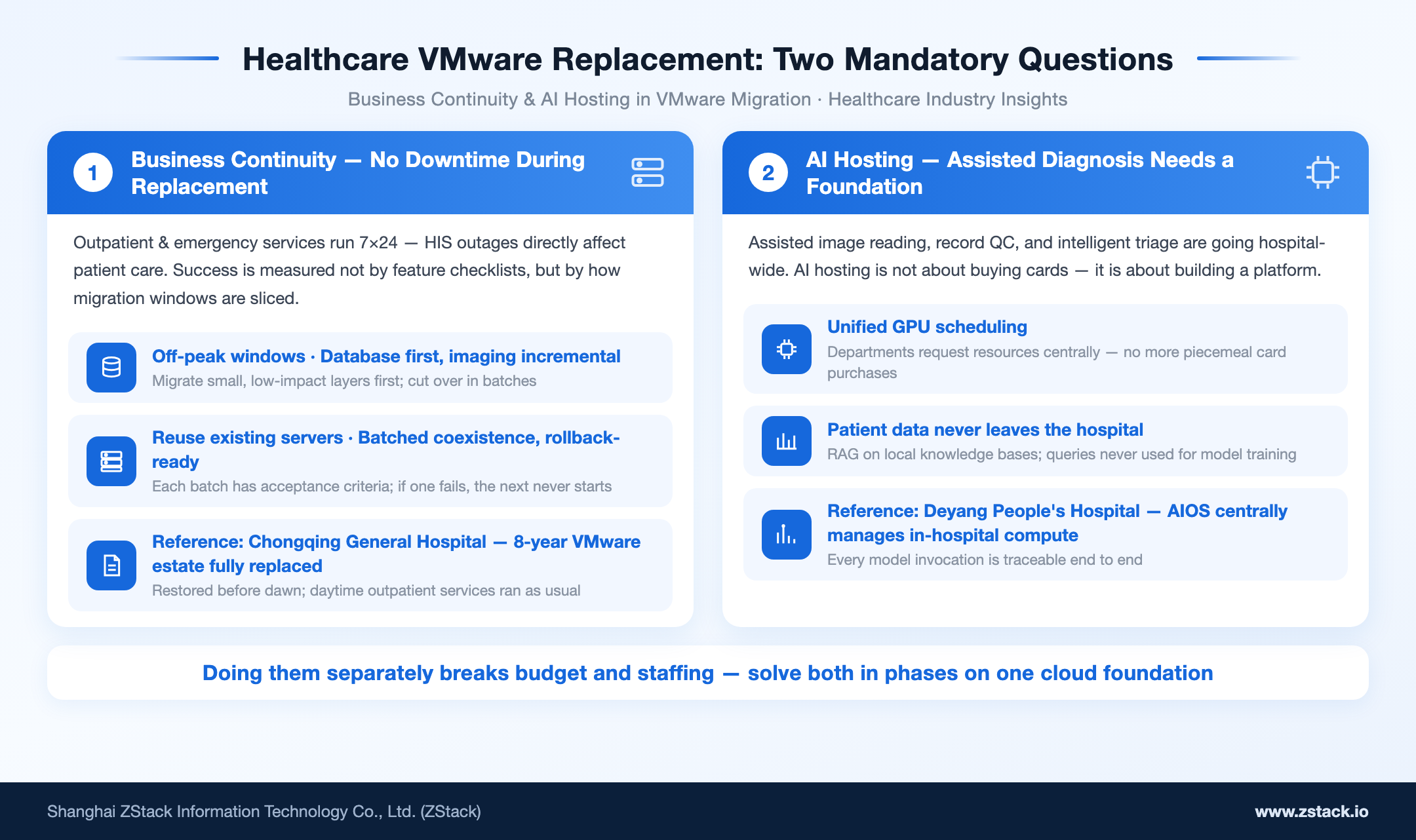
Outpatient and emergency services run 7×24; an HIS outage directly affects patient care. Chongqing General Hospital (a Grade-A tertiary hospital) has run its VMware environment for eight years, hosting HIS, PACS, LIS, and electronic medical records on it. For hospitals like this, the success of a replacement is decided not by product selection, but by the migration window — only the early-morning off-peak hours are usable, and normal operations must be restored before dawn. The viable approach is to decompose the migration: migrate the database layer first, where the data volume is small and the impact of any problem is controllable; once it is stable, migrate imaging data incrementally, cutting over in batches while daytime outpatient services run as usual.
Healthcare VMware Replacement — Question One: success is not measured by a feature checklist, but by business continuity — how migration windows are sliced, how cutovers are batched, and how rollback works when something goes wrong.
02 / AI INFRASTRUCTURE
AI Hosting Is Turning from a Bonus Item into a Mandatory Question
Healthcare informatization has advanced in four stages: HIS management informatization, CIS clinical informatization, interoperability and platformization — and it now stands at the fourth stage, the starting point of AI-native digital-intelligent healthcare. Assisted image reading, medical-record quality control, intelligent triage, and clinical research assistance: AI applications are moving from departmental pilots to hospital-wide deployment.
Then comes the question: where does the computing power come from?
The story that actually happens is often this: the hospital president wants AI; the IT department takes on the requirement — only to find that GPUs are not centrally managed, environments cannot be built, no one knows which model to choose, and no one knows how to pass the data security review. In the end it becomes “buy a few servers, install a framework, run a demo” — still far from production use.
Healthcare has one more hard constraint: patient data cannot leave the hospital.
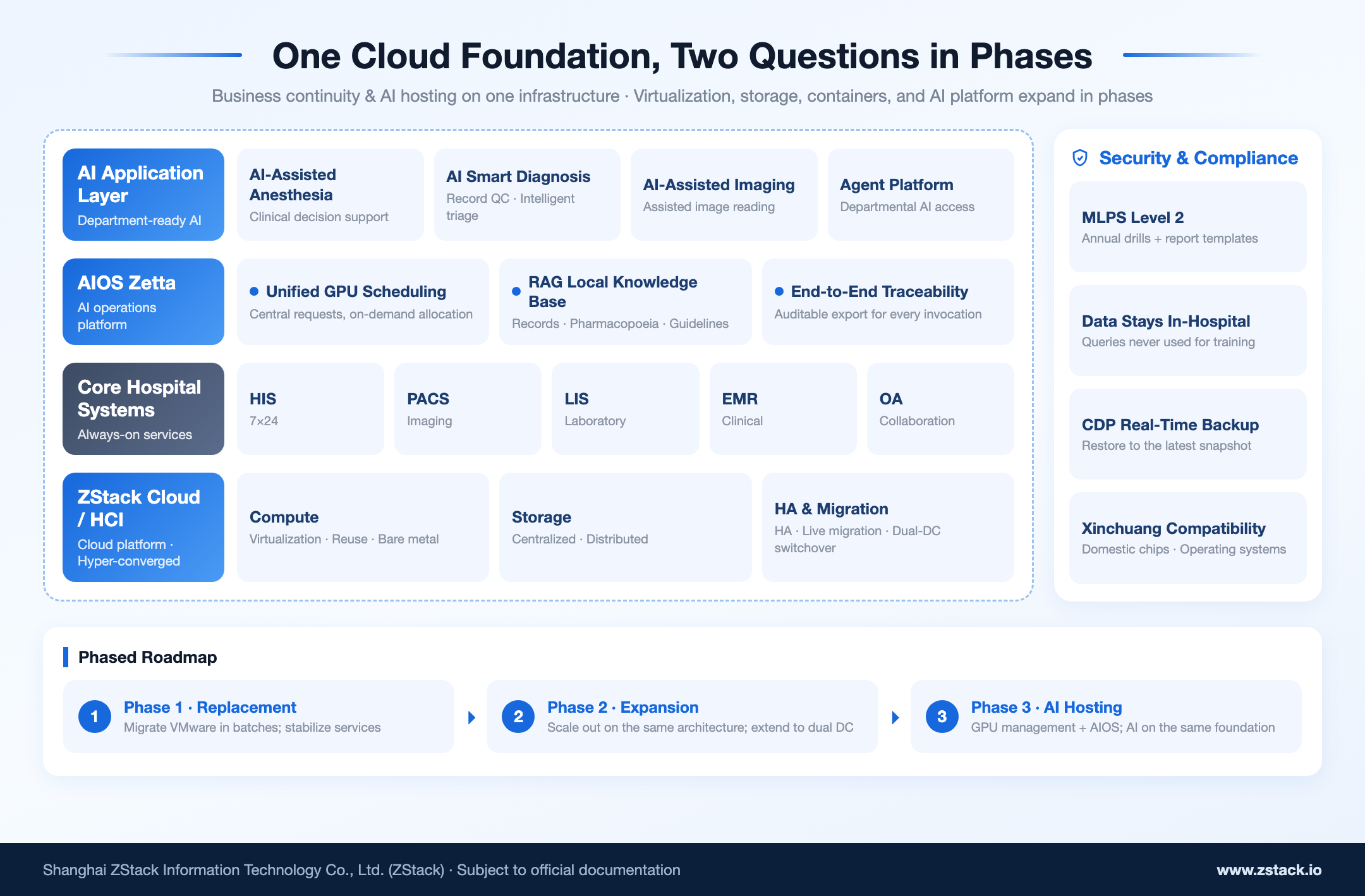
The path of a prefecture-level Grade-A tertiary hospital is worth referencing: building on a multi-phase expansion of its hyper-converged platform, it deployed AIOS (the Zetta AI platform) to centrally manage in-hospital computing power. Based on RAG (retrieval-augmented generation), medical records, pharmacopoeias, and clinical guidelines are mounted in a local knowledge base; the AI retrieves only within the hospital, and query data does not participate in model training. Every model invocation is traceable end to end, and the annual emergency drills required by MLPS Level 2 are supported by drill-report templates.
Healthcare VMware Replacement — Question Two: AI hosting is not about buying cards; it is about building a platform — unified scheduling of computing power, data staying inside the hospital, and traceable invocations. Missing any one of these means failing compliance.
03 / PRACTICE PATH
One Foundation, Two Questions Answered in Phases
Three cities, three hospital grades, three paths — behind them is the same judgment: replacement and AI hosting do not require two separate selections.
A large Grade-A tertiary general hospital: wholesale replacement of an 8-year VMware environment. Three new compute nodes were added and, together with MacroSAN centralized storage, used to build a ZStack Cloud platform; existing servers were reused and brought under management, and the i2 (Yingfang) solution handled batched cutover. After the replacement, first-image loading in PACS dropped from seconds to milliseconds (per feedback from the hospital’s IT department).
A county-level Grade-B secondary hospital: more than 20 hyper-converged nodes carry the hospital’s core services across two data centers in an active-standby setup. Everything except PACS image storage has been migrated, and the IT department independently operates and maintains both centers.
A prefecture-level Grade-A tertiary hospital: after multi-phase expansion of the hyper-converged platform, AIOS was layered on top — AI-assisted anesthesia, AI smart diagnosis and treatment, AI-assisted imaging analysis, and an agent platform all run on the same foundation.
What the three hospitals share is a core cloud platform with self-developed code — not based on open-source cloud architectures such as OpenStack — that has completed compatibility verification with multiple domestic chips and operating systems, which determines whether a platform can enter the healthcare industry’s Xinchuang catalog. Virtualization, storage, containers, and the AI platform all expand in phases on the same foundation, so the IT department does not have to maintain two separate systems.
04 / ACTION CHECKLIST
An Action Checklist for the IT Department
In 2026, IT departments don’t need to agonize over “whether to adopt AI.” Start by getting three accounts straight:
01
Map the renewal timeline — work backward from VMware renewal dates and reserve windows for replacement and validation.
02
Map business tiers — for core systems such as HIS, define migration windows and rollback plans first; validate with peripheral systems first.
03
Map the AI account — which AI scenarios the hospital will deploy, how large the computing gap is, and how patient data will be governed. Carry them on a unified platform instead of buying cards piecemeal.
The difficulty of Healthcare VMware Replacement has never been “whether to replace,” but rather “keep the business running during the replacement, and give AI somewhere to grow afterward.” Business continuity and AI hosting — neither can be postponed. Solving both in phases on a single cloud foundation is the path the three hospitals have already proven.