
In the past, when telecom operators built their cloud foundation, the focus was on pooling server, storage, and network resources so business systems could launch faster and run more reliably.
Today, the question has changed.
Virtualized workloads continue to carry core business, while government and enterprise clouds demand even higher levels of resource delivery and service quality. At the same time, AI has brought new requirements for GPUs, models, knowledge bases, and inference services. Operators no longer just need to build more compute — they need to think about how that compute can be uniformly scheduled, delivered in a standardized way, continuously operated, and ultimately turned into a service capability for both internal and external customers.
The core of cloud foundation reconstruction is shifting from "replacing a platform" to "building a commercially operable compute system."
01 / CAPABILITY GAP
The real challenge is not a lack of resources — it's a capability gap.
Traditional virtualization platforms excel at managing virtual machines, but AI workloads demand more than just additional servers. GPU resources must be allocated on demand and shared; model calls require permission control, usage metering, and end-to-end auditing; knowledge bases and business data must remain within controllable boundaries; and AI applications must be able to connect quickly to real-world scenarios such as customer service, operations, and government/enterprise services. If virtualization, GPUs, models, and applications are each built on separate platforms, resources may appear to grow while operational complexity grows with them: account systems become inconsistent, resource quotas become hard to coordinate, security auditing develops gaps, and the path for business teams to request and use compute becomes longer. What operators need is not more independent resource pools, but a unified foundation that can scale continuously — moving from fragmented virtualization, GPU, and model resources to a unified cloud foundation with standardized compute services, achieving unity across resources, services, and operations.
02 / THREE UNIFICATIONS
A cloud foundation upgrade should accomplish three "unifications."
01 Resource unification. Whether it's existing virtualization resources, general-purpose compute, or heterogeneous GPU compute, all should be brought under a consistent resource management and scheduling system. Only then can operators truly grasp global resource utilization and reduce idle capacity and redundant construction.
02 Service unification. For internal business units, government/enterprise customers, or industry applications, resources should no longer be just "delivering a machine" — they should be a service that can be requested, configured, and metered. Cloud hosts, high-performance computing, GPU instances, model inference, and knowledge base services can all gradually form a standardized service catalog.
03 Operational unification. From identity and permissions, tenant isolation, and quota management to monitoring and alerting, backup and disaster recovery, and call auditing, operators need a management mechanism that spans both traditional and AI business. Only with consistent operational standards can compute services gain the foundation for replication at scale.
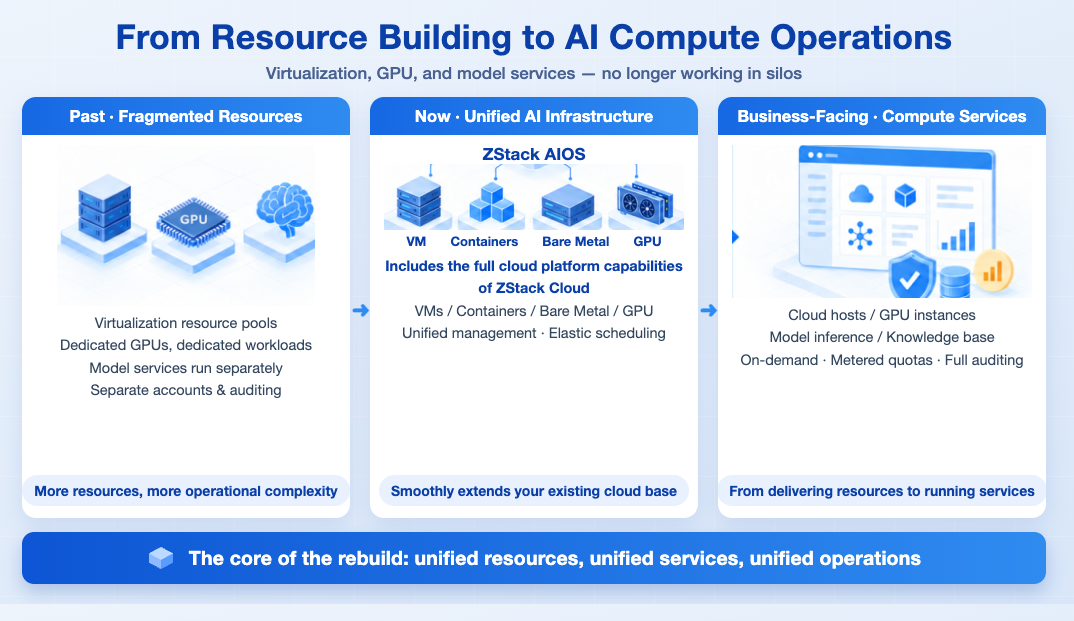
03 / SMOOTH EVOLUTION
Moving from existing cloud to AI infrastructure doesn't require tearing everything down.
For existing virtualization environments, the most important thing is not a one-time cutover, but first making resources visible, management controllable, and migration reversible. ZStack Cloud can take over unified management and smooth migration of virtualization resources, while providing cloud platform capabilities such as multi-tenancy, backup and disaster recovery, and elastic bare metal. Operators can follow business priorities: first migrate development/test and general business, then carry out independent verification and drills for core systems — keeping the cloud foundation upgrade always grounded in business continuity. When AI needs emerge, ZStack AIOS (智塔) extends cloud platform capabilities further into AI infrastructure: at the bottom, it uniformly onboards heterogeneous compute such as GPUs; in the middle, it supports model import, fine-tuning, inference, and evaluation; through a unified gateway, it manages model calls, permissions, and auditing; and upward, it connects knowledge bases, orchestration tools, and business applications. This is not building a separate AI island next to the existing cloud — it is enabling the cloud platform to naturally serve AI workloads. Take over existing virtualization business with ZStack Cloud, then smoothly extend to ZStack AIOS 智塔, gradually turning AI compute into a sustainably operated service.
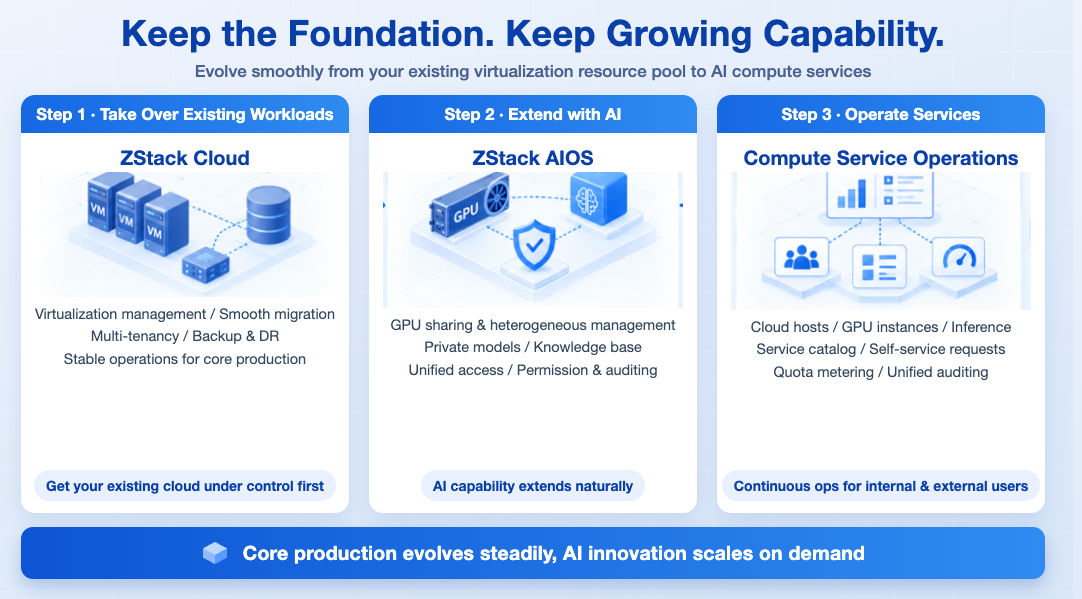
04 / BUSINESS PRIORITY
Replace platform boundaries with business priorities.
When reconstructing the cloud foundation, operators don't need to rush into deciding "which systems must be upgraded immediately." Instead, they can first sort workloads by business priority: core production systems — prioritize stability, disaster recovery, and reversibility; development/test and general business — prioritize validating migration processes and resource operation models; Xinchuang (domestic IT innovation) resources — onboard and expand them uniformly by architecture and business needs; AI scenarios — start with verifiable business such as intelligent customer service, knowledge Q&A, and operations assistants, then gradually connect deeper production data and processes. The value of this path is that it neither turns existing business into a burden for transformation, nor leaves AI innovation stuck in a test environment.
05 / CUSTOMER PRACTICE
From pilot validation to multi-region replication.
One operator enterprise, when building its AI infrastructure, first selected several scenarios for pilot validation. On the basis of keeping existing cloud resources running stably, it built unified compute, model, and operational management capabilities on ZStack AIOS. After the pilot succeeded, the enterprise distilled the experience into a standardized model and gradually extended it to more resource domains. Through a unified platform, unified operations, and a unified service catalog, business teams can obtain compute services more efficiently, while operations teams complete resource scheduling, monitoring, and management in a consistent way. This practice shows that AI infrastructure construction does not have to begin with large-scale transformation. Completing small-scale validation first, then replicating the mature model, allows cloud foundation upgrades and AI innovation to advance in tandem.