
The AI assistant is selected and the business scenarios are thought through, yet the project stalls at the next step: how does an Agent call the enterprise's existing business systems?
The data lives in legacy systems, the processes live in legacy systems, and the business rules refined over many years live in legacy systems too. When enterprises want employees to query business progress, access internal information, or have an Agent help with their work through natural language, they need to bring these existing capabilities into AI applications.
A full rebuild means investing development resources, migrating data, and arranging a business cutover. Piece-by-piece rework, meanwhile, involves vendor cooperation, interface development, and cross-department coordination. In some cases, the original vendor can no longer provide services — the system still runs, but rework struggles to obtain the necessary technical support.
The value of AI applications has yet to be realized, while the cost of system rework is already on the table.
Must a system that has served for ten years leave the stage because of this?For systems that still hold business value and have usable interfaces, enterprises can keep moving forward on their existing foundation.
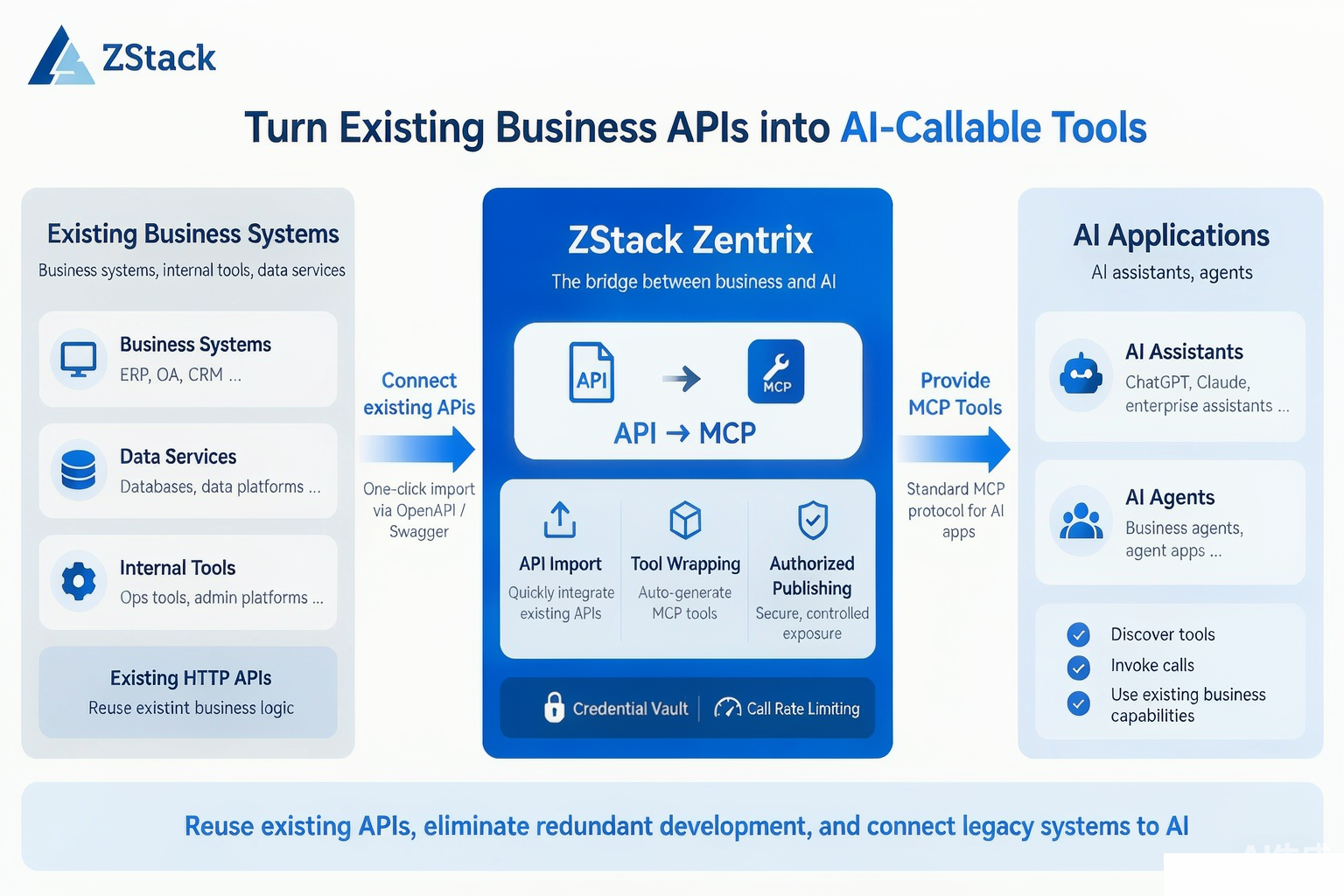
ZStack Zentrix Enterprise AI Gateway converts existing business interfaces into Agent-callable tools through API-to-MCP transformation, combined with unified publishing, authorized distribution, credential hosting, and call control — helping enterprises reduce duplicate integration and bring years of system capabilities into new AI applications.
01 / BUSINESS VALUE
Keep existing business assets, put rework investment into new value
A system that has run for years carries the business capabilities built through long-term enterprise investment. Its stable data structures, proven processing rules, and collaborative relationships with other systems all support daily work. Querying a business record, retrieving a service status, or returning a set of business data may already have mature interfaces behind them. When enterprises build AI applications, these capabilities can keep delivering value.
Take querying business processing progress as an example. For an Agent to give a reliable answer, it needs to access the original system, retrieve the relevant records, and then compose an answer based on the returned information. The data and processing logic already in the system are precisely the foundation that makes this AI application feasible. If, merely to add an AI entry point, one redevelops the same query functions and reconnects the same business data, then existing capabilities are not being fully leveraged. By reusing interfaces, enterprises can devote more energy to scenario design, user experience, and business outcomes, letting AI projects reach real-world use faster.
For systems in good running condition with mature interface conditions, Zentrix offers an incremental build path: the original system keeps processing business, AI applications gain a new access method, and rework is concentrated in the integration and management layer. The system's own security, performance, and business-adaptation issues still require independent assessment. But "connecting to AI" does not necessarily mean a full replacement.
02 / CAPABILITY REUSE
One fewer duplicate integration, one more reused capability
An enterprise's integration needs rarely stop at one system or one Agent. Business departments need to query services, R&D teams need internal tools, and operations staff need business data. Existing services may offer HTTP APIs, some may already support MCP, and their interface descriptions, authentication methods, and maintenance teams all differ. If every new AI application requires re-sorting interfaces, redeveloping adapters, and reconfiguring credentials, then as the number of projects grows, so do the integration and maintenance costs. Interface changes must be adjusted everywhere, permission changes must be handled separately, and the same capability may be rebuilt by multiple teams.
Zentrix places API-to-MCP transformation, tool publishing, and distribution in a unified entry point, letting enterprises build reusable integration methods around business capabilities. Once an interface is integrated and configured, it can serve multiple AI applications within the authorized scope. When adding new Agents later, teams can prioritize using already-integrated capabilities, reducing the work of starting over. The management of interfaces, credentials, and available scope also gains a centralized entry, reducing the coordination burden of scattered maintenance. As the scope of integration expands, what enterprises gradually accumulate are business tools that AI applications can keep using. The investment in existing systems also gains new room to create value.
03 / API TO MCP
API-to-MCP transformation gives legacy systems an Agent-facing entry point
MCP is a standard way for AI applications to connect external tools. Through API-to-MCP transformation, Zentrix encapsulates the business capabilities provided by existing interfaces into tools that MCP-capable clients can recognize and invoke. This path can be summarized as:
Existing business API → Zentrix integration and transformation → publish MCP tool → authorize for AI applications → call the original system and return results.
Import existing interfaces, reuse the original system's business capabilities
Administrators select the interfaces to expose and prepare the corresponding interface descriptions and authentication information. Zentrix supports importing existing HTTP APIs through OpenAPI specifications, parsing interface actions, and completing the necessary tool information, connection, and authentication configuration. The original system continues to process requests and execute existing business logic. Enterprises can leverage the service capabilities they have already built, reducing the work of redeveloping similar functions for AI adaptation. For systems whose original vendors can no longer easily provide services, if the existing interfaces are still usable and conditions such as interface information and access permissions are met, the integration path can also be evaluated from the interface layer, reducing dependence on reworking the original system internals.
Publish as tools, so AI applications can discover and invoke interfaces
After integration, administrators publish the relevant capabilities as tools and configure the available scope. Authorized users obtain connection configuration from the unified entry point, load the tools in an MCP-capable AI client, and can then initiate the corresponding calls.
Using "query business processing progress" as an illustration: an employee makes a request to the AI, the Agent selects the query capability based on the tool's purpose, and passes parameters as required. Zentrix forwards the request to the original system, which returns the business records, and the Agent then composes its answer based on them. Employees gain a more convenient business entry point, the existing system continues handling data queries and business processing, and the enterprise can iterate its AI applications along this chain.
Centralized integration reduces duplicated work for later expansion
Completed, integrated tools can be distributed to different users or workspaces as needed. When a new AI application needs the same business capability, it can be reused within the authorized scope, letting a single integration keep delivering value. Concrete implementation still needs to account for interface quality, completing adaptation around authentication, parameter semantics, pagination, and data permissions. The unified transformation and publishing mechanism reduces duplicated work, letting implementation teams focus on the differences of customer interfaces themselves.
04 / ACCESS GOVERNANCE
Connected, and also stable and manageable in use
When enterprises open business capabilities to Agents, they also need to clarify usage boundaries. Zentrix brings authorization, credentials, and traffic control into the integration chain, so that teams can configure access management for the original system as they advance their AI applications.
Distribute by scope, so business capabilities open with boundaries
Administrators can configure the available scope of a service, allowing authorized users or workspace members to obtain connection configuration and invoke tools. When personnel responsibilities or application scopes change, access can be adjusted or revoked. Gateway admission and backend data-permission configuration work together, helping enterprises open capabilities according to business needs.
Host credentials centrally, reduce scattered key maintenance
Through backend credential hosting, Zentrix uses the corresponding authentication information during proxy calls, so client connection configurations do not need to expose upstream service keys. Enterprises reduce the work of distributing and maintaining backend credentials across multiple clients, and gain a centralized entry for credential management.
Control call frequency, protect the original business operation
Agents may invoke tools continuously during task execution, and may retry repeatedly under abnormal conditions. Zentrix supports rate limiting by dimension such as user, restricting requests when they exceed configured thresholds to help control the call frequency entering upstream systems. Administrators can also view call conditions and locate failed or restricted requests.
These capabilities let enterprises establish access rules and operational protection while opening existing interfaces, preparing for the subsequent expansion of AI applications.
05 / CUSTOMER PRACTICE
Sinolink Securities: existing interfaces connected to AI, business capabilities kept reusable
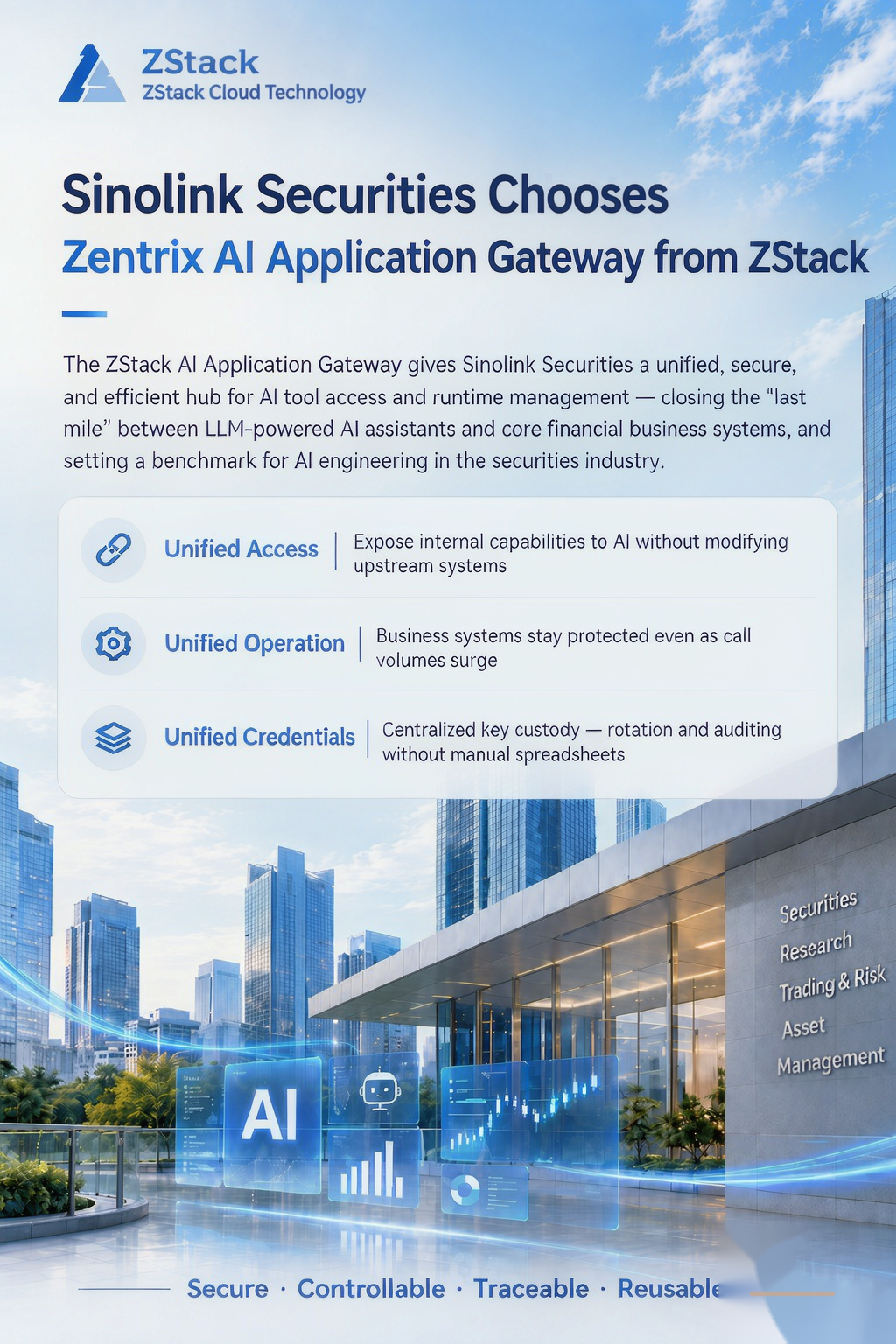
Sinolink Securities faced the challenge of connecting traditional business to AI applications during its AI build-out. The customer wanted to open business services and internal tools scattered across multiple departments to Agents. Faced with the coexistence of existing MCP services and traditional HTTP APIs, the customer needed to preserve the original systems as much as possible, reduce piecemeal rework and repeated integration, while centrally managing access permissions, backend credentials, and call frequency.
Through OpenAPI import and interface action parsing, Zentrix transformed the relevant HTTP APIs into Agent-callable tools, then published and distributed them through the unified entry point. After authorized users obtain connection configuration, they can invoke the integrated query interfaces in an AI client, with the original system processing requests and returning business information.
After integration, the existing interfaces gained a way to serve AI applications while the original business logic continues to be reused. Service scope is centrally adjusted by administrators, backend keys are hosted by the gateway, rate-limiting policies configured per user can restrict requests exceeding thresholds, and call conditions can be viewed in the backend.
The customer thereby opened the call path from existing business interfaces to the AI client, and brought access management into the same framework. When expanding AI applications later, the existing integrated capabilities can continue to serve as a reusable foundation.
Let Your Existing Investments Keep Creating New Value in the AI Era
Enterprises can start with a query scenario that offers stable interfaces, clear permissions, and easily verifiable results — completing the transformation, authorization, and invocation through Zentrix — then gradually expand to more systems that meet the requirements. This path narrows the scope of change needed at the starting stage, allowing enterprises to observe the real-world business impact of AI applications earlier and continue investing as needed.
Existing systems, interfaces, and business rules all have the opportunity to keep participating in building new applications.
Preserve the business assets you've already accumulated, reduce redundant integrations, and let more AI applications tap into your enterprise's own capabilities — this is exactly the new space Zentrix by ZStack opens up for legacy systems.
Is your enterprise stuck at this same step: your AI applications are ready, but your business systems just won't connect?
Contact ZStack team for a consultation on the legacy-system-to-Agent solution and a product demo.
Based on your existing systems and business needs, we'll walk through interface reuse conditions, adaptation scope, and access control requirements; evaluate the path from your existing business systems to Agent; develop an implementation plan that aligns with your current business architecture; and drive the continued reuse of your existing business capabilities in AI applications.