
The financial industry has already accumulated extensive AI application practices in areas such as risk identification, customer service, and investment research. As large models and AI Agents advance deeper into the business, professional data, business tools, and cross-system collaboration are becoming important directions for further expanding AI applications.
The deeper the application, the higher the requirements on foundational capabilities. From localized model deployment and data protection, to authorization, auditing, and operational management of AI invocations, to integrating legacy systems built over many years, financial institutions need to coordinate models, business, and governance so that technological innovation steadily enters production.
As a leading domestic financial institution whose business spans investment research, asset management, and wealth services, it faces similar tests of business connectivity and governance when expanding AI applications in investment research & advisory, employee productivity, and R&D operations: how can its long-accumulated professional systems be invoked by AI Agents, while preserving the original permission boundaries and production management requirements?
01 / Integration Challenges
Client Challenge: Business Moves Forward, Legacy System Integration Hits a Wall
10+ systems and 200+ APIs Integration touches extensive modification. The client's AI integration needs span multiple system categories, including investment research & advisory, employee internal services, and R&D operations. Developing adapters system by system and debugging interfaces one by one demands substantial effort; some systems' original vendors have already ceased maintenance, making new adaptations hard to support. Business capabilities that still serve daily operations now face the challenge of being opened up to AI.
After integration, financial business management requirements must still hold
Which business tools can be used by different departments, personnel, and AI Agents; how backend keys are protected; how permissions are revoked after personnel changes — all need clear management mechanisms. As scenarios multiply, these requirements will continue to apply to every access.
From single queries to continuous invocations, production systems face new access patterns
A single AI task may invoke multiple business tools in sequence. When multiple AI Agents run concurrently, the client needs to constrain access pressure and trace the invocation process when anomalies occur. The larger the integration scale, the more urgent the need to manage permissions, traffic, and records in a unified way.
02 / Shared AI Foundation
Goal: Preserve Professional Accumulation, Open a Path for AI Innovation
Facing the integration bottleneck, the institution aims to establish a cross-department, shared AI integration and governance system: on the basis of continuing existing business logic and data permissions, open up legacy system capabilities so that new applications can build on existing achievements.
Toward this goal, ZStack helps the client use the Zentrix enterprise AI gateway to connect AI Agents with business systems at the API layer, bringing capability exposure, access authorization, and operational management into a unified entry point. Professional systems continue to handle business; departments expand AI applications around their own needs; shared integration and governance capabilities are centrally maintained by the IT team.
The fit between ZStack's solution and this project lies in placing the continuity of legacy systems, the flexibility of multi-department applications, and the consistency of enterprise management into a single architecture. When connection and management share a common foundation, business innovation gains the conditions to advance continuously.
03 / Business Integration
Solution: From Connecting APIs to Supporting Business Production
One-click MCP conversion opens a new entry for legacy systems.
To break through the integration bottleneck, the first step is turning existing APIs into business tools that AI Agents can invoke.
Through Zentrix, administrators import OpenAPI interface descriptions; the platform parses the interface actions and converts existing HTTP APIs into MCP business tools with one click. After configuring authentication and open scope, they can be published uniformly. Existing MCP services can also be directly integrated and managed under the same entry.
For systems whose original vendors have ceased maintenance but still expose usable interfaces, this path offers a new integration opportunity. When interface descriptions, authentication, and access permissions are in place, the client can reuse original business capabilities at the interface layer, reducing dependence on additional development from the original vendor.
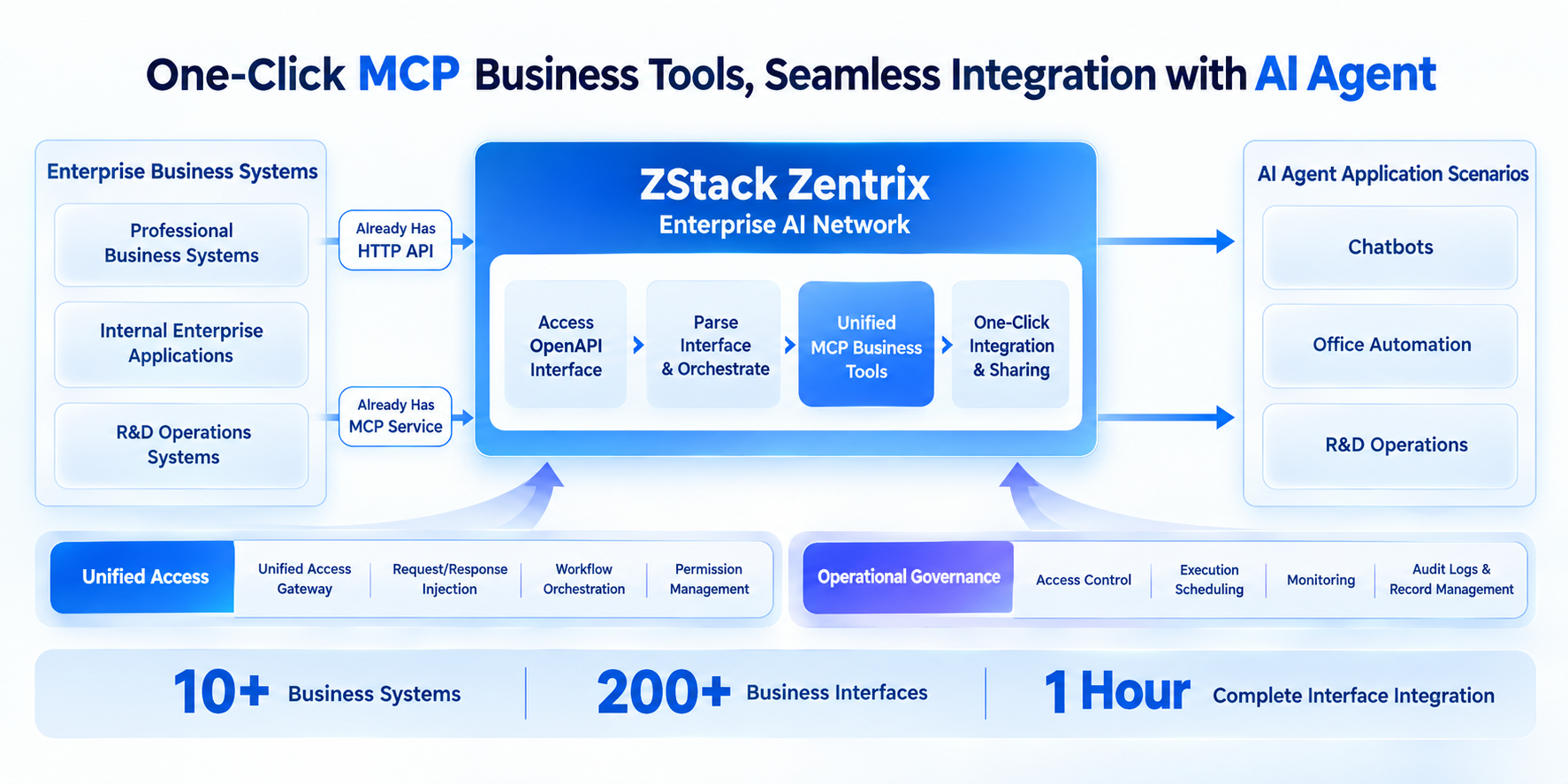
In actual delivery, once interface description files were ready, Zentrix's batch import and one-click MCP conversion completed the full conversion of 10+ business systems and 200+ APIs within 1 hour.
Interfaces previously scattered across systems began to be exposed to AI Agents as unified tools.
Into three scenarios, bringing professional capabilities into AI workflows.
After conversion, the results serve concrete business.
In the investment research & advisory scenario, AI Agents invoke professional interfaces and multiple authorized data services as needed by the task, retrieving data and organizing analysis results. Professional systems continue to provide data and business processing capabilities, and AI Agents connect these capabilities into user tasks.
In the employee productivity scenario, employees use AI Agents in WorkBuddy to access approved internal business tools. Backend service credentials are centrally managed by the gateway, so the AI Agent side does not need to store raw keys.
In the R&D operations scenario, the query capabilities of business tools such as GitLab, Jira, DevOps, and Confluence are provided to AI Agents after authorization. All tools share a common service entry, and integrated capabilities can be distributed according to open scope.
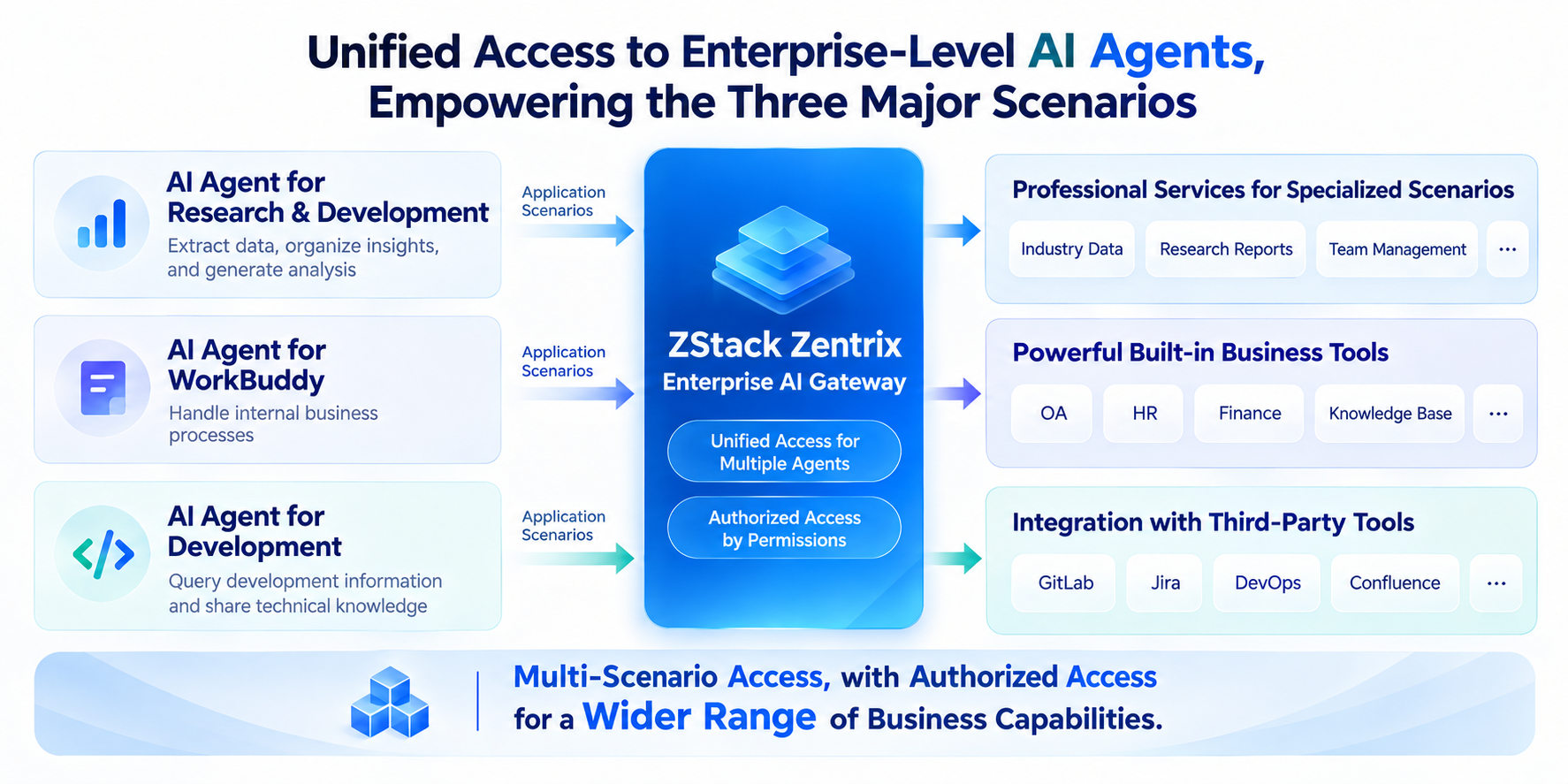
These three scenarios serve different business needs, yet all must answer the same question: is every invocation within the approved scope of use?
Embedding governance into the invocation chain, keeping applications running.
To accommodate multi-department use, ZStack helps the client implement authorization and operational policies in Zentrix's access chain.
At the invocation admission stage, the gateway manages open scope by personnel, department, or workspace, verifies access eligibility before requests enter backend systems, and aligns with the backend's original data permissions. Once authorization is revoked and the update takes effect, old connection configurations cannot bypass the gateway to keep accessing controlled services.
At the operational stage, rate limiting, concurrency control, and circuit breaking jointly constrain the pressure from automated invocations. Invocation records and management auditing provide a basis for anomaly troubleshooting, helping the IT team determine whether issues stem from access permissions, traffic policies, or backend services.
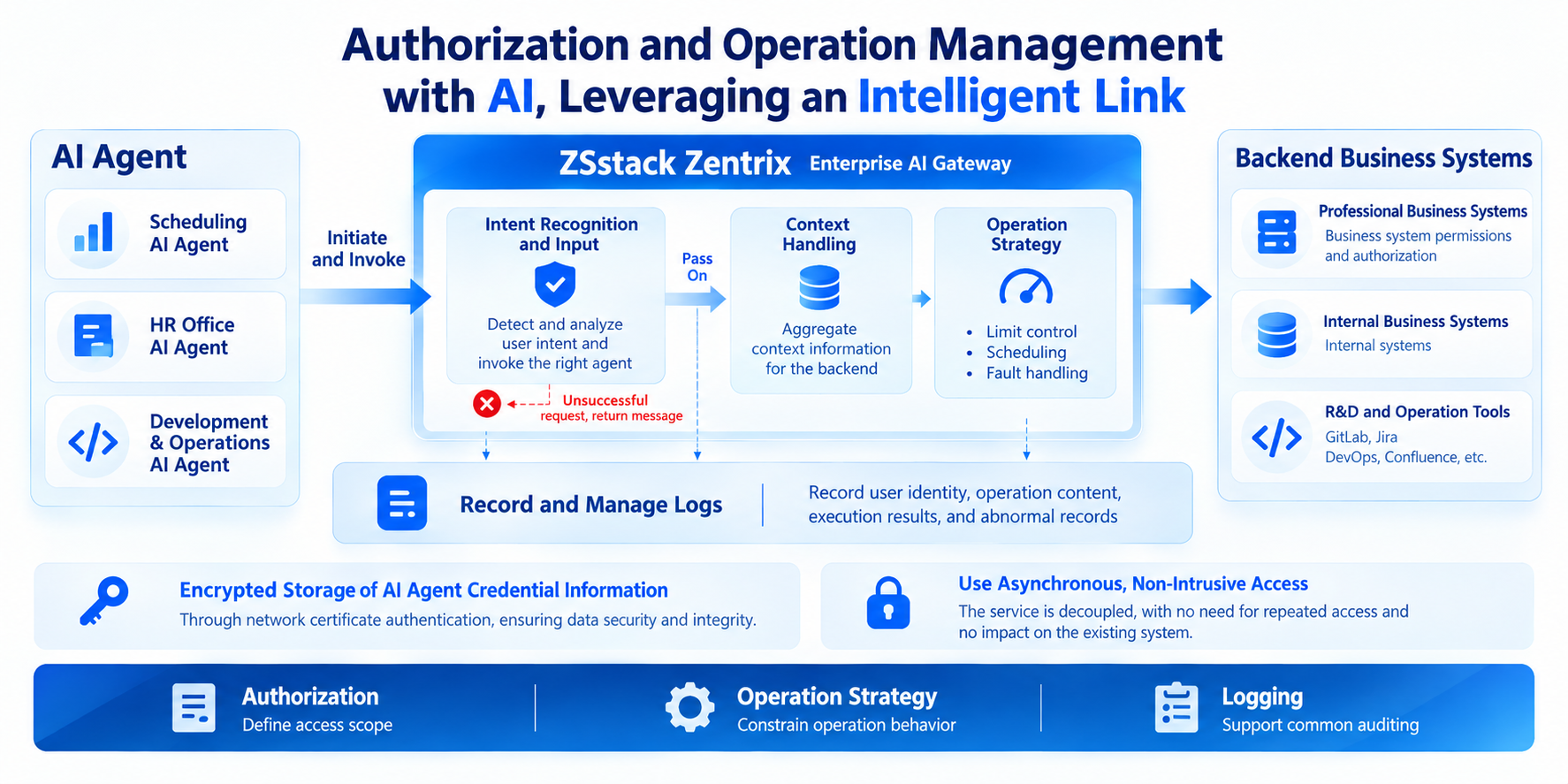
From tool publishing to actual use, to permission adjustments and exception handling, integrated business capabilities now have a continuous management mechanism, supporting the three scenarios in entering production.
04 / Lasting Business Value
Client Value: Let the Next Innovation Start from Existing Achievements
Legacy systems gain new service space, and existing investment continues to deliver value.
Through interface conversion, systems meeting integration conditions can continue serving AI applications. The client reduces the work of writing adaptation code interface by interface, and finds a reuse path for systems lacking original-vendor maintenance support, carrying professional data and business logic forward into new applications.
Business expansion gains common rules, and multi-department applications can advance in coordination.
Different scenarios share authorization, credential, and operational management mechanisms. As applications expand, the IT team can manage based on unified invocation and audit records, reducing repeated cross-system verification, so that capability opening and production governance are implemented in sync.
Future development gains a reusable starting point, and innovation results can accumulate continuously.
When new AI application needs arise, already-opened business tools, the existing authorization system, and established operational rules can all become the project's foundation. Each business capability integrated adds a callable resource for subsequent applications; each scenario expanded can continue using the governance mechanisms already built.
From the conversion of 200+ APIs to production applications in investment research & advisory, employee productivity, and R&D operations, ZStack helps the client connect professional accumulation to AI innovation. Through the shared foundation established by Zentrix, the results of this integration can continue to support the next business expansion.
Is your AI Agent also stuck at the business system integration step?
Contact ZStack to learn about Zentrix's one-click MCP conversion and unified governance solution — and let your next AI application start from existing business capabilities.