
When an enterprise connects to its first large language model, a single endpoint and one API key are usually all it takes. At this stage, the main concern is whether the model works and whether the API can be reached.
But when AI moves from isolated experiments into production, enterprises realize they are managing four types of AI capabilities: models used by different teams, Agents responsible for planning and execution, MCP tools connecting to enterprise systems, and Skills installed on Agents.
The once-simple pattern of "application to model" expands into two simultaneously running chains:
· Business Application → Large Language Model
· User → Agent (loading Skills) → MCP → Tool → Enterprise System
The real risk of a longer usage chain is that the enterprise’s original control mechanisms begin to fail.
More models, unstable scheduling. More models are being connected, but scheduling is unstable.
Model pricing and availability keep changing, and different businesses have different requirements for quality, latency, and cost. If every application handles model selection, failover, and key configuration on its own, business systems become deeply tied to specific vendors and integration methods.
Agents, MCP and Skills scattered beyond control. Agents, MCP, and Skills are becoming more scattered, but capabilities and permissions cannot be controlled.
Enterprises struggle to accurately know which Agents and MCP Servers are connected, which tools are exposed, which Skills are installed on different Agents, what versions they are, and who maintains and uses them. Underlying system credentials may also remain scattered across personal environments and project configurations.
Security, cost and records separated. Security, cost, and operational records are separated from one another, making risks hard to calculate and trace.
Who is the real user? Has sensitive data left the enterprise boundary? Which department do the tokens and costs belong to? After an anomaly, can the full call process—identity, model, Skill, and tool—be reconstructed? These questions often require crossing multiple systems to answer.
The richer AI capabilities become, the less the enterprise can uniformly schedule and control them.
What enterprises truly lack of is not another model interface, but a unified management platform covering models, Agents, MCP, and Skills.
ZStack Zentrix AI Gateway—Bringing Scattered Control Points Back into Enterprise
Zentrix AI Gateway is a new-generation AI traffic and security governance product designed for the large-scale enterprise deployment of AI. It is not only a generic API gateway that forwards model requests, nor a proxy layer connecting multiple large models. Its core purpose is to converge model calls, Agent access, and MCP tool usage—scattered across different teams, applications, and tools—into a manageable, controllable, and auditable unified platform.
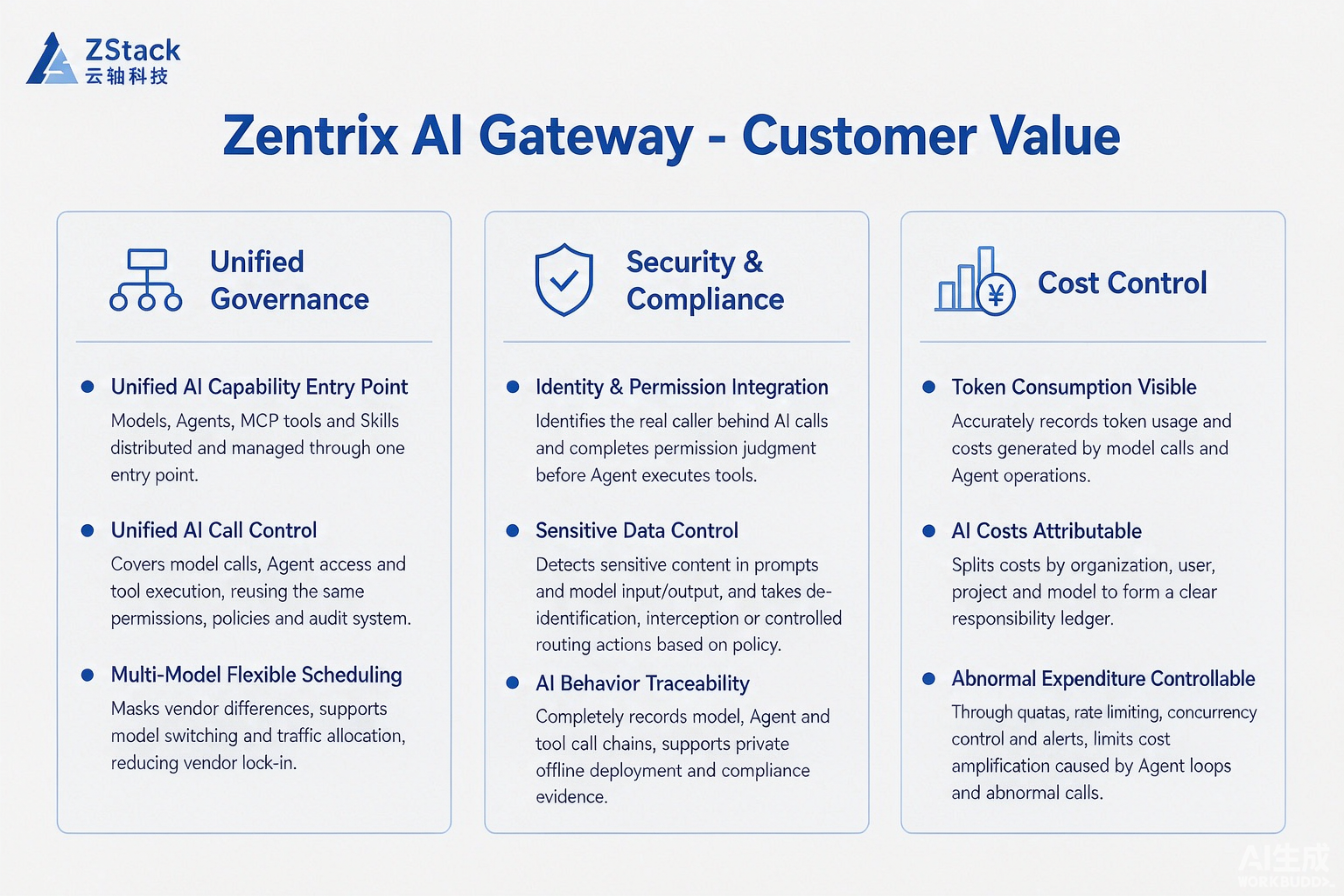
Three major capability: Zentrix delivers three major customer values
AI Model Gateway,
Agent & MCP Gateway,
Security, Compliance & Operations.
· Model side: On the model side, it unifies vendor access, protocols, routing, failover, and key management.
· Agent & tool side: On the Agent and tool side, it uniformly registers and connects A2A Agents, MCP Servers, and enterprise tools, and catalogues and versions applications, Skills, and prompts.
· Governance & Operations side: On the governance and operations side, it links capability distribution, authentication and authorization, content and data security, quota metering, cost attribution, operational observability, and auditing to the same call chain.
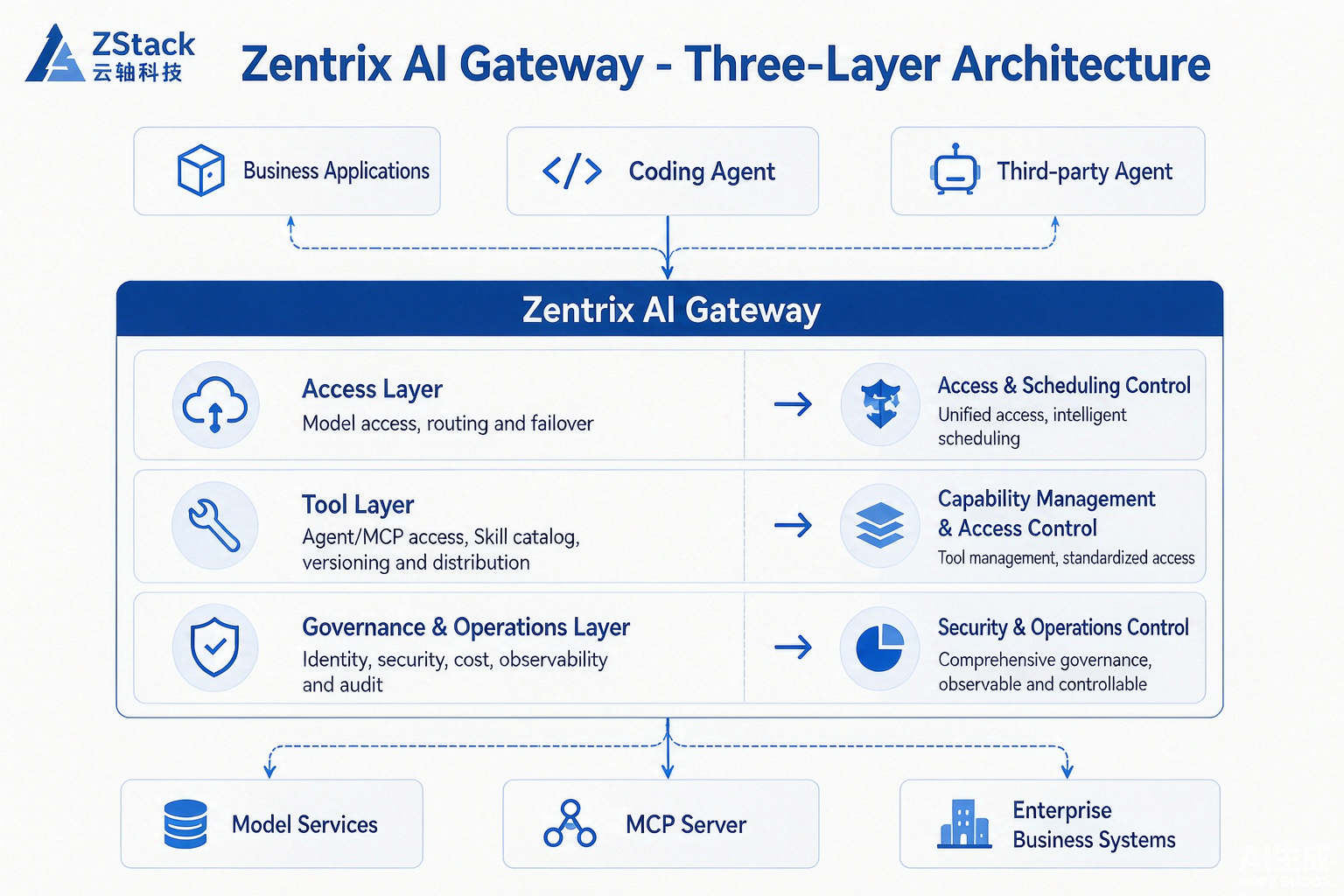
These three layers are not three independent sets of features. Together, they answer the full lifecycle of an AI call: from entering the enterprise’s control scope, to acquiring model, Skill, or tool capabilities, to completing security judgments, cost recording, and audit trails.
1.Before: Determine which capabilities can be published and to whom they are distributed;
2.During: Determine how each invocation is routed, whether it is allowed to proceed, and how many resources it may consume;
3.After: Reconstruct who invoked what, which policies were triggered, and how much usage and cost were incurred.
1. Access Layer: Keeping Model Changes from Repeatedly Impacting Business Systems
When enterprises use multiple models, what really needs managing is not a vendor list, but a set of production resources that continuously change.
Model prices adjust, availability fluctuates, different tasks have different quality and latency requirements, and vendors may throttle or experience short-term failures. If every application handles these differences itself, model management capabilities get rebuilt repeatedly in different business codebases.
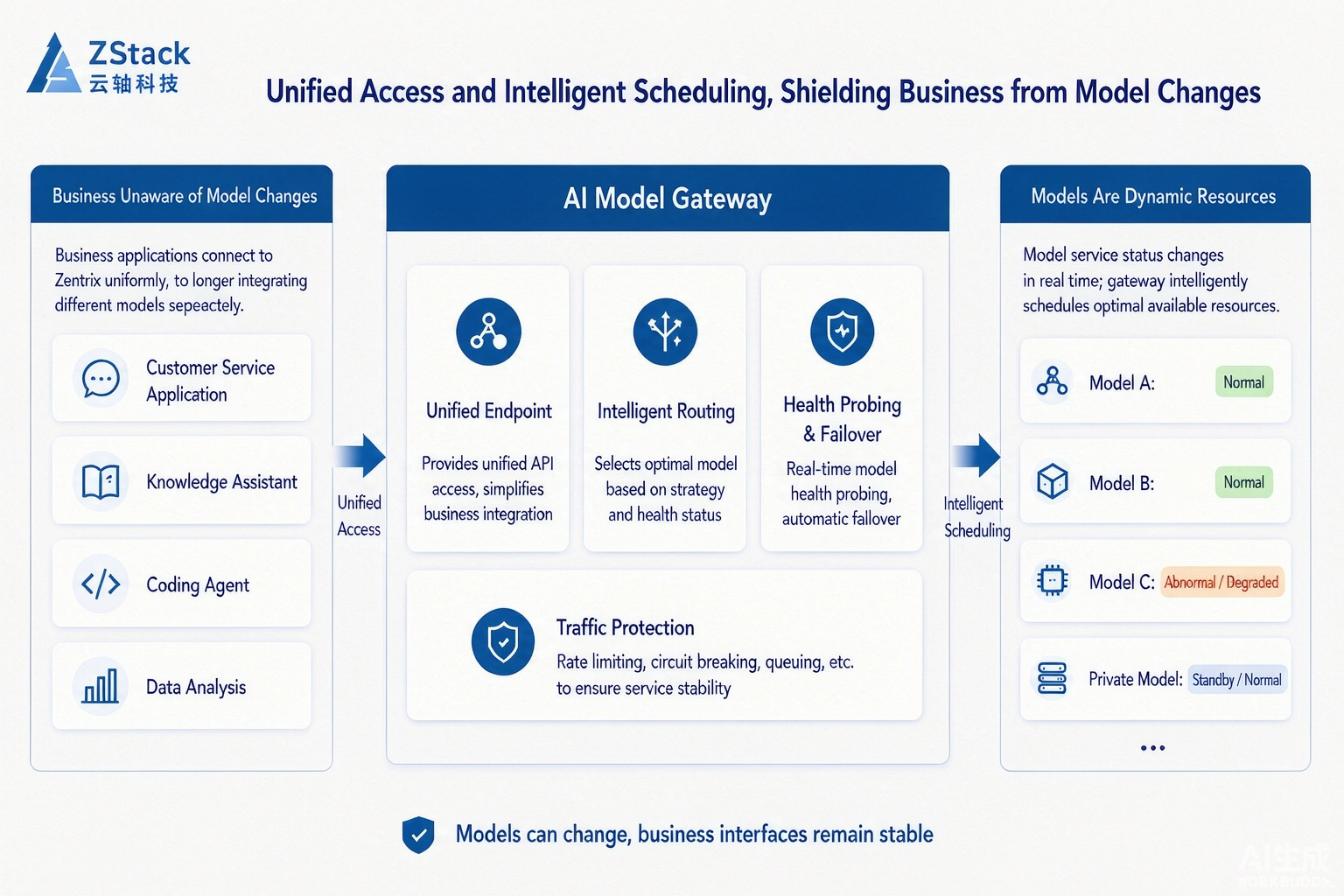
Zentrix’s AI Model Gateway provides a unified OpenAI-compatible endpoint externally, while internally absorbing protocol differences among upstream providers. For applications compatible with this interface, usually only the access address and credential configuration need to be adjusted to use the model services already governed by the enterprise through the same entry point.
A unified endpoint is only the first step. Around the ongoing operation of models in production, Zentrix further brings together several mechanisms:
· A model and vendor catalogue for unified maintenance of connected models, status, and availability scope.
· Routing rules for selecting upstream channels based on business priority, price, availability, or weight.
· Health probing, runtime degradation, and backup strategies to reduce direct business impact when upstream anomalies occur.
· Model enablement, disablement, and configuration distribution so access strategy adjustments no longer depend on every business releasing a new version.
· Request validation, traffic shaping, concurrency control, overload protection, and service degradation to preserve operational boundaries during traffic spikes.
Combined these capabilities,allow upper-layer business interfaces to remain stable even when models change frequently.
Keys no longer need to be scattered across clients along with model configurations. Upstream API keys are centrally hosted by Zentrix and automatically injected when forwarding requests. Callers use manageable, revocable access credentials without directly touching the real upstream keys. Thus, key rotation, revocation, and permission changes can be executed at a unified entry point, rather than waiting for each project to modify itself.
Models and vendors can keep changing, but business systems do not have to be repeatedly rebuilt because of it.
2. Tool Layer: Turning Agents, MCP, and Skills from Personal Configurations into Enterprise Capabilities
Models solve "how to understand and generate." Agents are responsible for planning and execution. MCP tools connect to external systems. Skills hand a set of reusable methods, processes, or professional knowledge to Agents.
When Coding Agents, self-developed Agents, and third-party Agents begin to enter the enterprise, new questions quickly arise: Which Agents and MCP Servers has the company actually connected? What tools do they expose? Which Skills are installed on different Agents, and what versions? Who maintains them? Which departments and users can use them? Where are the credentials stored?
If these capabilities continue to exist as personal configuration files, scripts, project interfaces, and file copies, enterprises can hardly form stable inventory, distribution, version control, and revocation mechanisms.
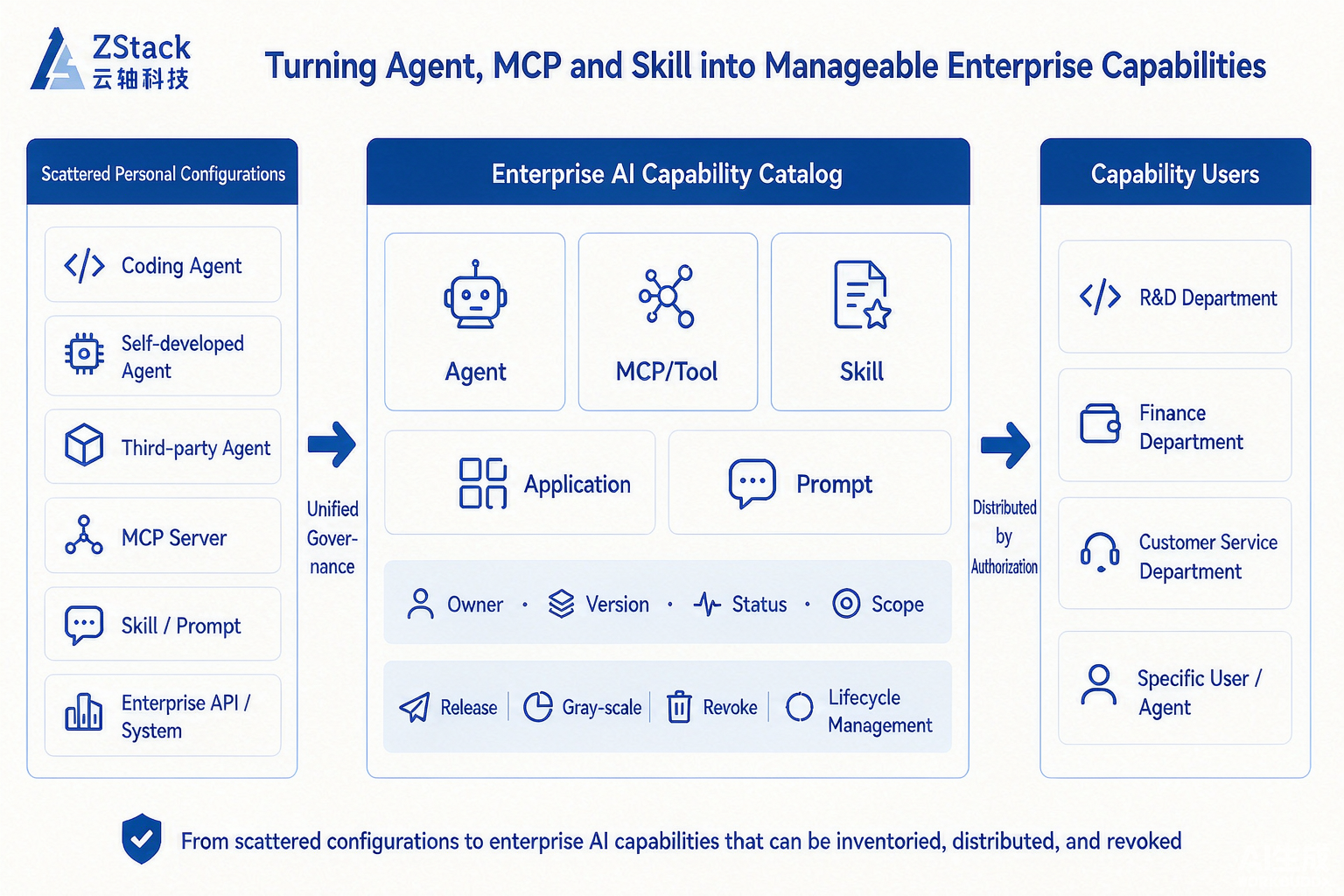
Zentrix’s Agent & MCP Gateway brings MCP Servers, A2A external Agents, Skills, applications, and prompts into a unified catalogue, forming queryable, configurable, distributable capability assets with version records. For existing business systems with HTTP or gRPC interfaces, they can be imported and wrapped based on OpenAPI, Protobuf, or cURL descriptions, allowing legacy systems to be used by Agents as standard MCP tools without being rebuilt from scratch.
After capabilities enter the catalogue, they still need to be correctly assigned. Zentrix can distribute Agent, Skill, and tool capabilities by department, functional group, and user, and supports release, gray-scale rollout, and revocation.
This enables enterprises to gradually transform scattered Agent, MCP, and Skill configurations into enterprise AI capabilities with owners, versions, usage scopes, and lifecycle records.
More critically, Zentrix not only registers these tools, but also sits in the call path. Before a tool call is actually executed, the gateway can make admission judgments based on caller identity, authorization scope, and tool status. When tool definitions change, re-review can also be triggered.
Agents, MCP, and Skills are no longer scattered in personal configurations, but become enterprise capabilities that can be inventoried, distributed, revoked, and held accountable.
3. Governance & Operations Layer: Bringing Security, Cost, and Operational Status into the Same Call Chain
Unified access to models and tools does not mean governance is complete.
After a call enters Zentrix, three questions are still answered: Is it allowed? Is it safe? Can the enterprise afford it?
Access control. Zentrix can perform authentication and authorization based on access credentials, organizational relationships, and model or capability scope. Requests that do not meet conditions are rejected at the gateway entry, rather than reaching upstream systems first and relying on post-hoc logs to discover problems.
Content and data security. Zentrix provides content security and PII detection for model inputs and outputs. Related detection can run locally within the enterprise, and based on policies, take actions such as allow, audit, de-identify, or block on matched content. In scenarios where Agents call web resources or internal tools, WAF and SSRF protection continue to constrain dangerous requests and outbound access that should not occur.
Cost control. Zentrix attributes tokens and costs to the corresponding organization, user, and model, and limits available quotas through quota management. The gateway uses a lease pre-deduction mechanism: reserve quota before the call begins, then settle or roll back based on actual usage after it ends, reducing the risk of concurrent requests causing budget overruns.
Operational observability. Administrators no longer only see a total bill from the model vendor. Zentrix AI Gateway can observe call volume, success rate, token consumption, response time, time to first token, throttling, errors, and traffic trends from a unified entry point, and drill down to specific call details. Related metrics and alerts can also be integrated into existing enterprise notification and operations processes.
The significance of placing security, cost, and observability on the same call chain is:
AI usage security, cost, and operational status are no longer three separate post-hoc results, but a complete process that can be judged, controlled, and traced on the same call chain.
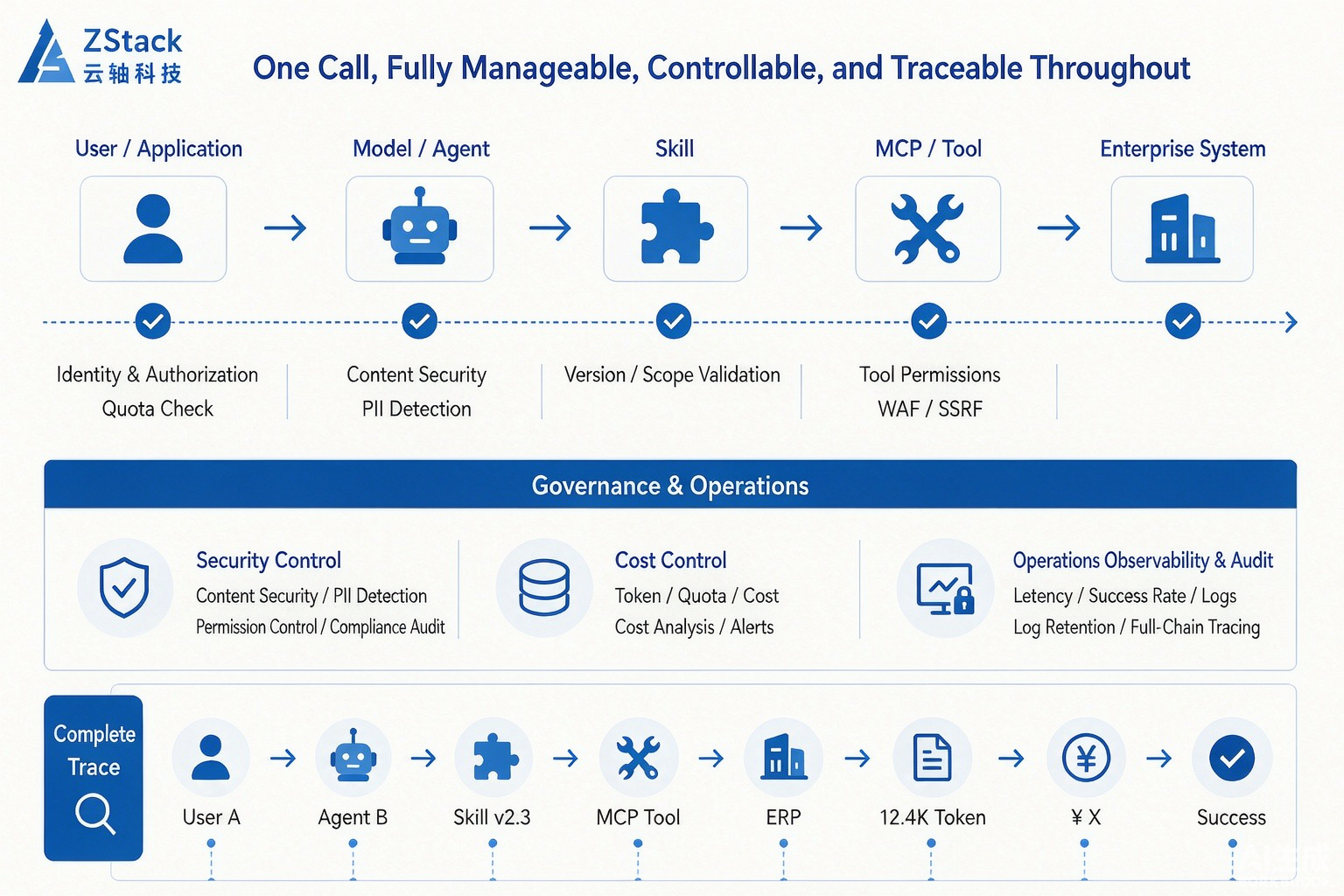
Zentrix: Letting Enterprises Regain Control of AI Usage
Building an AI gateway is not about adding yet another forwarding node to the existing architecture.
The real value lies in converging the control points originally scattered across business applications, developer configurations, model vendors, and Agent toolchains to where AI model invocation actually happen.
Ultimately, it lets enterprises regain three key types of control:
Access & Scheduling Control. Model revoke, Agent access, and tool usage move from scattered connections to unified management. Enterprises can adjust models, vendors, and routing strategies based on business needs without being tied to a single upstream.
Capability Access & Security Control. Enterprises can know which Agents, Skills, and tools are being used and distributed to whom, and complete identity, authorization, and security judgments before calls occur. The call chain can grow longer, but the chain of responsibility should not break.
Usage & Cost Control. Costs are not only visible, but can be attributed to organizations and users. Quotas and budget caps can also participate in actual call decisions, rather than just being summarized after costs have occurred.
What kind Enterprises Need Zentrix?
Not every team have large models usage need to immediately build a complete enterprise AI gateway.
When an enterprise is still in the single-team, single-model, low-risk experimentation stage, simple access may be enough. But the value of a unified entry point rises quickly when the following situations appear:
· Multiple teams are connecting to different models or vendors separately.
· Production applications require model disaster recovery, traffic protection, and stable observability.
· Employees are already using Coding Agents, self-developed Agents, or third-party Agents, and have begun installing or sharing Skills.
· MCP and internal tools have begun accessing enterprise data and business systems.
· The enterprise needs to attribute AI costs to departments, set budget warnings, and impose hard limits.
· The business requires private deployment, air-gapped environments, or localized deployment.
· Security and compliance teams need to control, audit, and provide evidence for calls.
A unified entry point is not the endpoint of enterprise AI governance, but the starting point that makes governance truly executable.
What's Next
This series will continue along three main threads: AI Operations Governance, AI Cost Control, and AI Security Control.
Governance article: We will further break down how models, Agents, MCP, and Skills can be uniformly inventoried, distributed, and scheduled, and how operational status can be continuously observed, turning AI from a one-time integration into a production resource that can be operated long-term.
Cost article: We will explain how tokens and costs are attributed to organizations, users, applications, models, and specific calls, and how budgets enter the request admission process through quota lease pre-deduction, moving cost from a vendor total ledger to an attributable, constraining operational process.
Security article: We will further explain how identity penetrates, how permissions are adjudicated, how tool drift is re-reviewed, how content and PII are detected locally, and how dangerous calls are blocked before execution to form a complete audit evidence chain.