
Recently, a technical leader at a gaming company revealed during a public speech that their team once deployed dozens of Agents to work collaboratively on a single project, generating approximately 2 million RMB in Token costs overnight. This figure far exceeded conventional AI consumption expectations. Many industry observers speculated that the underlying causes likely included Agent circular calls, anomalous retries, or the absence of quota thresholds — allowing costs to surge unchecked and unnoticed.
AI cost control is becoming an essential capability that AI-native enterprises must have.
Of course, controlling AI costs should not come at the expense of business efficiency and effectiveness. What truly needs to be managed are the calls generated by human actions or Agent anomalies that do not yield corresponding business results — stopping them before costs spiral out of control.
While this scenario is extreme, the underlying cost risk is far from an isolated case. As models and AI applications move from pilot to production, costs do not simply scale linearly with business volume; they can be driven upward by multiple factors simultaneously:
Scale Growt | As departments, users, and applications increase, call volumes rise accordingly. |
Agent Amplified Consumption | A single task triggers multiple rounds of calls, behind which lies a continuously billed call chain. |
Higher Per-Call Costs | Model switching, longer context windows, or expanded Tool definitions can all increase the cost of a single call. |
Accumulation of Ineffective Calls | Timeouts, failures, and repeated retries do not add to business outcomes, yet they continue to incur costs. |
When these factors intertwine, what enterprises typically see is a perpetually growing supplier-level aggregate bill: Which department, user, or application are the costs coming from? Is the increase driven by normal business growth, or by model changes and anomalous calls? When the budget is nearing its limit, why are new requests still being processed?
To answer these questions, AI cost management must move beyond month-end reconciliation and enter the process of every single call as it occurs.
The true hallmark of controllable AI costs is not using fewer Tokens, but rather ensuring that every expense has an attribution, every call has a budget boundary, and every anomalous consumption can be promptly detected.
Zentrix places cost control at the point where AI calls actually occur — seeing where money is spent through multi-dimensional metering, setting cost boundaries through pre-call budget enforcement, and tracing anomalous sources through cost observability. This allows valuable AI applications to operate freely while ineffective consumption is promptly halted.
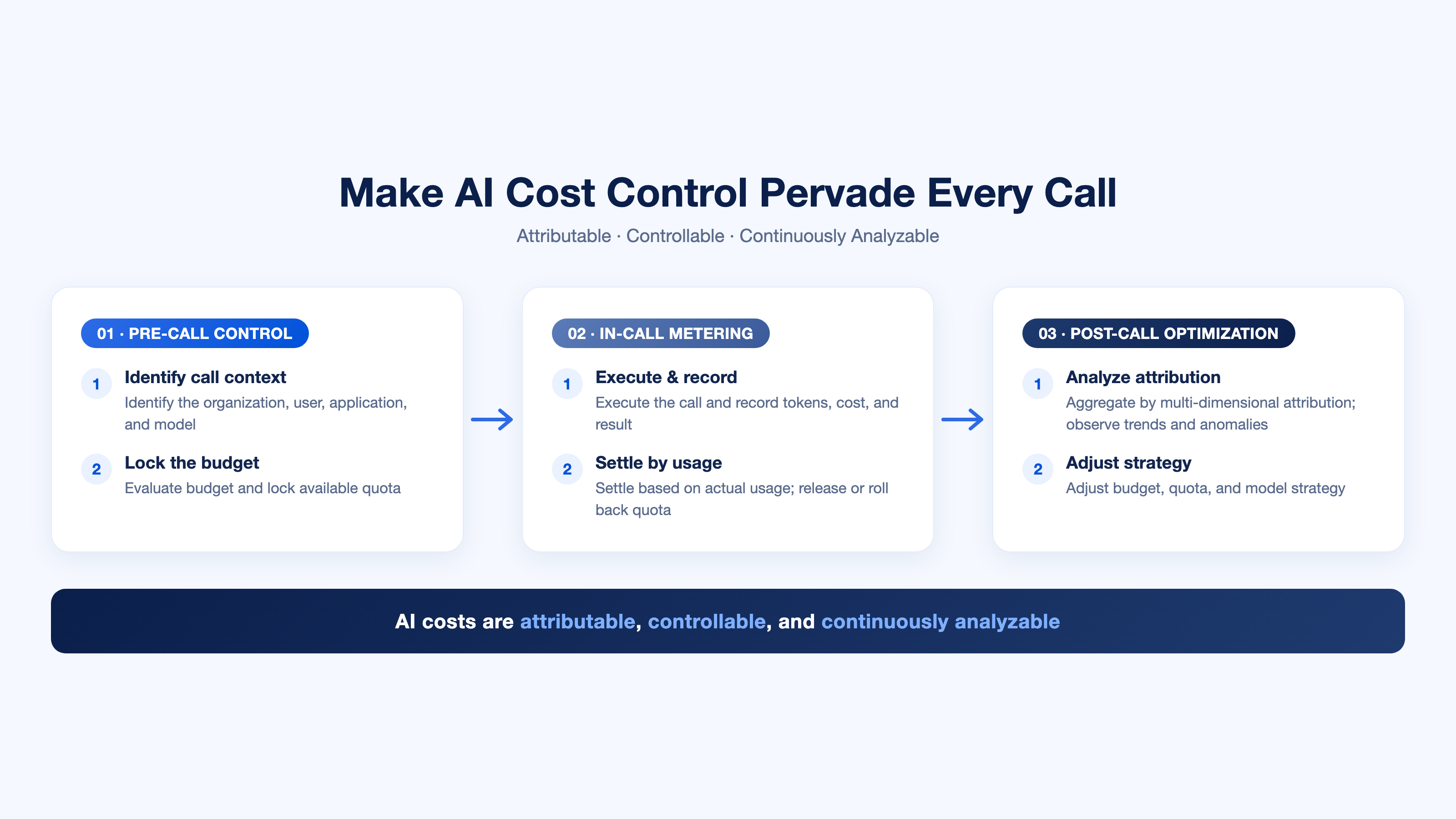
Built on a unified call gateway, it connects caller identification, usage metering, budget assessment, quota reservation, and actual settlement into a single cost control chain.
01 / COST ATTRIBUTION
Step One: Give Every Token an Attribution — Breaking Down AI Bills to Each Call
Suppliers can typically provide model usage and total costs, but internal cost management also needs to know: who generated these consumptions, which business they came from, what models were used, and ultimately which specific call they fall on.
Zentrix's multi-dimensional metering capability first establishes attribution for every call that passes through the unified gateway. Based on call credentials and request context, the gateway records and aggregates usage along the following dimensions.
Organization & Department Dimension | View call volumes, Token consumption, and costs generated by different organizational units, providing a basis for departmental accounting and budget allocation. |
User & Application Dimension | Identify which user or application initiated the consumption, further attributing costs to specific users and business entry points. |
Model Dimension | Record the actual models called along with their Token usage and costs, enabling comparison of cost performance across different models. |
Per-Call Dimension | Retain the Token consumption, cost, and execution result of specific requests, allowing aggregated costs to be further drilled down to call-level details. |
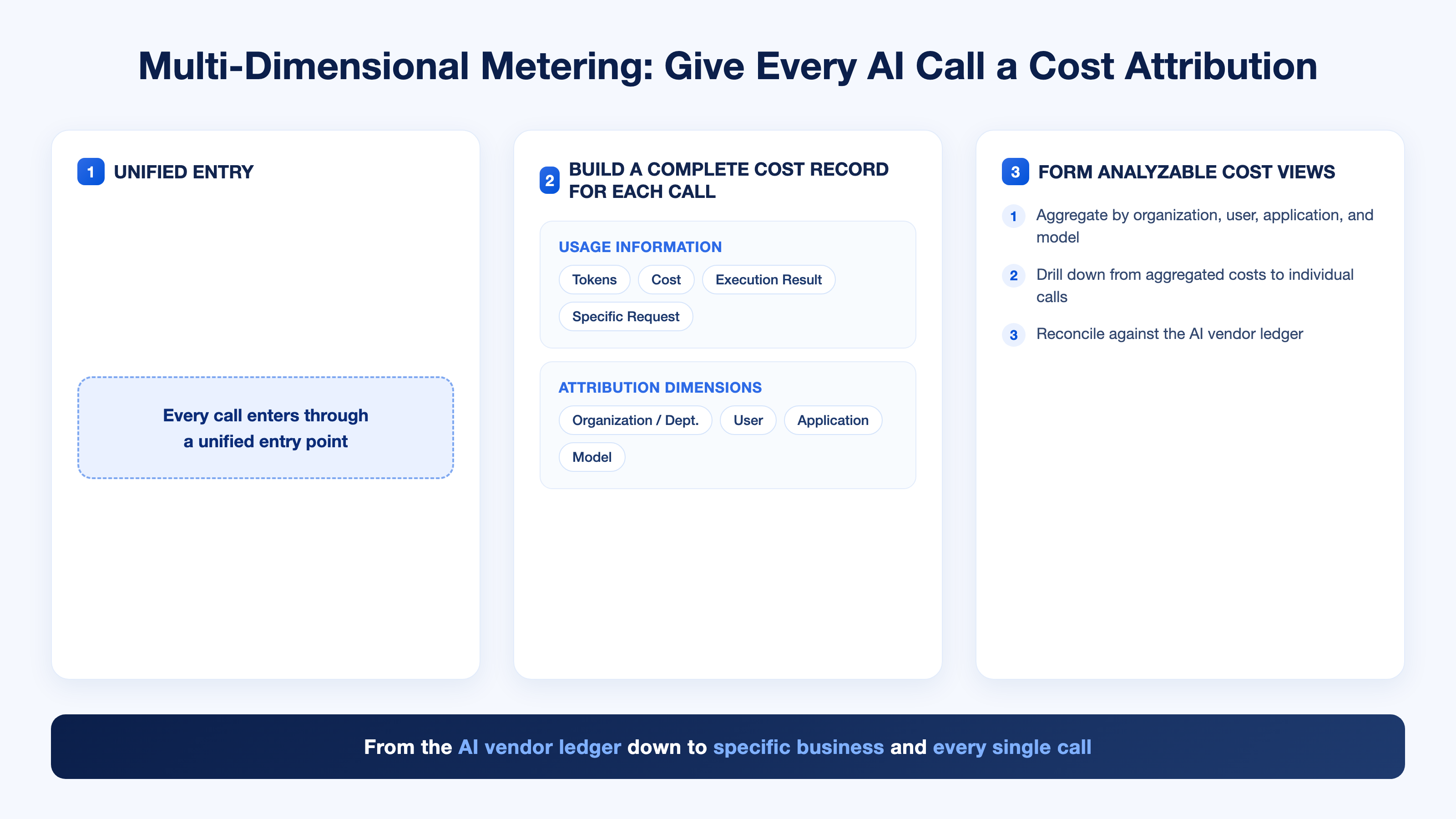
Once these attribution dimensions are combined with usage data, the supplier's aggregate bill can be further broken down. Drilling down layer by layer from the total cost: first identify which department or application the cost increment is concentrated in, then compare the models used, Token consumption, and call results, and finally pinpoint the specific request.
From "how much did the enterprise spend in total" to "who spent how much for which business", Zentrix transforms AI costs from a supplier-level aggregate bill into an internal account that enterprises can truly manage.
02 / BUDGET ENFORCEMENT
Step Two: Make Budgets Truly Enforceable — Reserve Quota First, Then Execute Model Calls
Even if an enterprise sets budgets, deducting quota only after model calls are completed can still lead to overspending. When multiple requests arrive simultaneously, they may read the same remaining quota and all pass validation. By the time calls are completed and settled, the costs have already been incurred, and the budget may have been breached.
Zentrix addresses this through quota lease pre-deduction, moving quota assessment ahead of model execution:
Pre-Call Reservation | Upon receiving a request, the system first identifies the associated organization, user, application, and model, then locks the available quota for this request, preventing it from being double-consumed by other concurrent requests. |
Interception on Insufficient Quota | Requests that fail to obtain a valid quota lease are no longer allowed to access upstream models. |
Post-Call Settlement Based on Actual Usage | After the request is completed, settlement is performed based on actual Token usage and costs, releasing any unused quota. If the call fails, a rollback is executed according to predefined rules. |
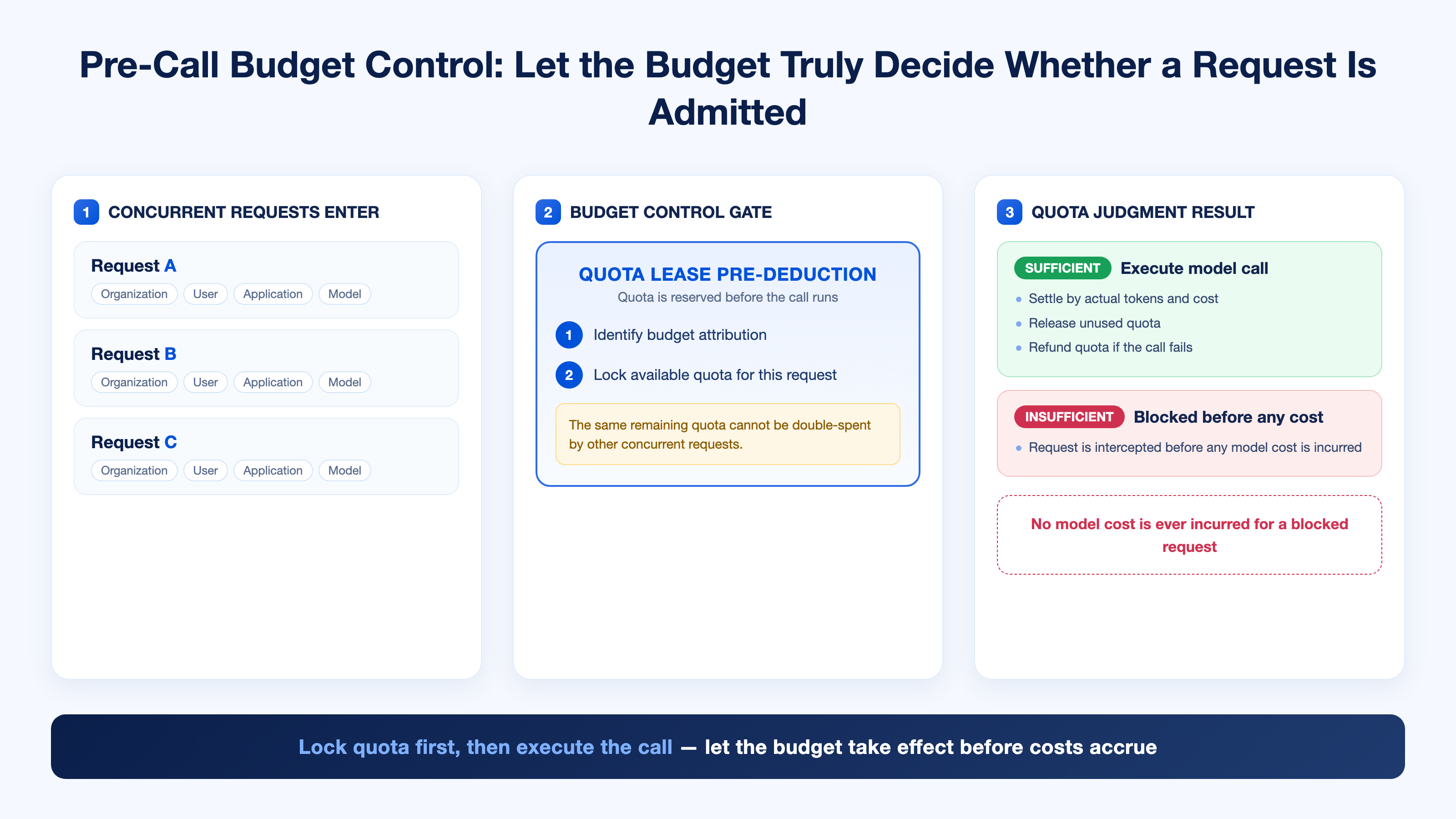
This pre-call quota locking mechanism reduces the risk of multiple concurrent requests reusing the same quota, ultimately causing budget overspending. The budget is no longer merely a statistical value in after-the-fact reports; it directly participates in the decision of whether each request is allowed to proceed.
Quota lease pre-deduction brings budgets into the request approval process, establishing enforceable cost boundaries for shared model resources.
03 / COST OBSERVABILITY
Step Three: Expose Anomalous Costs Promptly — Tracing from Cost Fluctuations to Call Behavior
Budget control addresses "whether the next call can continue," while sustained operations must also answer "why costs have changed."
Zentrix can observe Token usage, costs, call volumes, and budget utilization trends from the unified gateway, and view rankings and details by organization, user, application, and model. When overall costs fluctuate, the platform team can first identify which objects the changes are concentrated in, then drill down to specific requests to analyze context length, models called, execution results, and retry patterns.
The purpose of cost observability is not merely to detect "spending too much," but also to help platform teams take corresponding actions based on different cost changes:
Per-Call Cost Increase | Compare the models called, Token consumption, and output effectiveness to determine whether the increase is caused by model switching or context length growth, then evaluate whether the model strategy needs adjustment. |
Call Volume Growth Without Corresponding Business Results | Drill down to request details, check whether Agents have timeouts or anomalous retries, and prioritize fixing the call chain. |
Highly Repetitive Request Content | In scenarios where timeliness and result consistency requirements permit, evaluate whether semantic caching can be used to reduce repetitive model calls. |
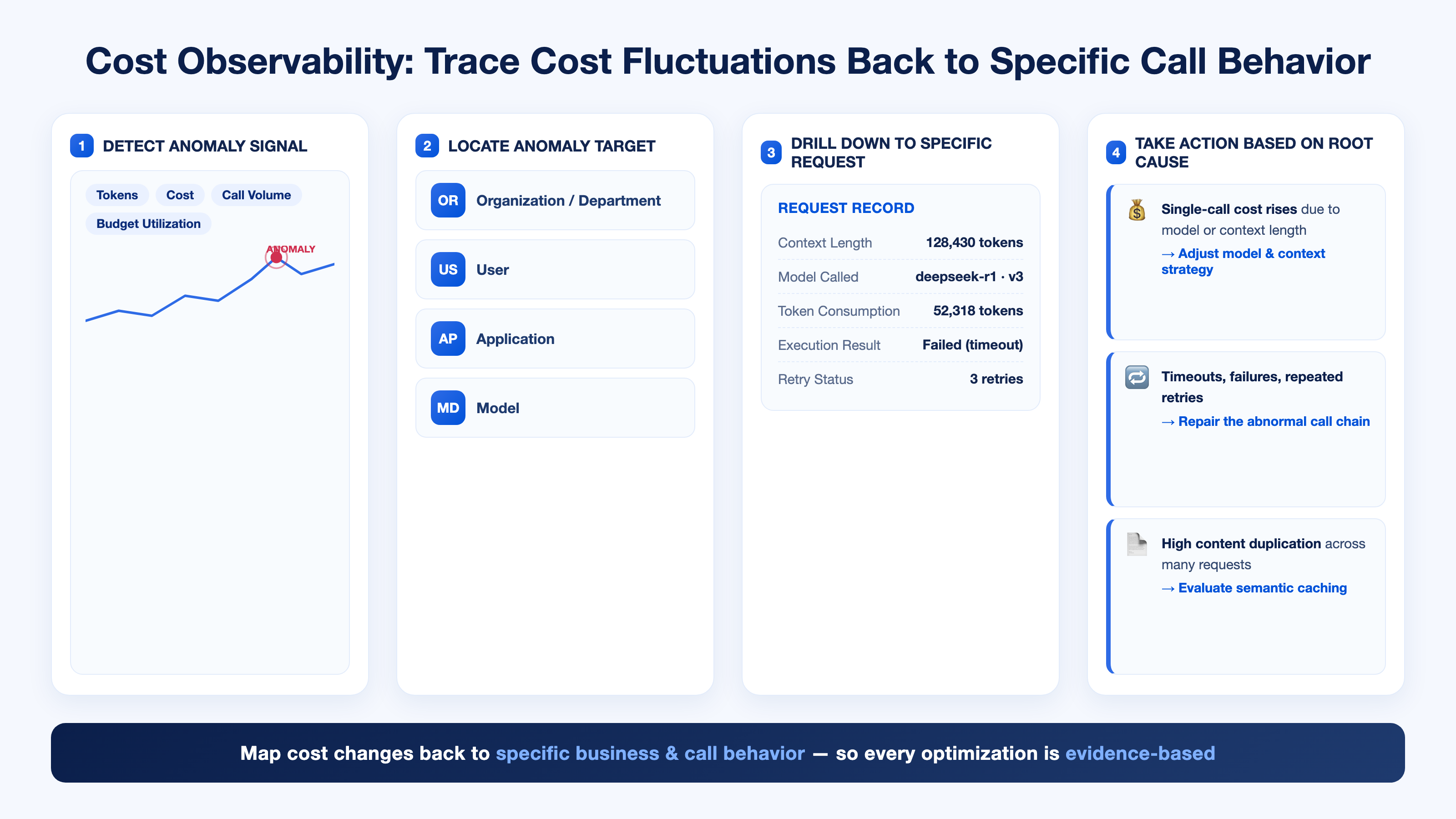
Through multi-dimensional comprehensive and granular analysis, enterprises can avoid indiscriminately selecting cheaper models or compressing every call, thereby establishing an observable, adjustable balance among quality, stability, timeliness, and cost.
Relevant metrics and alerts can be integrated into the enterprise's existing email, enterprise WeChat, and other notification and operations processes, ensuring anomalous costs receive attention before the settlement cycle ends.
Observation results can also be used to adjust budgets, quotas, model selection, and capability usage scope: high-value businesses can receive more appropriate resource boundaries, anomalous callers can have their quotas promptly tightened, and model strategies can be re-evaluated considering stability, quality, and pricing.
Cost observability restores cost changes to specific business activities and call behaviors, providing a basis for budget and model strategy adjustments.
04 / WHAT'S NEXT
From "Reviewing Bills at Month-End" to "Managing Budgets Before Each Call"
Multi-dimensional metering, quota lease pre-deduction, and cost observability together form a complete closed loop spanning pre-event, in-process, and post-event stages:
01 | Before a call occurs, Zentrix first identifies the request's attribution, assesses the budget, and locks available quota; |
02 | During call execution, it records actual Token usage, costs, and execution results, and completes settlement, release, or rollback; |
03 | After the call ends, it aggregates and analyzes by organization, user, application, model, and specific request to identify trends and anomalies; |
04 | Analysis results are then used to adjust budgets, quotas, and model strategies, which in turn govern subsequent calls. |
This mechanism relies on a unified gateway and complete caller information. Requests that bypass the gateway to directly access upstream models cannot naturally enter the unified attribution and quota system. Therefore, during implementation, it is also necessary to gradually consolidate the scattered model addresses and real credentials on the business side.
Once consolidation is complete, the platform team can enforce budget constraints before costs are incurred, complete metering and settlement during the call process, and after the fact, drill down from the supplier's aggregate bill to specific organizations, applications, models, and calls to quickly locate the source of cost anomalies.
With these three capabilities, Zentrix makes AI costs attributable, enforceable, and continuously analyzable
If your enterprise is also struggling with uncontrollable AI costs, consider the following questions:
— When you receive the supplier's bill at month-end, can you only see the overall cost, with difficulty distinguishing how much each department, user, and application spent?
— When the budget is already approaching its limit, are new model calls still continuing, causing costs to spiral out of control?
— When costs suddenly spike during a certain period, is it difficult to quickly identify which applications or Agents are responsible? Can you pinpoint whether the cause is model switching, context length growth, or anomalous retries?
— To trace a single cost anomaly, does the platform team still need to cross-reference supplier bills, application logs, and multiple management consoles?
If multiple conditions above are already present, it indicates that the current approach to AI cost management is reaching its limits. Enterprises can start by reviewing the status quo around cost attribution, budget control, and anomaly tracing, then combine their own organizational structure, model integration approach, and management requirements to further explore how Zentrix can incorporate these scattered issues into a continuous cost management process.