
Over the past two years, enterprise AI has focused on how to make it work: how to connect models, how to build applications, and whether Agents can actually run.
Today, more and more enterprises have moved past the early pilot stage. Models and AI applications are entering more business scenarios, and Agents are starting to connect enterprise data and business systems through MCP, Tools, and Skills. As a result, the number of AI capabilities, the scale of invocations, and the degree of business dependency are all increasing.
Enterprise AI is moving from pilot validation to large-scale production use.
Take a financial industry customer as an example: as models, Agents, and AI scenarios proliferate, some invocations begin to enter production, and a large number of operational issues emerge.
· When a Skill or MCP tool is about to be upgraded, the platform team must first identify which Agents and consumers will be affected
· When a model channel is rate-limited or times out, the business side needs to switch to available services quickly
· When runtime anomalies occur, model providers, network links, gateway configurations, and application invocation records may be scattered in different places
The deeper AI is used, the more centralized the requirements for capability management and production operations become. The focus extends from model access to the long-term operation of AI capabilities.
ZStack Zentrix builds a continuous AI capability operations chain—from the moment capabilities enter the enterprise to when they actually run—based on a unified AI capability object and a unified invocation entry point.
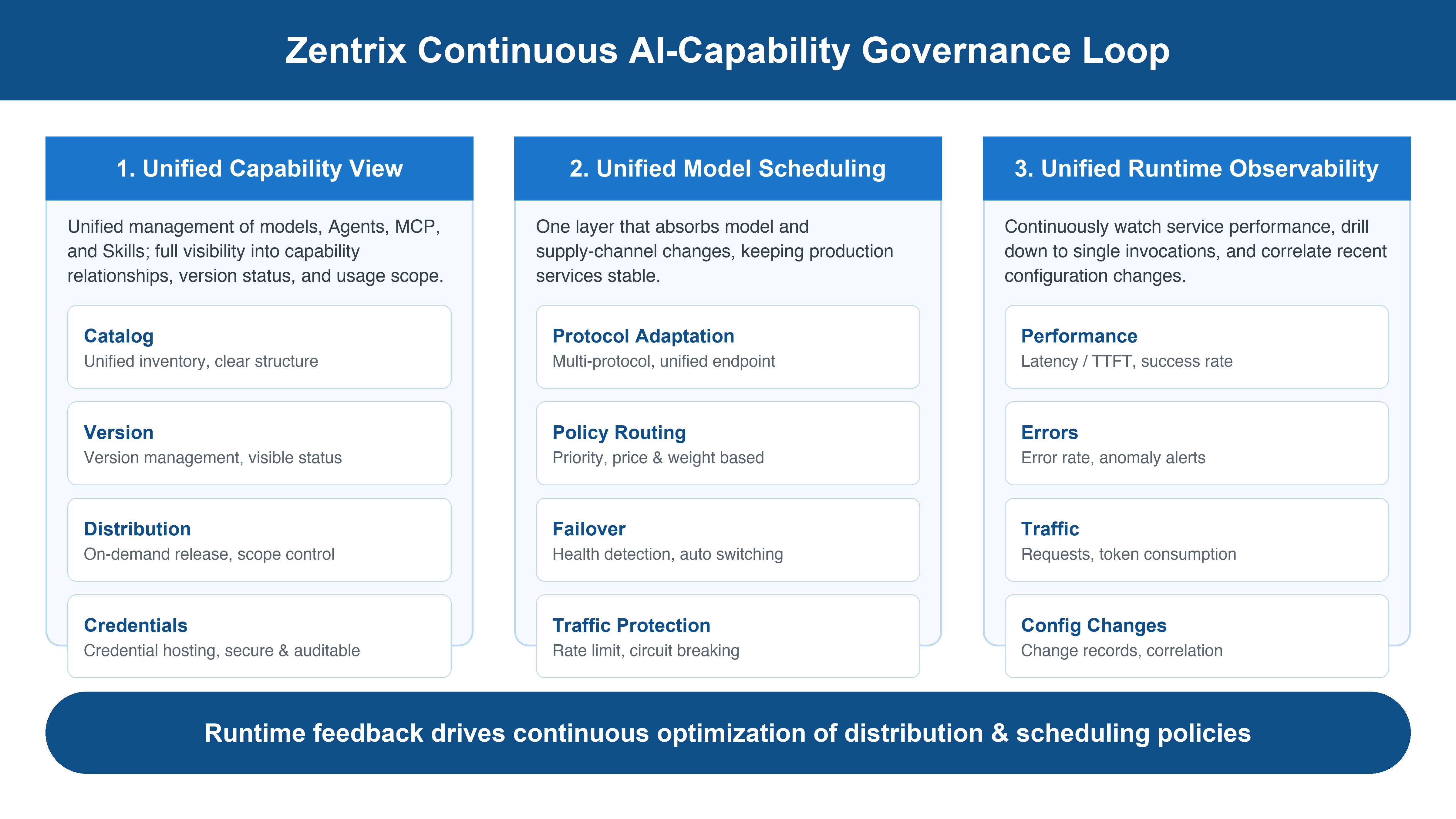
Figure 1. Zentrix Continuous AI-Capability Governance Loop: (1) Unified capability view, (2) Unified model scheduling, (3) Unified runtime observability. Runtime feedback continuously refines distribution and scheduling policies.
First: Unified Capability View — Making AI Assets Inventoryable, Distributable, and Traceable
Models, Agents, MCP, and Skills are constantly being combined and reused. An Agent may change models, add new MCP Servers, or load different versions of Skills; a single capability may go through trial, canary release, upgrade, expansion, and revocation. Versions, dependencies, and usage scopes change at any time.
To manage ever-changing AI capabilities, you must first unify the understanding of their relationships and lifecycles. Before upgrading, decommissioning, or adjusting the scope of a model, Skill, or MCP tool, you need to quickly identify the associated Agents and consumers, and complete release, upgrade, rollback, or revocation accordingly.
If these relationships only exist in project documents, chat records, and personal configurations, every change requires reconfirming the usage scope. The speed of impact analysis directly limits the pace of capability upgrades and increases the risk of erroneous changes, missed changes, and difficult rollbacks.
Unified Capability Catalog — Aggregating AI Capabilities and Their Key Attributes
The Zentrix AI gateway includes model providers, model services, A2A Agents, MCP Servers, tools, and Skills in a unified catalog, recording their status, version, maintenance relationships, and applicable scope. Applications and prompts can also be version-managed in the corresponding catalog.
The unified catalog can maintain access points, current status, versions, maintainers, associated Agents or tools, release targets, installation scope, and change records of different AI capabilities.
Take Skill as an example. The platform team can view the current version, which Agents or user environments it is installed in, which scopes still remain on the old version after an upgrade, and which Agents it has association relationships with. When a Skill needs to be upgraded, rolled back, or discontinued, these relationships can directly help determine the impact scope and execute subsequent adjustments.
After these relationships enter a unified view, models, Agents, MCP, and Skills have clear asset identities and change rationales. Platform teams can judge the impact scope along versions and associations, transforming upgrade preparation that originally relied on manual inquiries into a queryable, executable management process.
The unified catalog presents AI capability inventory, version dependencies, and change impact at the same time, providing a basis for release and upgrade operations.
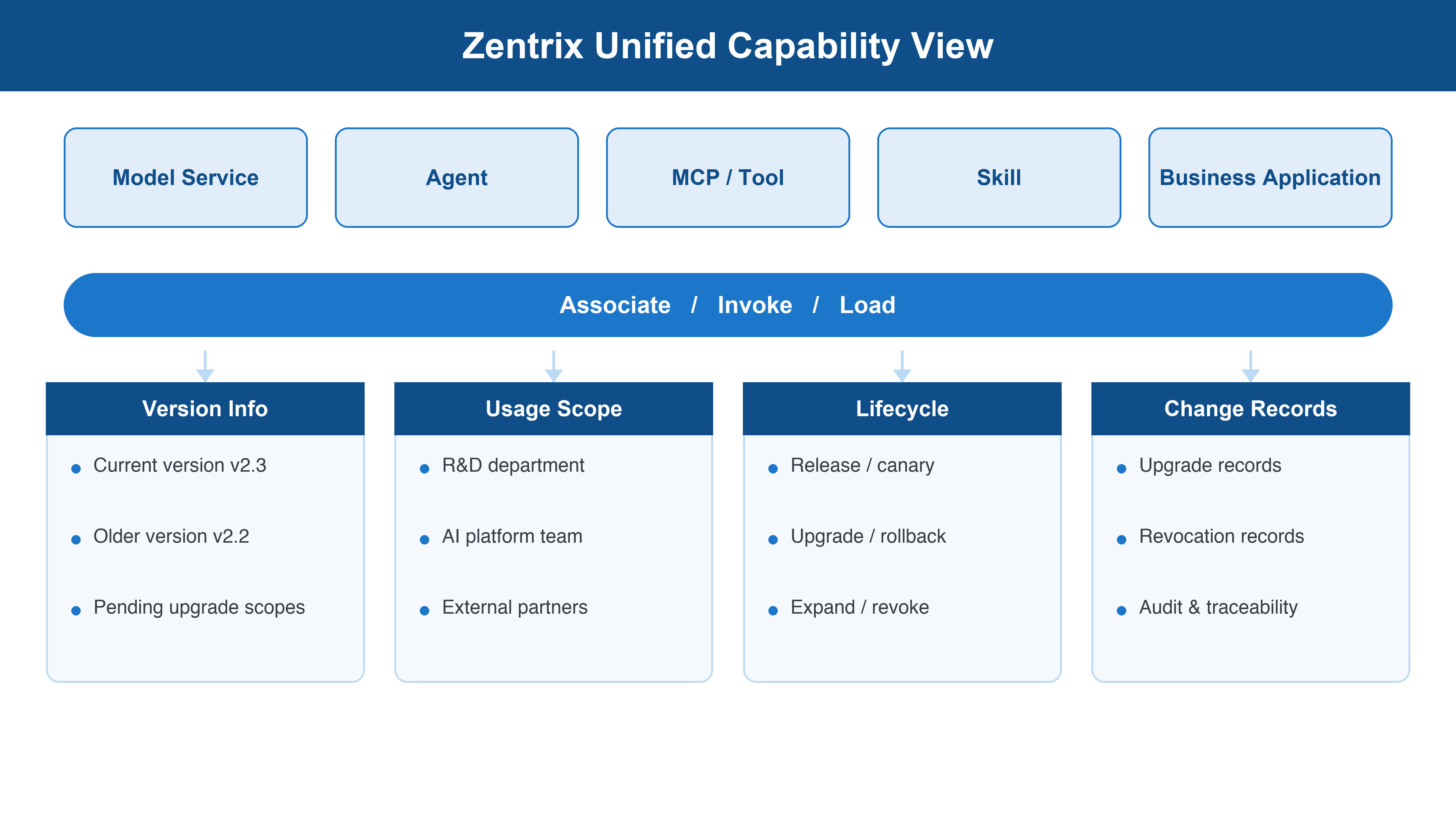
Figure 2. Zentrix Unified Capability View: models, Agents, MCP/Tools, and Skills are linked through association / invocation / loading, while version, scope, lifecycle, and change records are tracked in a single catalog.
Turn Existing Business Interfaces into Capabilities Usable by Agents
A large number of ERP, OA, ticket, and business systems inside enterprises already have HTTP or gRPC interfaces. Agents can continue to use these existing business capabilities on top of them.
Zentrix supports importing existing interfaces through OpenAPI, Protobuf, or cURL descriptions and further encapsulating them as standard MCP tools, enabling these interface capabilities to be discovered and invoked by Agents.
After interface import, necessary configuration and integration can still be completed based on the original interface authentication methods. While preserving the existing business systems and interface systems, more business capabilities can be gradually brought into the scope of Agent usage, reducing the repeated construction of connection layers for each Agent.
Multi-dimensional Distribution — Opening AI Capabilities by Scope in an Orderly Manner
After capabilities enter the catalog, their release and usage scope must still be controlled. A database query tool may only be open to a specific team, a Coding Agent can be trialed in the R&D department first, and a newly released Skill can be verified on a small scale before expanding its installation scope.
Zentrix can distribute models, Agents, MCP tools, and Skills by department, functional group, and user, and supports release, opening, canary, scope adjustment, and revocation. Administrators can first determine whether a capability enters the available scope, and then configure which organizations and personnel it is opened to.
For Skills, distribution also establishes a relationship with versions. After the maintainer updates the capability package, they can identify which Agents or users still remain on the old version and arrange canary release, upgrade, or rollback accordingly, covering the complete process from release, adjustment to recovery.
Once the release scope and version relationship are uniformly recorded, new capabilities can first be validated in a limited scope, and then gradually expanded based on runtime results. When problems occur, adjustments or revocations can be made along the existing scope, reducing the change risk brought by one-time opening.
Centralized Credential Hosting — Supporting Orderly Opening of AI Capabilities
As models and AI capabilities open up to more teams, the real upstream credentials also need to converge accordingly.
Zentrix centrally hosts real API keys from model providers and automatically injects them when forwarding requests. Callers use unified access credentials with configurable expiration and revocation, without directly holding the real upstream keys.
When personnel leave, projects end, or supplier credentials rotate, related credentials can be processed through a unified entry point, reducing the situation where real credentials are scattered in code and configuration files for a long time.
Catalog, versioning, distribution, and credential management together constitute the foundation of AI capability operations, enabling constantly changing models, Agents, MCP, and Skills to be managed and delivered in a unified manner.
Second: Unified Model Scheduling — Flexibly Responding to Supply Changes and Ensuring Stable Service Operation
After multi-model and multi-channel environments enter production, handling protocol adaptation, scheduling, failover, and traffic protection in a dispersed manner increases duplicate work and can easily affect service stability due to inconsistent configurations or untimely handling. A platform is needed for unified control.
Zentrix converges these changes into a unified invocation entry point, forming a continuous processing chain through protocol adaptation, policy routing, health detection and failover, and traffic protection.
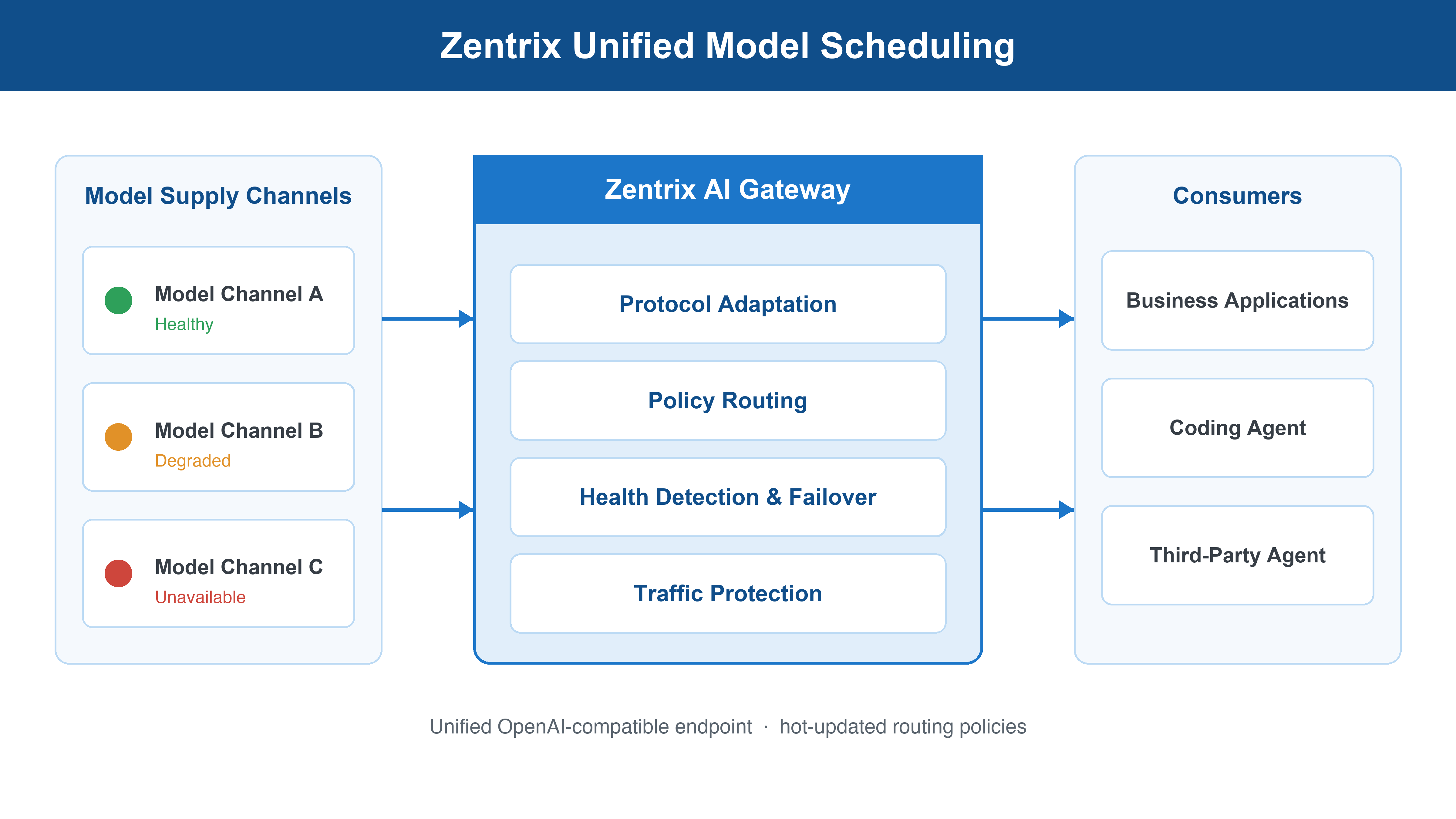
Figure 3. Zentrix Unified Model Scheduling: model supply channels (A/B/C) pass through protocol adaptation, policy routing, health detection, and traffic protection before reaching consumers such as business applications, Coding Agents, and third-party Agents.
Protocol Normalization — Reducing the Impact of Model Changes on Business Access
Zentrix provides a unified OpenAI-compatible endpoint externally, and internally completes conversion of request parameters, request headers, response formats, and error codes between different providers.
For applications compatible with this endpoint, adding or replacing models usually only requires adjusting the access address, credentials, and model configuration, without the need to maintain multiple vendor SDKs in the long term. Changes in models and providers are borne by the platform, and business systems can maintain stable access methods.
Policy Routing — Allowing Model Selection to Adjust with Business Needs
Different businesses have different requirements for stability, price, and model quality. Critical business can prioritize stable channels, ordinary tasks can choose more cost-effective models, and new models can first be validated with a small amount of traffic.
Zentrix can perform policy routing based on priority, price, and channel weight, making model selection a dynamically adjustable operational strategy.
When adding service channels, adjusting model usage ratios, or validating new models, strategy adjustments can be completed in the unified control plane, and business teams do not need to maintain channel selection logic separately.
Health Detection and Failover — Reducing the Impact of Model Anomalies on Production Business
Production environments need to respond to abnormal states of model supply channels in a timely manner. When upstream continuous failures, timeouts, or availability degradation occur, Zentrix can isolate anomalies through runtime downgrading, circuit breaking, and backup channel switching; after services recover, traffic is gradually restored according to policy.
This mechanism can reduce the probability that a single supplier or single channel anomaly directly affects all business. The continuity of AI services is borne by the platform.
Fault handling also shifts from business discovering anomalies and changing configurations one by one to the unified policy identifying the state and executing preset degradation paths.
Traffic Protection — Establishing Capacity Boundaries for Shared Model Resources
Agent workflows often contain multiple rounds of model invocation. If an application performs abnormal retries or generates a large number of concurrent requests in a short time, it may quickly occupy the overall bandwidth of shared model services.
Zentrix can set request rate, token rate, and concurrency limits around callers, sessions, and upstream services, and combine traffic shaping and overload protection to isolate abnormal traffic, reducing the probability that sudden requests or abnormal retries from a single application squeeze the impact on other businesses.
Model on/off, channel weights, and routing policies can also be adjusted in the unified control plane and take effect hot. Related policies can be updated in a timely manner according to production status, and business systems do not need to re-release for every change.
Unified model scheduling bears the operational complexity brought by model and supply channel changes, allowing business to maintain stable operation during strategy adjustment. Models can be added and adjusted on demand, and protocol adaptation, channel selection, and fault handling are precipitated into platform capabilities, reducing repeated access and decentralized operations.
Third: Unified Runtime Observability — Making AI Service Performance Measurable and Runtime Anomalies Traceable
The runtime quality of AI services involves multiple dimensions. Even if requests return successfully, excessive time to first response still affects user experience; although the overall success rate may look normal, a certain model, supply channel, or caller may still experience continuous errors; slow gateway processing and abnormal upstream model responses also need to be located separately.
When locating runtime problems, invocation performance, model usage, error distribution, and runtime context need to be analyzed together, and in the event of anomalies, drill down to individual invocations to find the cause.
If this information is stored separately in vendor backends, gateway logs, and application monitoring, a single failure often requires multiple teams to go back and forth to check. The value of unified observability is to bring alerts, trends, and individual invocations into the same localization path.
Zentrix observes the number of invocations, success rate, errors, rate limiting, response time, time to first response, and traffic trends from the unified entry point, and supports drilling down to specific invocation records.
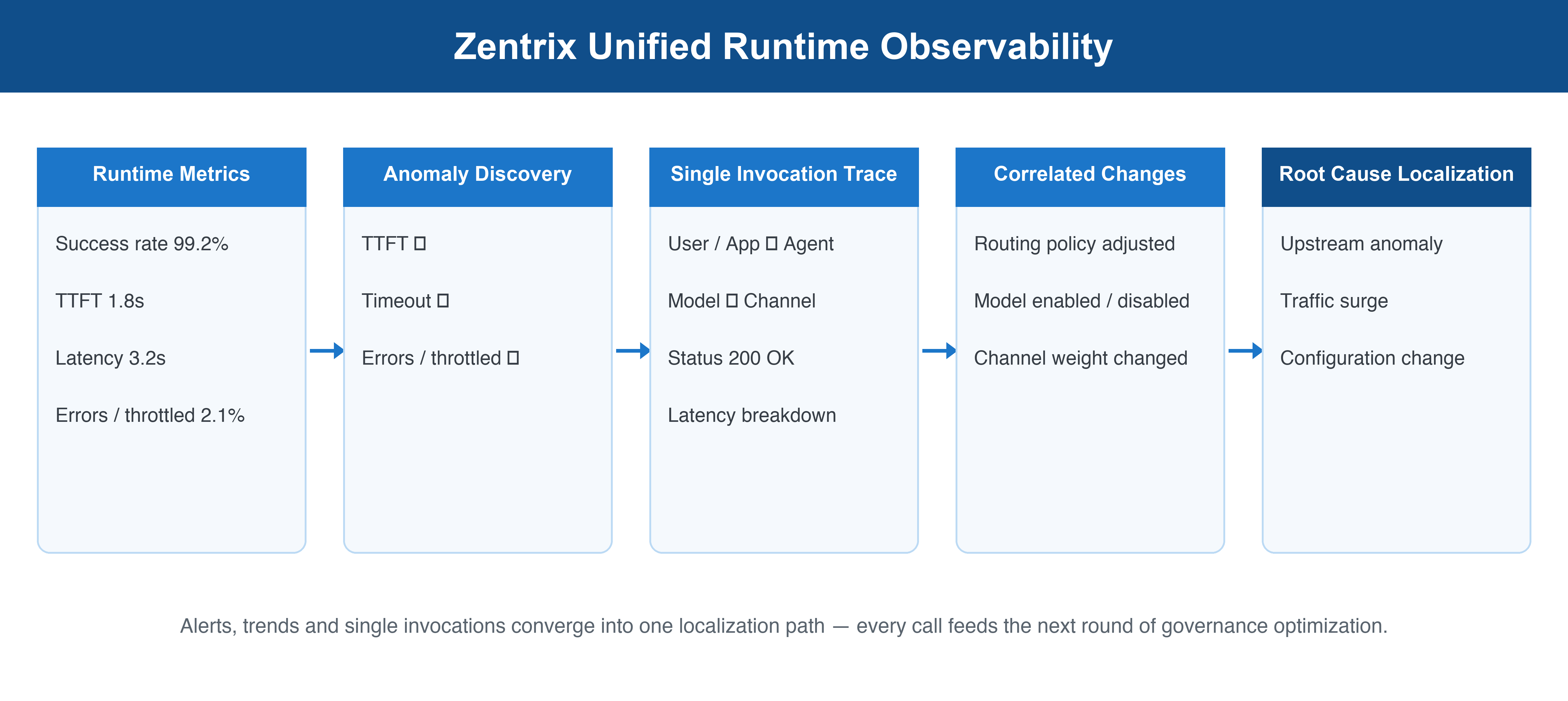
Figure 4. Zentrix Unified Observability: runtime metrics → anomaly discovery → single invocation trace → correlated changes → root cause localization, forming a closed-loop troubleshooting path.
Time to First Token (TTFT) — Measuring the Real Experience in AI Interactions
For streaming conversations, the waiting time users actually perceive usually depends on how quickly they see the first result. Observing only the total duration of the entire request is difficult to fully reflect the real experience.
TTFT can supplement this dimension, helping platform teams promptly discover problems where the first result returns slowly, and more accurately judge the impact of different models and supply channels on user waiting experience.
At the same time, gateway processing time and upstream model response can also be observed separately, used to determine whether performance issues come from model providers, network links, or the gateway processing itself.
Correlating Configuration Changes with Invocation Records — Shortening the Anomaly Localization Path
AI runtime problems may also be related to recent strategy and configuration changes.
Zentrix retains both configuration change records and runtime invocation records. The former records who created, modified, enabled/disabled, or revoked models, Agents, Skills, credentials, and policies; the latter records what a certain request called, whether it succeeded, key performance metrics, and why it failed.
After correlating the two types of records, you can determine whether an anomaly comes from upstream state changes, sudden traffic increases, or recent configuration adjustments. The troubleshooting process converges from “checking multiple systems separately” to “drilling down from abnormal metrics to the invocation, and then checking related configuration changes.”
Unified observability provides analysis and traceability basis for AI capability management and service stability, and also makes adjustments to routing, traffic, and capability distribution strategies based on real runtime data.
Runtime Feedback Drives Strategy Iteration — Making AI Governance Continuously Evolve
The unified capability view provides management objects and association relationships, model scheduling carries operational strategies, and unified observability produces real feedback; runtime results are then used to adjust capability distribution, channel weights, and traffic strategies, making every invocation a basis for the next round of governance optimization.
Zentrix brings capability relationships, runtime status, and strategy adjustments into the same closed loop, reducing the work of maintaining asset lists, release records, routing configurations, and runtime logs separately.
Continuous runtime feedback drives optimization of distribution and scheduling strategies, moving models, Agents, MCP, and Skills from one-time delivery to continuous operation, becoming reusable, manageable, and continuously evolving production resources.
When Does Your Enterprise Need AI Governance?
For enterprise decision-makers, here are a few concrete signs to judge whether you have entered the stage where AI governance is needed:
· Are models, Agents, MCP, and Skills scattered across different teams, making versions and usage scopes difficult to master uniformly?
· Before capability upgrade or decommissioning, do you still need to confirm affected objects one by one?
· When models and supply channels change, do business systems need to adjust configurations separately?
· After runtime anomalies occur, do you need to repeatedly check between vendor backends, gateway logs, and application monitoring?
When multiple of these appear, it indicates that the current management approach is approaching operational boundaries, and a unified, executable AI governance system needs to be built as soon as possible.
Related Articles & Next Installments
Past reviews:
· ZStack Zentrix Launch: From Fragmented AI Access to Unified Management and Governance
· AI Usage Is Becoming More Fragmented and Uncontrolled; How Can Enterprises Regain Control?
In the next article, the Cost Deep Dive, we will focus on the problems of difficult cost attribution and hard-to-constrain budgets; in the subsequent Security Deep Dive, we will discuss identity, permissions, and data risks after Agents access enterprise systems.