
Two weeks ago we open-sourced ZSvirt under GPL v3.0. Full source, installation images, no license fee for production use, and the migration toolset shipped in the same release.
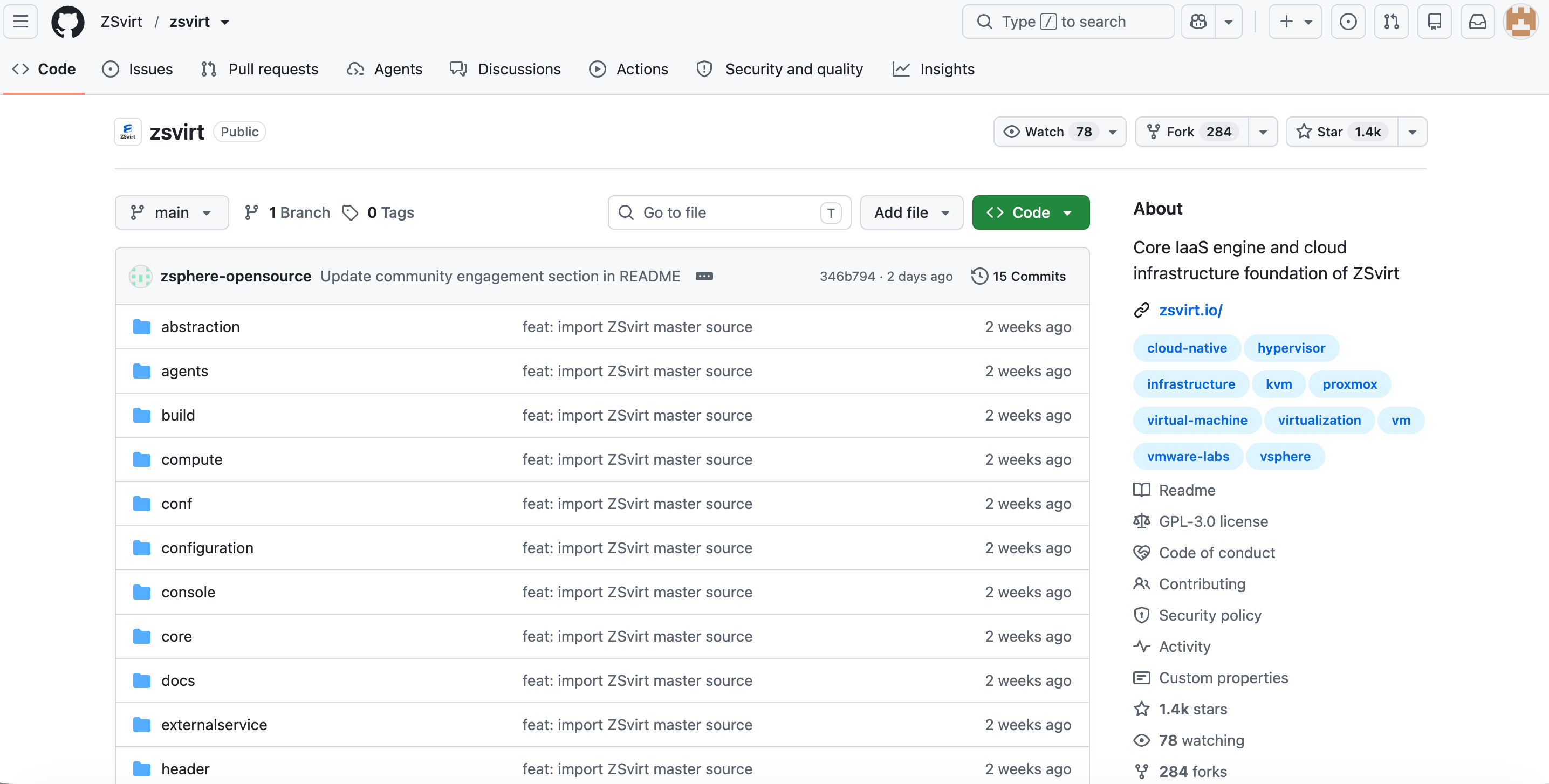
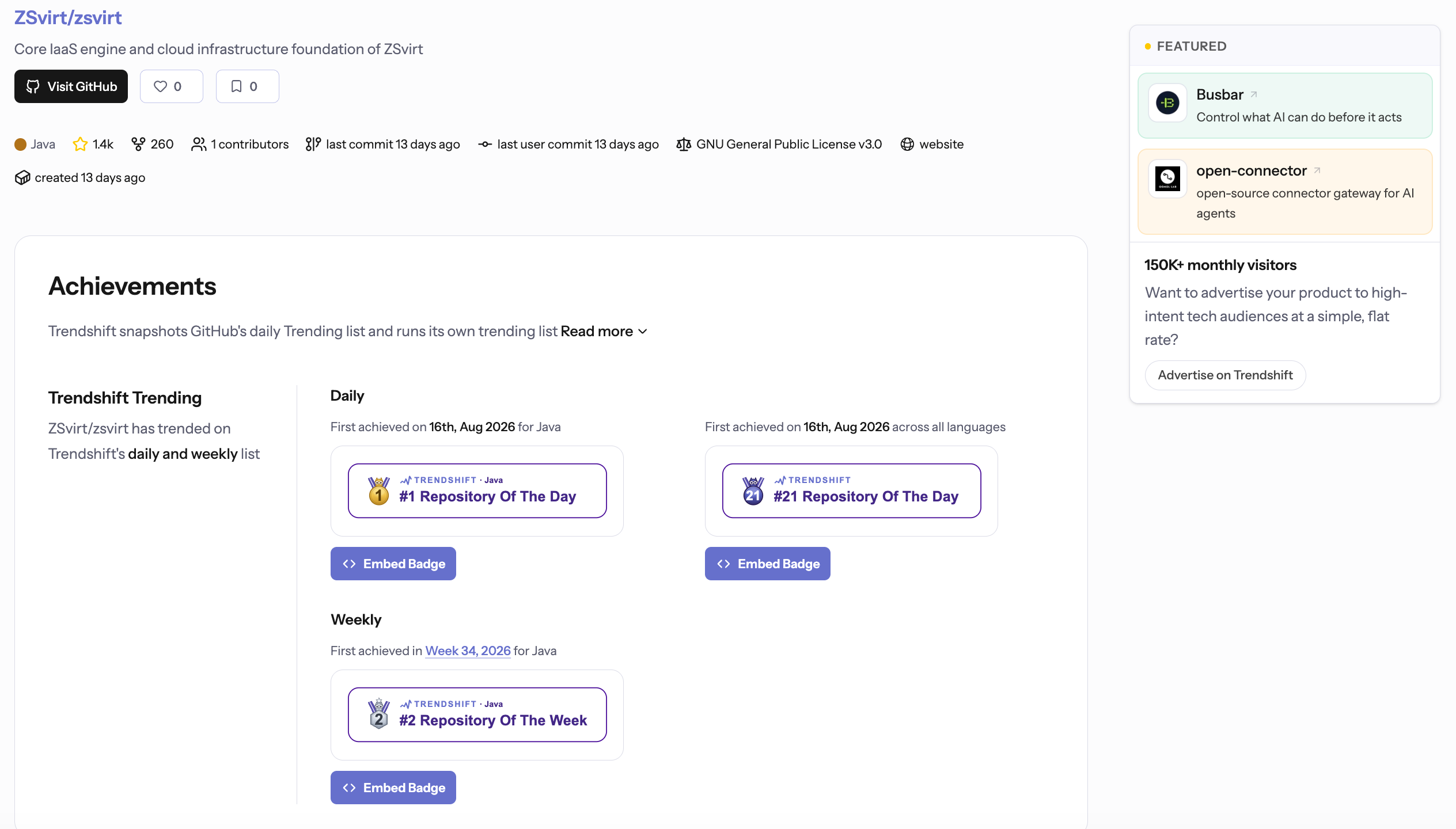
As of August 27: 1.4k stars, 283 forks, 78 watchers. On Trendshift, ZSvirt picked up three badges — #1 Java Repository of the Day, #21 Repository of the Day across all languages (August 16), and #2 Java Repository of the Week for week 34.GithubTrendshift
Numbers are the easy part. What actually taught us something was what people did next.
People started taking it apart
A network and security consultant wrote a LinkedIn post introducing ZSvirt and pointed readers to our live demo. He did get one thing wrong, though: he assumed ZSvirt was built on OpenStack.
Worth clearing up. ZSvirt is not an OpenStack derivative. It comes out of ZSphere, ZStack's commercial virtualization platform, and follows a technical path independent of both VMware and OpenStack — unified resource abstraction, a fully asynchronous framework, stateless services, a workflow engine with rollback, a message bus, consistent hashing, plugin-based extensibility. All of it is in the repo if you want to check.
On Quora, someone put ZSvirt's unified management model side by side with VMware (vCenter + ESXi) and Proxmox (DC Manager + PVE) — how the management node and hosts coordinate, how agents get deployed, whether ZMigrate needs a guest agent.
A GitHub Trending channel with 60k+ subscribers covered ZSvirt in one of its roundups.
Some of it was introduction, some comparison, some questions. Two weeks in, that's more useful to us than the star count. We put the code out to hear exactly this.
No spare server? You can still get ZSvirt running
Here's the problem that surfaced almost immediately.
Until now, trying ZSvirt meant one path: find a server, mount the ISO, install, initialize the management node, configure storage and networking. That path works. But for a team still deciding whether a VMware alternative is even worth evaluating, it's a lot to ask — hardware to free up, resources to request, time to schedule, all of it before anyone has decided to switch.
So we added OVA and QCOW2 images to the download center.
If you already have a virtualization environment, you don't need to prepare any hardware. Import the image, boot it, and in roughly five minutes you have a running ZSvirt environment you can click through.
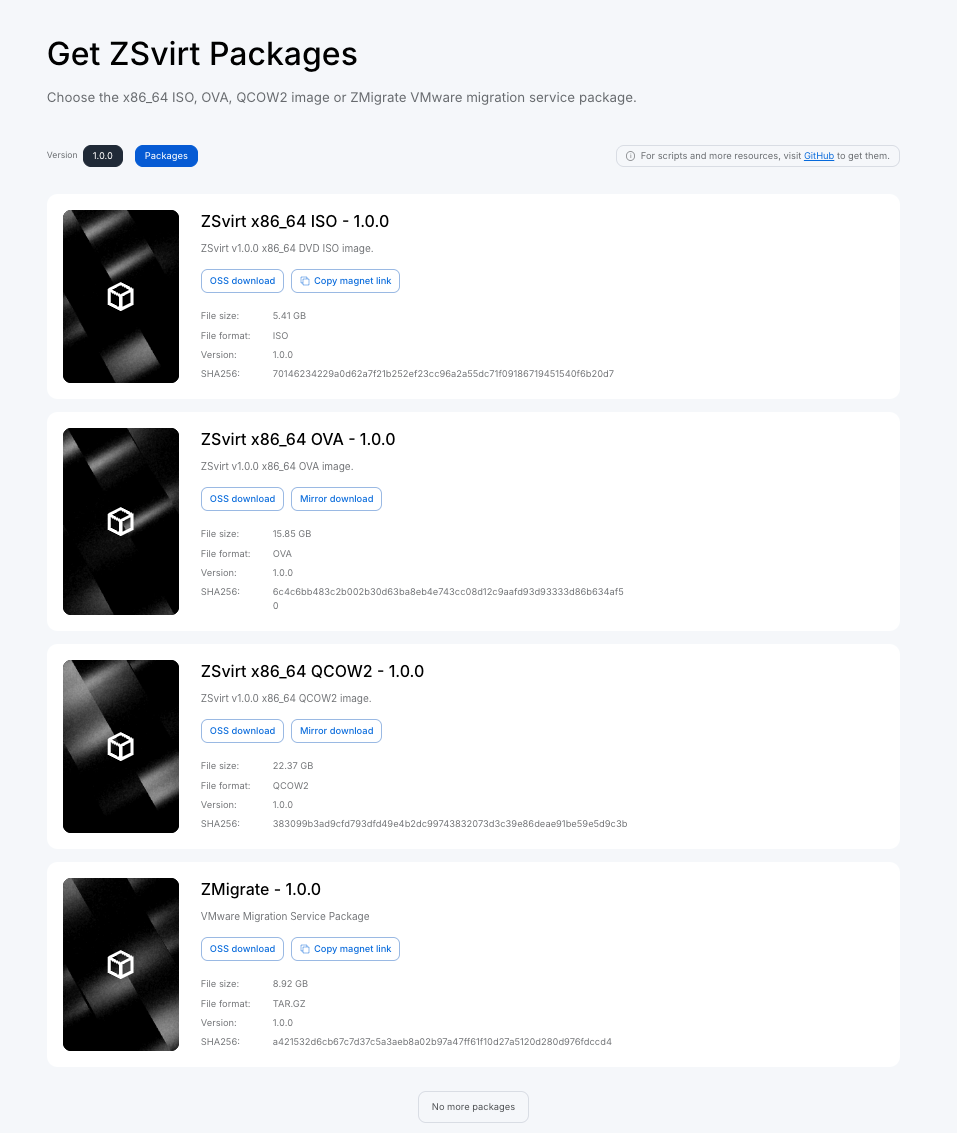
OVA happens to be the standard appliance format in VMware environments. Which means you can spin up the VMware alternative you're evaluating inside your existing vSphere — see how it manages resources, what the console looks like, whether the capabilities line up — before committing to a formal PoC.
Four packages are available now: ISO for bare metal, OVA and QCOW2 for existing environments, and the ZMigrate VMware migration service package, which needs no license in the open-source edition. All shipped with SHA256 checksums.
Source code isn't enough, so we published the docs too
Reading a repo tells you how something is built. It doesn't tell you how to install it, how to migrate onto it, or why it was designed that way. In the closed-source world that knowledge tends to live inside a vendor's pre-sales and professional services teams — customers get a proposal and an on-site engineer, but not the ability to judge for themselves.
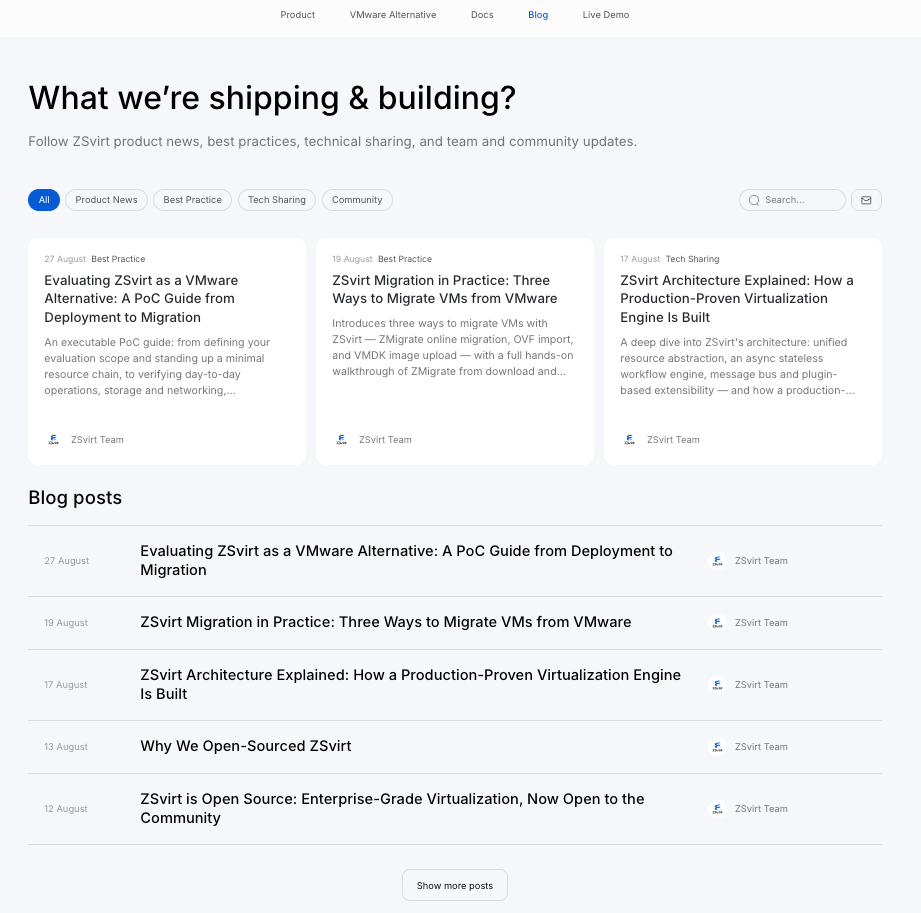
So over these two weeks we published four pieces:
· Why we open-sourced it — how we landed on GPL v3.0, and where the line sits between the open-source and commercial editions
· From ISO to your first VM — minimum single-server deployment, hardware requirements, troubleshooting table
· Architecture explained — unified resource abstraction, async design, stateless services, the workflow engine, message bus, plugin model
· Three ways to migrate off VMware — ZMigrate live migration, OVF import, VMDK upload, with guidance on which to pick
The architecture piece makes a point worth repeating here: this engine has been running in more than 1,000 production environments for years. What we open-sourced is that engine, not a version redesigned for the occasion.
On migration, it depends on the scenario: ZMigrate for bulk moves where downtime isn't acceptable, OVF import for a handful of VMs, VMDK upload if all you have is the disk files. One thing to be upfront about — the current release caps the number of concurrent online migrations. We'll lift that over coming releases. Offline import has no such limit.
ZSvirt also exposes RESTful APIs, Java and Python SDKs, and a Terraform Provider, so it can slot into existing operations and IaC workflows rather than living only behind a GUI.
Replacing VMware shouldn't just mean swapping platforms
Trading one closed platform for another solves this year's invoice. It doesn't solve the problem that got you there.
Virtualization sits at the bottom of the stack. Once it's chosen, servers, storage, DR and automation all get built on top, and that stack lives five to ten years. Moving the VMs was never the hard part. The hard part is what your options look like on the other side.
Full source, production use with no license fee, migration tooling in the box — those three came from the same view: a replacement should hand back long-term control, not just lower the bill.
What we'd like next — and how to join in
For an enterprise virtualization project, what matters more is what comes after: whether anyone actually installs it, migrates real workloads onto it, opens issues, sends pull requests, builds integrations.
So we're kicking off a ZSvirt user experience program on GitHub Discussions — install it, run it, tell us what broke and what's missing. There will be incentives for taking part; details go up on Discussions shortly. Watch the repo, or come find us on Discord and just talk to us.
ZSvirt's MCP Server has also moved into the official org. We're working on a standard way for AI agents to talk to virtualization infrastructure. Still early — we'll write that one up separately.
Two weeks ago we handed the code over. The work now is making it worth keeping.
ZSvirt. No limits, no locked doors.
Join the Community
· Issue tracker: GitHub Issues
· Community discussions: GitHub Discussions
· Social media:
· YouTube: https://youtube.com/@ZSvirt
· LinkedIn: https://www.linkedin.com/in/zsvirt-community/
· X/Twitter: https://x.com/ZSvirt
· Discord: https://discord.com/invite/KHsw63z9xA
· Email: community@zsvirt.io