
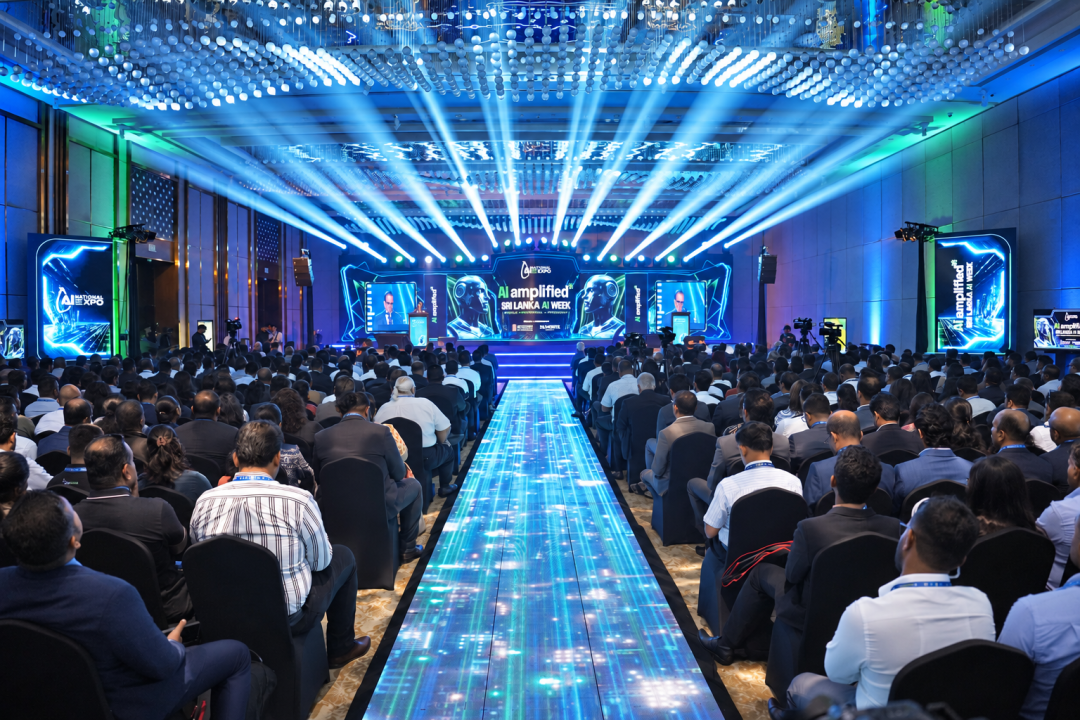
On September 29–30, the National AI Conference 2026 was held in Colombo, the capital of Sri Lanka. Frank Zhang, founder and CEO of ZStack, was invited to attend and deliver a keynote speech on how cloud and AI infrastructure can lower the barrier to AI adoption, providing support for the digital and intelligent transformation of enterprises and the public sector.
The conference was a key part of Sri Lanka AI Week 2026. The series of events was jointly organized by Sri Lanka's Ministry of Digital Economy, GovTech Sri Lanka, and SLT-MOBITEL, bringing together representatives from government, industry, and the technology ecosystem to exchange ideas on AI innovation, public services, enterprise transformation, and AI governance. It serves as a national-level exchange platform for Sri Lanka to advance AI adoption and the development of its digital economy.
As generative AI and agent technologies accelerate their entry into public services and enterprise operations, the scope of AI applications continues to expand. However, issues such as fragmented compute resources, complex platform construction, difficult model service management, and security governance still constrain AI from moving beyond pilots to large-scale adoption.
Making AI benefit more organizations requires not only lowering the barriers to building and using it, but also enabling unified management and security governance of compute, models, and applications.
Addressing this topic, Frank Zhang drew on ZStack's technical expertise in virtualization, private cloud, and AI infrastructure — extending from the efficient utilization of existing compute resources to model service delivery and AI application governance — to share technical approaches for enterprises and the public sector to build sustainable AI infrastructure.
01 / UNIFIED COMPUTE RESOURCES
Revitalizing Existing Compute to Make AI Infrastructure Lighter
In traditional IT environments, servers and GPUs often belong to different architectures and resource pools, and compute resources such as physical machines, virtual machines, and containers may be managed by different platforms. Facing varied demands — large-model training, inference, and lightweight AI applications — the lack of unified scheduling can easily lead to idle resources and duplicated investment.
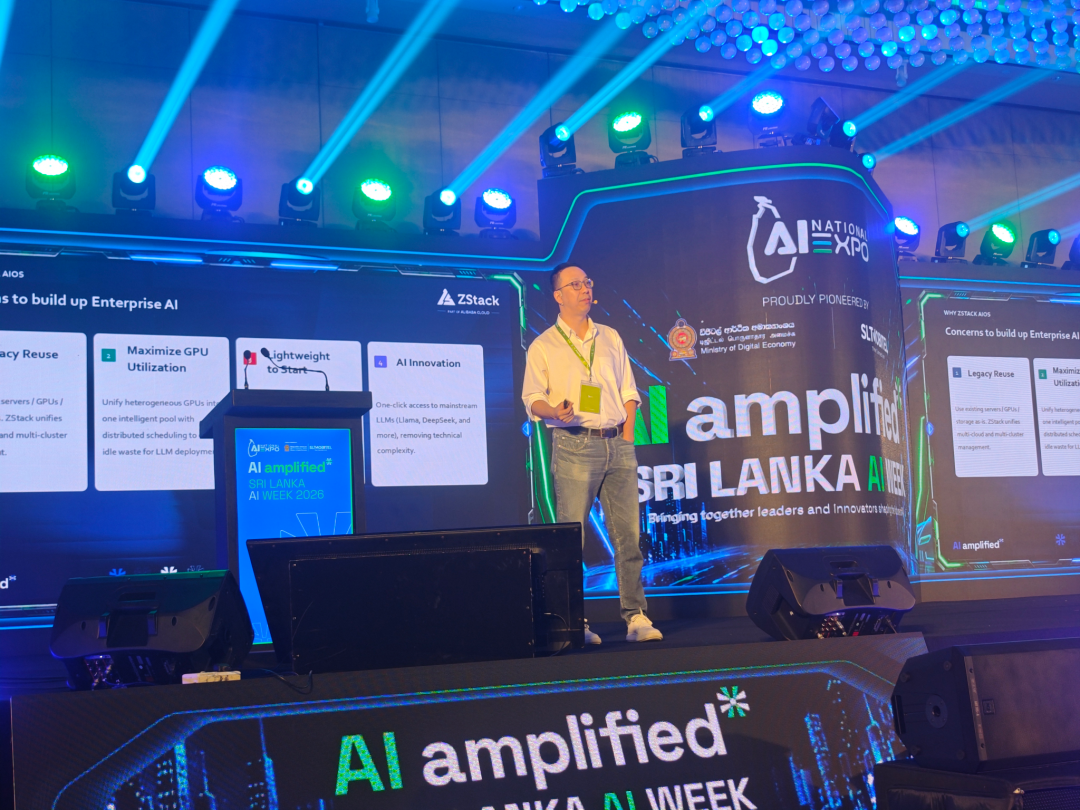
The ZStack AIOS platform takes the unified management of heterogeneous compute as its foundation, enabling different types of compute resources to be allocated according to actual business needs through resource pooling and flexible scheduling.
For GPU resources, the platform supports GPU passthrough, vGPU, MIG, and dynamic memory slicing, among other approaches — ensuring high-performance computing while also allowing single-GPU resources to flexibly serve multiple inference and development scenarios.
This capability is especially valuable for organizations with substantial existing IT investment but relatively scattered AI compute resources.
By supporting compatibility with existing servers and GPU devices, enterprises can use their current hardware to progressively build an AI environment, scaling resources as their business grows and reducing the investment and complexity of one-time construction.
During the speech, ZStack also showcased the lightweight deployment and elastic scaling features of AIOS, enabling organizations to start with smaller-scale infrastructure and gradually add compute and model service capabilities.
02 / SUSTAINABLE MODEL SERVICES
From Compute Resources to Model Services: Building Sustainably Operated AI Capabilities
Once compute is under unified management, enterprises still need to turn these resources into model services that the business can continuously use.
Built on the unified compute foundation, AIOS provides full-lifecycle management covering model import, fine-tuning, inference, and evaluation, and supports deploying model services through virtual machines and containers. With unified model management and service interfaces, enterprises can select different models, deployment methods, and compute resources based on application needs, reducing repetitive work in model deployment, operation, and maintenance.
This system extends further into compute service operations. Through a unified portal, multi-tenancy, resource quotas, and usage metering, compute resources can be allocated on demand, and model services can be delivered and managed uniformly across different departments and business scenarios.
For enterprises and the public sector, as applications such as intelligent Q&A, internal knowledge retrieval, and office assistance continue to grow, a unified infrastructure and model service system can reduce resource fragmentation caused by independent departmental construction and create conditions for different business units to share AI capabilities.
From underlying compute to model services, and further to business-facing application support, the capabilities provided by AIOS enable AI infrastructure to extend from resource construction to service delivery and long-term operation.
03 / AI ACCESS & GOVERNANCE
Setting Boundaries for AI Access: Supporting Large-Scale Adoption Through Unified Governance
As AI applications penetrate deeper into business processes, the objects that enterprises need to manage also change.
In the past, IT management focused mainly on servers, networks, storage, and application systems. Entering the Agent era, model calls, tool execution, credential usage, sensitive data flows, and token consumption have all become new objects requiring management.
For example, the same Agent may simultaneously call multiple models, enterprise knowledge bases, and business system tools. Clear control mechanisms must be established around which capabilities different personnel can access, which operations agents can perform, whether sensitive information is protected, and how much each call costs.
In the latter part of his speech, Frank Zhang highlighted the ZStack Zentrix enterprise-grade AI gateway.
As an independently delivered enterprise-grade AI gateway, Zentrix sits between business systems, agents, and other applications on one side, and models, Skills, MCP tools, and other AI capabilities on the other. Through a unified entry point, it manages model and tool calls from different sources, reducing the complexity of integration and operations in multi-model, multi-protocol environments.
In unified distribution, Zentrix supports model routing and traffic scheduling based on conditions such as call policies and service status. In security, mechanisms such as credential management and sensitive data protection reduce the risk of information exposure during calls.
For the autonomous execution capabilities of agents, Zentrix further extends permission control to the tool-call layer, allowing different identities, roles, and business scenarios to follow corresponding authorization policies and exert control over critical operations.
At the same time, the platform supports recording AI call processes, tracking tool execution behavior, and aggregating and analyzing token consumption and usage costs, enabling enterprises to understand how AI resources are actually used and providing a basis for auditing and operational optimization.
These capabilities extend AI governance from fragmented application management to unified call and execution processes, and provide technical support for enterprises and the public sector to use models and agents under security and compliance requirements.
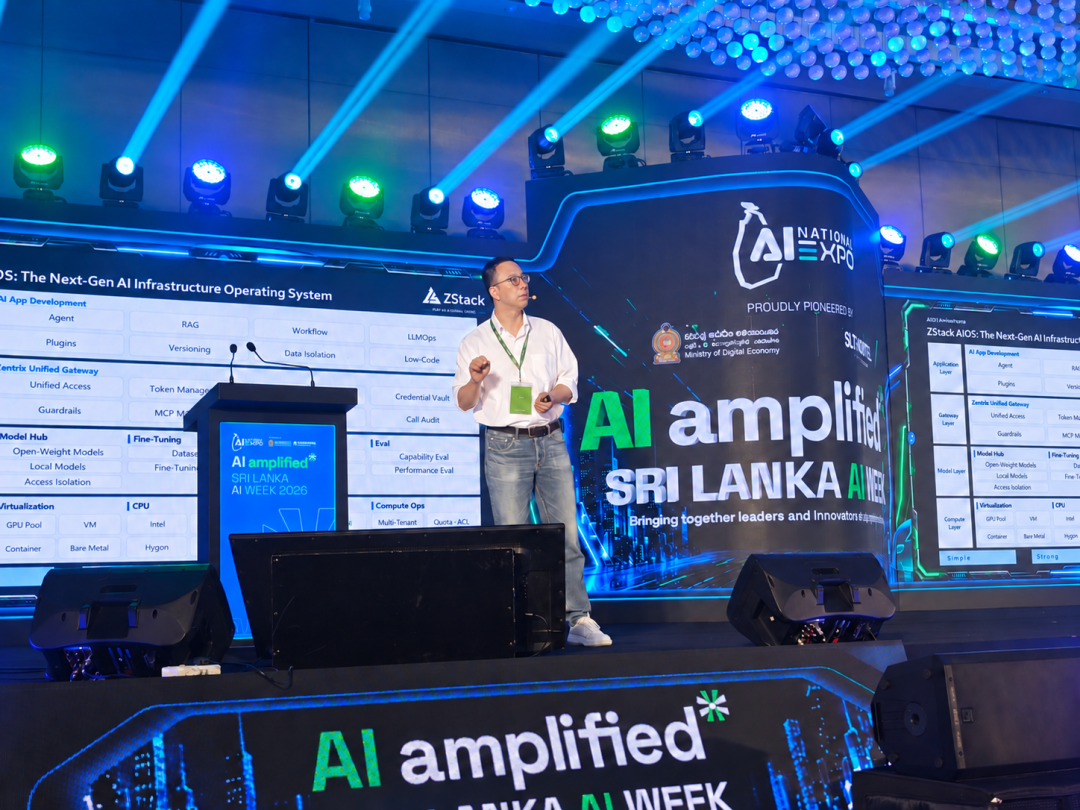
In this speech, ZStack presented a technical system spanning heterogeneous compute management, model service delivery, and AI call governance. AIOS addresses the underlying resources and model services, while Zentrix further connects business applications with AI capabilities and applies unified governance to the call process. The two work in synergy at different layers, supporting AI as it moves from infrastructure construction to actual business use.
As a strategic subsidiary controlled by Alibaba Cloud, ZStack has built a product portfolio covering the ZCF cloud platform, ZVF virtualization, HCI hyper-converged infrastructure, and the AIOS platform, serving more than 5,000 enterprise customers across over 50 countries and regions worldwide. Building on its long-standing expertise in virtualization, private cloud, and heterogeneous resource management, ZStack is extending its mature cloud infrastructure capabilities into AI compute management, model services, and application governance.
Its invitation to speak at this national-level AI conference in Sri Lanka further reflects ZStack's active participation in international AI technology and industry exchange, and provides a platform for sharing its cloud and AI infrastructure practices with the global market.
Enabling organizations of all sizes and resource conditions to access and use AI capabilities more conveniently and securely, and turning technological innovation into tangible business value.